
News
Grab two free PC games before Epic's clock runs out, while Undertale and Divinity: Original Sin 2 are 75% off
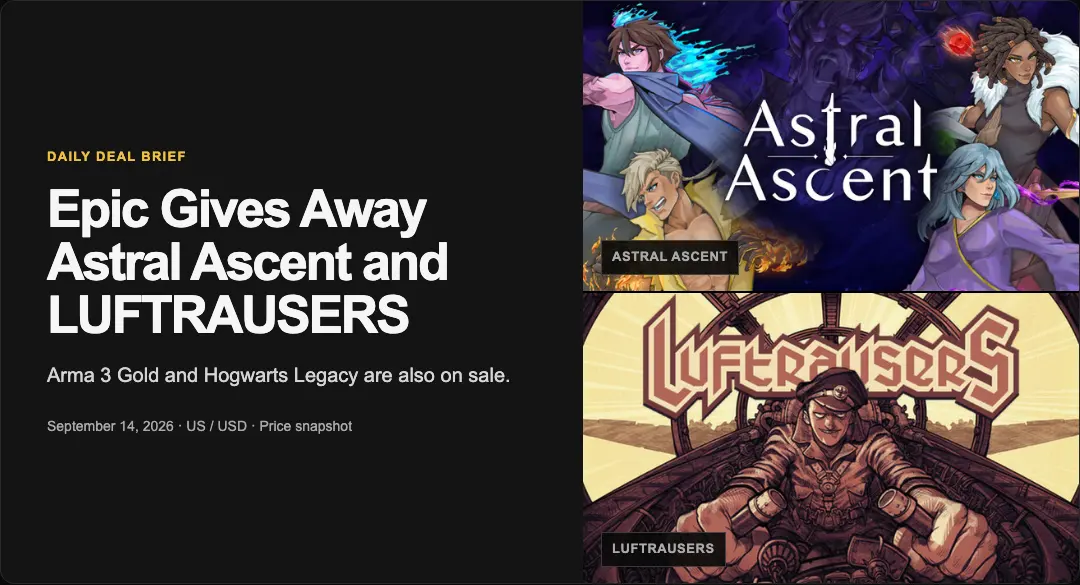
Astral Ascent and LUFTRAUSERS are free to keep today, while two of PC gaming's most celebrated RPGs cost less than $14 c
















The release schedule in a financial report may look, at first glance, like nothing more than a cold list of dates and titles. But when Fire Emblem: Woven Threads appears in the 2026 lineup, the table suddenly starts to feel a bit like a table of contents—like the opening credits of an ensemble film yet to be released, laying out the cast names first and leaving the audience to guess where the story will go. Nintendo recently revealed its future first-party software plans, and the core message is clear: the exclusive lineup for Switch 2 has already begun to take shape, while the original Switch has not been hurried off the stage. From a narrative standpoint, this is not a simple handoff to a new console, but a more cautious—and more seasoned—way of writing a transition.

From the Switch 2 side, the titles Nintendo has put forward are quite representative. Animal Crossing: New Horizons Nintendo Switch 2 Edition, Mario Tennis Fever, Pokémon Pokopia, and Super Mario Bros. Wonder Nintendo Switch 2 Edition + Ringing Co-op Park have already been listed as part of the exclusive lineup for the coming period, showing that Nintendo is still relying on its most dependable cast of characters to forge the first round of emotional attachment to the new platform. Seen from another angle, this arrangement resembles a film studio bringing back familiar faces when launching a new franchise, because audiences may not necessarily buy into hardware itself, but are often willing to return to the theater for characters they already know. Unfortunately, what we can see for now is still more about “who will appear” than “how they will appear,” so while the lineup carries weight, the dramatic tension has yet to truly emerge.
Yoshi and the Incredible Guidebook is scheduled for spring 2026, Fire Emblem: Woven Threads is set for 2026, and Splatoon: Inkstrike Squad remains undated. These titles, in fact, correspond to three forms of expression Nintendo excels at most: fairy-tale-style imagination, long-form storytelling driven by character relationships, and a youthful sense of community. Fire Emblem in particular has always relied more heavily on character positions, factional tension, and choices of fate to create memorable impact, so even with only a title revealed, it is already enough to spark anticipation among many players. On a deeper level, if Switch 2 truly wants to establish its own narrative identity, it ultimately cannot rely solely on “the return of classic characters”—it also needs one or two new works capable of defining the mood of its era.

As for the original Switch, Nintendo has clearly not adopted the kind of near-brutal generational cutoff some might expect. Tomodachi Collection: Dream Life will arrive on Switch on April 16, 2026, while Rhythm Heaven: Miracle Star and Pokémon Champions have also been confirmed, which means the older platform is still being treated as a stage for writing side stories, rather than an old bookshelf being hastily packed away. For ordinary players, this is actually a very practical buying signal: if you care more about the games themselves than chasing new hardware on day one, then there is no need to rush into upgrading at this stage. This is especially true for players who prefer light social experiences, rhythm games, or Pokémon-related content—the old Switch still has a clearly playable future ahead of it.
The player community will probably split into two kinds of responses because of this. One side will feel Nintendo is being too conservative, like a polished commercial film that is skillfully made but unwilling to take risks; the other will argue that this is precisely where Nintendo is smartest, because it always manages to make platform transitions feel less abrupt. My own view leans more toward the latter. Although this release plan is far from dazzling, it at least demonstrates a real sense of pacing: letting the new console carry the main storyline forward, while the old one handles the emotional closing notes. The pity is that while the list has already been laid out, what will truly determine the quality of this phase is whether these games can ultimately turn their characters, worlds, and gameplay into a piece of game storytelling worth remembering.




Kommentare 0
Wir freuen uns auf deine Meinung
Beteilige dich an der Diskussion und teile deine Bewertung des Spiels.
Noch keine Kommentare. Teile deine Bewertung.