
























Opening
Try to build a curved wall in almost any life sim and you hit the same wall — a literal one, made of grid squares, that forces every room into a right angle. Paralives walks right up to that grid and quietly tears it down. That single, deliberate act tells you almost everything you need to know about what this game wants to be.
This is a life simulation that hit Steam Early Access on May 25, 2026, made by a small independent studio out of Quebec led by Alex Massé. The launch was a phenomenon: 250,000 copies sold in eight hours, a same-day concurrent peak of 78,603 players, the top spot on the Steam best-seller chart, and a Very Positive rating that has held steady at 90 percent across more than 15,000 reviews. Behind those numbers sits a crowd that spent years resenting the way The Sims sells its content one expensive expansion at a time, finally handed a contender willing to fight on the front foot.
But here is the honest framing up top: right now this is a game split clean down the middle. The building and the character creation are already good enough to make reviewers say, out loud, that they beat The Sims. The part where you actually live a life — Live Mode — is thin, unfinished, and buggy. This review is about that fault line, and about which side of it you happen to fall on.
A word on the Early Access label, because it does real work here. This is not a finished game wearing a disclaimer; it is a foundation with a two-year roadmap stapled to it, sold at $39.99 on the explicit understanding that everything to come arrives free. Judge it as the finished article and it will disappoint you. Judge it as a remarkably confident first draft — and as a bet on a studio that has been unusually straight about what is and is not in the box — and it starts to make a great deal of sense. Keep both of those frames handy as you read on.
Story | 6.5/10
Historia: 6.5/10There is no plot here — your Parafolk write one for you
Paralives hands you no scripted campaign. Its entire narrative pitch fits in three words the game keeps returning to: homes, lives, bonds. You make a character — the game calls them Parafolk — drop them into a life stage, and from there it is all yours. They find work, fall in love, raise kids, grow old. The story is whatever emerges from those choices, not something a writer handed down to you.

That is the whole bargain of the genre, and it is what separates a life sim from a traditional RPG. Nobody scripts the climax; the drama has to surface on its own, out of the systems. Two of your Parafolk clash because their personalities grate. A kid grows up and picks a path you never saw coming. Those moments are the plot. The trouble is that, for now, the engine producing those moments simply does not fire often enough, and the stories it tells stay faint.
Together Cards turn a friendship bar into a stack of memories
The cleverest narrative idea Paralives has is a system called Together Cards. In most life sims, a relationship is a single meter that creeps from stranger to best friend; fill it and you are done. Paralives refuses that. It uses actual cards to hold the shared history between two characters — the relationship stops being a number and becomes a deck that records what the two of them have actually been through together.

What I like about it is how it turns an abstract score into concrete fragments of story. The depth of a bond is not how full a bar is; it is how many cards of real weight the two of you have stacked up. Pair that with personalities, talents and dynamic needs that you assign rather than inherit — children do not auto-copy their parents, so every Parafolk has to be defined by hand — and on paper you have the scaffolding for genuinely personal characters. On paper.
The reason that scaffolding matters is what it could enable later. A relationship made of specific memories is a relationship a designer can mine for events — an estranged sibling, a friendship soured by one bad card, a romance built on a stack of small shared wins. The system is a promise that, once Live Mode has more to do, the drama it produces can be rooted in actual history rather than a number ticking up. The architecture is laid; what is missing is the volume of life flowing through it.
Being honest: Live Mode can't tell a good story yet
In the hand, it is another matter. Nearly every review lands on the same shortfall: Live Mode often feels slow, with little happening, missing the spontaneous drama that keeps you watching. KeenGamer handed the game an 8.5 and still said flatly that play in Live Mode "can feel slow and uneventful." A review over at DTGRE simply put the problem in its headline as a question — the build mode is incredible, but is Live Mode actually ready?
Set beside The Sims 4, which has run the genre for over a decade, the comparison is blunt. Paralives has the more interesting ideas about relationships and life simulation, but nowhere near the content or the density of events. The Sims gives you neighbours who cause chaos on their own and a town that always seems to have something going on; Paralives cannot match that buzz today. The saving grace is that the team is upfront about it, saying plainly that Live Mode content will arrive in waves rather than pretending it is already whole.
So how you grade this dimension comes down to a single question: are you buying the story it tells now, or the one it will tell two years from now? Today, the narrative is mostly potential — a clever frame with too little hanging on it. The 6.5 here is not a knock on the design; it is an honest read of how much story actually reaches the player at this moment, and a deliberate signal that the gap between idea and payoff is, for now, wide.
Audio | 7.0/10
Sonido: 7/10A soundtrack that soothes but slips away
The music in Paralives is cozy, low-key, and quietly adaptive — it shifts with your mood and your setting, one mood while you build, another when a character is hurting. As an approach there is nothing wrong with it. It serves the one thing a life sim needs most: that warm, settle-in atmosphere that makes you want to stay a while longer than you meant to.
The catch lives right there. The mood is present; the melody is not. KeenGamer put it plainly — the soundtrack is warm and mood-adaptive, but not especially memorable next to The Sims. That series turned its build-mode themes into music people can hum from memory, a calling card of the whole franchise. Paralives has nothing yet that loops in your head after you quit, no single cue that becomes shorthand for the experience the way a great sim theme eventually does. The adaptive layering is competent — transitions are smooth, the tone always matches the moment — but competence is not the same as a hook, and a hook is the one thing the score is missing.
For a game meant to keep you company across hundreds of hours, an unmemorable score is not a wound, but it is the last breath of distance between competent and iconic. Music is one of the cheapest, highest-leverage things a life sim can nail, and it is exactly the kind of thing a free update could quietly upgrade later, so I would not write the book on it yet.
Parli: borrowing the right trick from Simlish
For voices, the game leans on an invented language called Parli, and longtime players will recognise the move instantly. The Sims did the same thing with its famous Simlish — characters jabber in something you cannot parse, yet whose tone tells you exactly how they feel. It dodges the crushing cost of localising real dialogue while leaving the performers room to act.

At launch Parli ships with four preset voice options, carrying emotion through inflection alongside facial expression and body language. Honestly, this is a smart and necessary call: a small Quebec studio was never going to record real voice acting across every language and every character, and a fictional tongue puts their limited budget where it counts. It also future-proofs the game against localisation — a Parafolk speaking Parli sounds the same to a player in Tokyo, São Paulo or Berlin, which is no small thing for a title selling worldwide on day one.
But measured against its spiritual ancestor, Parli is young — it has yet to earn that instantly endearing, you-just-smiled signature Simlish carries, and its hooks land just as lightly as the score's. Four preset voices is also a thin roster; you start to notice the repetition once your town fills out, and a wider, more characterful range is exactly the sort of thing the free-update pipeline ought to prioritise. Sound, all told, is the right kind of fine: it fits, it works, it never dazzles, a steady piece of the puzzle that clears the bar without leaping over it.
Visuals | 7.5/10
Gráficos: 7.5/10Hand-drawn toon shading: Sims-adjacent, but softer and warmer
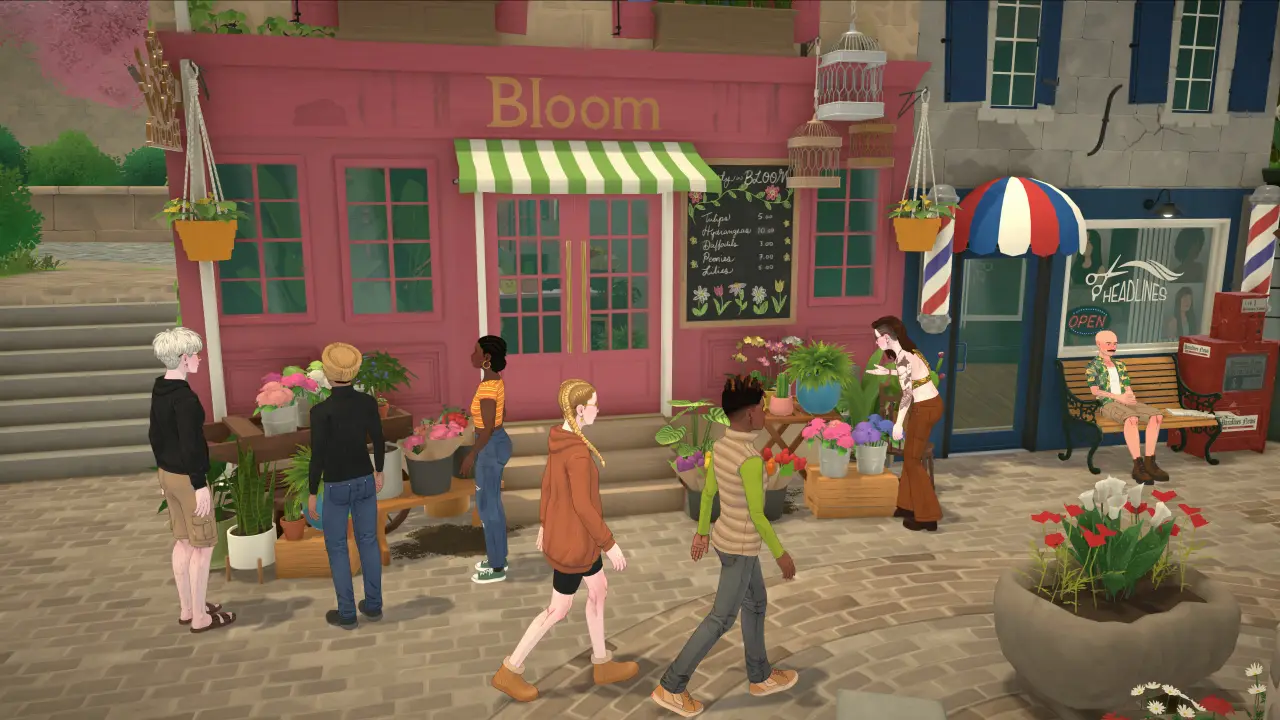
Paralives wears a hand-drawn look that fuses 2D and 3D under a toon-shading pass, and the result is warm, soft, and easy to pick out of a lineup. A lot of people clock the resemblance to The Sims and its American-cartoon house style on first glance. Look closer, though, and the characters here lean a touch more realistic — less exaggeration, more of the texture of ordinary daily life.

In fairness, none of this is breathtaking, and it does not try to be. KeenGamer called the aesthetic distinctive and cozy but "nothing breathtaking," which is exactly right for what the game is. A sim about everyday domestic life does not need blockbuster spectacle; it needs a palette you are happy to sit inside for hours. By that measure the art does its job — clean colour, gentle light, houses and people that both photograph well. There is also a quiet practical upside to a stylised look: it ages slowly and runs lightly, which matters for a game you are meant to live with for years rather than finish in a weekend. Animations are mostly smooth, with the occasional stutter, and the overall presentation reads as cohesive rather than ambitious — a deliberate, sensible choice for a small team that spent its rendering budget on freedom instead of fidelity.
Melino, the seamless town that never makes you wait
What genuinely deserves a spotlight sits underneath the art: the structure of the world. The launch town, Melino, is a true seamless map. Walk from your home to a shop, a restaurant, or someone else's place, and there is no loading screen between lots. You can even hop a train to cross town.

That matters more than it sounds. The Sims 4, a decade-long genre ruler, has long been dinged for its chopped-up, lot-by-lot loading — every errand and house call broken by a black screen that slices "life" into disconnected fragments. Melino keeps the world whole, so a character's daily movement finally feels continuous. This is one place where the newcomer genuinely outdoes its elder, and you feel it in the first ten minutes. A neighbour walking past your window is a neighbour who actually exists in the same space you do, not a sprite spawned in once a lot finishes loading, and that small continuity quietly does a lot of the heavy lifting for immersion.
Don't gloss over it: lost textures, clipping, and a messy UI
Early Access leaves its fingerprints on the visuals too. In the opening days the bugs became a story of their own across communities worldwide: characters randomly losing their textures and going bald-model blank, clipping and snagging while using furniture, even giving birth in the middle of a public street instead of at home. Clips of these moments spread everywhere as accidental marketing, but they are real technical faults all the same.
The UI is the other agreed-upon weak spot. PC Gamer called it messy and often unintuitive, with little feedback when something goes wrong — you frequently know something failed without ever learning why, which is its own kind of friction. To the team's credit, fixes came fast, with patches landing within three days of launch, and the studio has been visibly responsive rather than defensive. On platforms, the game runs on Windows and macOS, the latter needing at least an M2 chip, so Apple Silicon owners are covered while older Intel Macs are not. The verdict for this dimension: capable art, a standout world structure, and a finish dragged down by launch bugs that the team is plainly racing to sand off.
Combat | 9.0/10
Jugabilidad: 9/10Gridless building turns construction from LEGO into freehand drawing
If you only get one sentence on why Paralives matters, it is the gridless building. Before it, putting up a house in a life sim meant snapping right angles onto an invisible grid — walls ran straight, objects sat in their cells, and that was that. This game throws the grid out entirely. You drag an arc to lay a curved wall. You stack split-level platforms to get height changes without a single staircase. You shape your own stairs, rotate any object to any angle, and drop it precisely where you want it.
Then it goes further with scaling. Nearly every piece of furniture, every window and door, resizes freely on a slider — want a sofa that swallows a whole room, or a window shrunk to the size of your palm, both are yours. That turns construction from "assemble within fixed bricks" into "draw whatever you can picture," and pushes creative freedom to a height no rival currently touches. KeenGamer called the build mode "complex, but in a good way" — there is a learning curve, but once it clicks the ceiling on what you can make all but disappears. This is the single biggest reason the dimension earns a 9.0.
It is worth dwelling on how much that scaling slider changes the creative math. In a grid-locked sim, you decorate within the catalogue you are given; here, a single end table can become a coffee table, a side stool, or a child's desk, depending on how far you drag it. The catalogue effectively multiplies itself, and players have already started using the freedom in ways the developers surely did not storyboard — oversized props as architecture, tiny objects as detailing, whole rooms built from one repeatedly rescaled asset. That is the signature of a genuinely generative tool rather than a deeper menu.
The Paramaker hands the character over to you, completely
The other pillar is the character creator, the Paramaker, and its freedom is just as startling. There is a height slider that produces real, visible size differences between Parafolk — where most genre rivals quietly stamp out same-height people. Facial features adjust independently on each side, so you can build genuine asymmetry. Colour is not a handful of swatches but a full wheel, skin and clothing tinted to whatever you like.
Personality is thoughtful too: traits and talents are assigned by the player rather than inherited, which means children do not auto-copy their parents — every Parafolk has to be defined by hand. Pair that depth with Steam Workshop mod support live at launch, with the modelling tools handed straight to the community, and you can not only sculpt your own people but keep sculpting using assets the whole world is making. Building and the Paramaker together are the two most finished, most addictive systems in the package right now.
Live Mode is still under construction
Shift your gaze from making things to living a life and the temperature drops noticeably. Live Mode runs the loop genre veterans know cold — meet needs, work for money, age through the stages — but the depth has not caught up to the build and the creator. It functions, yet it often feels slow, with little arising on its own, and both the richness of interactions and the density of events stay thin.
Lined up against The Sims 4, ruler of the genre for over a decade, the scoreboard is clear. On building and character creation Paralives wins outright — the rival is boxed in by its grid and offers a shallower creator. On the depth and polish of life simulation itself, The Sims 4 is still well ahead. There are launch caveats here too, like curved walls that cannot yet take doors or windows, a feature already on the roadmap.
So the truth of this dimension is a tension, not a verdict. The creation systems are a finished-grade ceiling; the living systems are a promising half-build. The 9.0 rewards the upside and the direction the former sets, because that is where the game is genuinely best-in-class — but it is a score you should read with the Live Mode asterisk firmly attached. If your idea of gameplay is the act of making, this is already one of the most satisfying sandboxes on PC. If your idea of gameplay is the simulated life that unfolds afterward, the score you personally award will sit lower until the updates land.
Content | 6.0/10
Contenido: 6/10What you can actually play at launch: a living town and a pile of half-builds
The Early Access foundation is not as thin as you might fear. You get Melino, a seamless open town stocked with playable careers, a needs system for your characters, aging from young to old, and community spots like shops and restaurants you can walk into and use. Layer finished-grade building and character creation on top, and just designing houses, sculpting people, and steering a family through its days is enough to swallow dozens or hundreds of hours for anyone who likes to tinker.
What is missing matters just as much, though. The launch absence list runs long: pets — dogs, cats, horses — plus weather and seasons, pools, basements, gardening, even big social occasions like weddings, none of it ships in the launch build. All of it sits on the published roadmap, due to arrive across a series of later free updates rather than in one big drop. For anyone weaned on the everything-included sprawl of The Sims, that gap is something you feel — pets and seasons especially are near-default expectations, and without them the town can read a little empty, a little still. The upside is a clear roadmap; weather and seasons, for instance, are targeted from late 2026 onward, so the wait at least has a shape.
It is worth being precise about what "thin" means here, because it is not the same as broken. The systems that exist are functional and the town is genuinely playable from hour one. The shortfall is breadth, not foundation — there are fewer ways to fill a day than a veteran of the genre expects, and the absent feature set is large enough that some players will rightly decide the package is not yet worth their forty dollars. That is a fair call, and the game's own store page leans into it by labelling itself Early Access in plain sight.
Never any paid DLC: buy once, ride free to 1.0 and beyond
What truly rewrites the content story is the update model. Lead developer Alex Massé has put it in concrete: there will never be paid DLC, only free updates, even after Early Access ends. The team says base-game sales alone are enough to fund the whole effort. Full 1.0 is roughly two years out by their estimate — which means the money you spend now covers every new addition across those two-plus years.
That cut lands exactly where The Sims 4, the decade-long genre ruler, takes the most heat. The Sims chops a complete experience into expensive expansion after expansion; collecting the full set costs old hands far more than the base game ever did. Paralives flips the logic — sell you a foundation for about $39.99, then grow alongside it for free. Add Steam Workshop mods live from day one and the long tail runs on two wheels: free updates and community creations. That second wheel is easy to undersell — a passionate modding scene can outpace an official roadmap entirely, and handing players the modelling tools at launch is an open invitation for exactly that. Put bluntly, you are not just buying a game right now, you are placing a trust investment in that free-forever promise — its greatest asset, and in time its sternest test. As long as the updates keep coming and the pledge holds, the early bet pays off.
History gives that bet a precedent worth pointing at. Stardew Valley, built largely by one person, spent years shipping substantial free updates and turned slow, generous post-launch support into a permanent reputation. Paralives is making a louder version of the same wager, and the eight-hour, quarter-million-copy launch suggests the war chest to honour it is real. The question is no longer whether the studio can afford to keep its word — it is whether two years of free updates can fatten Live Mode into something as deep as the tools that surround it.






Comentarios 0
Nos interesa tu opinión
Participa en la conversación y comparte tu opinión sobre este juego.
Aún no hay comentarios. Cuéntanos qué te parece este análisis.