




















Opening
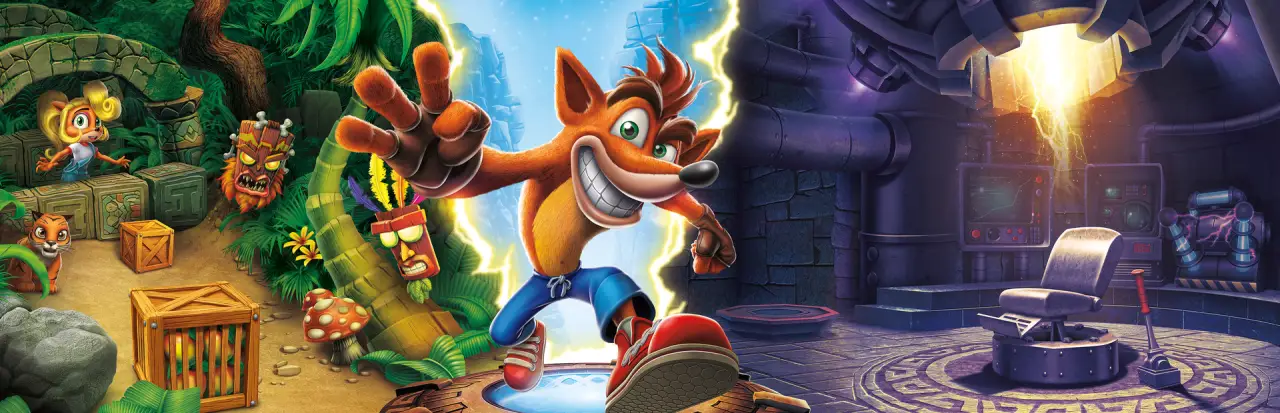
I lose count of how many wooden crates I shatter on the little jungle path before the game properly has me. A red crab scuttles past my feet, the grass blades shudder until my eyes swim, and somewhere in that haze a strange realization lands: the blurry smear of green I remember from the PS1 era has been filled in, pixel by pixel, into a full-blown Saturday-morning cartoon. The tree shadows are real now. The boxes are fake. And yet it is the boxes I care about, because they line up like notes in a rhythm game, daring me to march in time with the level designer's heartbeat.
Then the camera turns, artificial light replaces sunlight, and a sci-fi factory bares its teeth all at once: flame jets, TNT crates, and rivers of green ooze, every hazard demanding my attention. This is old-school platforming in its purest, most stubborn form. The viewpoint is fixed. The route is rigid but readable. Any mistimed input costs you a from-the-top restart, no negotiation. I mutter something unprintable under my breath, and my thumb has already tapped retry before my brain catches up.
That reflex is the whole pitch of the Crash Bandicoot N. Sane Trilogy. This is a remaster that does not soften its source; it sands the memory smooth and then hands you back the exact same teeth. Across the next few thousand words I want to pull apart what that means in practice, dimension by dimension, because the gap between "this is wonderful" and "this is infuriating" here is often a single jump, a single half-second of depth misjudgment. It is a design that is old to the point of wrinkling, and old to the point of still working.
Story | 6.5/10
Story: 6.5/10On a narrative level, this remains a deeply typical 90s mascot platformer. The spine is a simple adventure framework: beat the villain, collect the crucial items, and not much beyond that. The reviews are honest about it too, noting that against today's narrative-driven works the depth is slim and the growth arc thinner still.

A cartoon short, not a saga
This is not the kind of game whose ending sends you off to write a long analysis. It plays more like a string of self-contained cartoon shorts: fun to watch, and gone from your mind the moment you switch it off. The storytelling leans almost entirely on cutscenes and the characters' exaggerated body language rather than dialogue. The hero's broad expressions and the villain's hammy gestures, paired with the close-ups the camera grants them, are enough to communicate who is causing trouble and what you are trying to stop.
By modern standards this approach is a little one-dimensional, but it has the virtue of being light on its feet. You almost never have to pause for a long conversation, because the action, the faces, and the staging have already said everything that needs saying. There is a real economy to it. The game trusts its visual comedy to carry the plot, and for the most part that trust is well placed, even if no one will mistake any of it for genuine character drama. The pacing benefits enormously from this restraint, since the game never stops the momentum to deliver exposition you did not ask for and would not remember anyway.
What also helps is that the cast is built from broad, instantly legible archetypes. You do not need a codex or a recap to understand the relationships; one look at the hero's grin and the antagonist's scheming posture tells you everything. That legibility is a deliberate craft choice, not a shortcut, and it lets the trilogy communicate across language barriers and across the years without ever feeling dated in the way a clumsy script would.
Plain by design, and oddly convenient for it
Set against a 90s contemporary like the first Tomb Raider, or against the later wave of narrative-forward games, this is plainly far more bare-bones. But for a platformer of this type, story was never the main dish. It is closer to a sheet of wrapping paper, a convenient layer that lets you slot into the action quickly without overthinking the why. You are not pushing through a stage because you are desperate to see the next story beat; you are far more likely to finish a level and then, almost as an afterthought, watch the characters get pranked in some new and faintly ridiculous way.

Calling it thin is accurate, yet that thinness brings a quiet upside: it is genuinely low-maintenance. You can leave the game alone for days and come back without needing to "revise" the plot, because there is so little plot to lose track of in the first place. The story consistency across all three bundled games helps here too, since the tone and stakes never shift enough to require any mental recalibration between installments.
Why the wrapping still works
In an age where more and more games strain to tell sweeping stories, this commitment to telling exactly one complete excuse, no more, ends up feeling a little like retro junk food. There is nothing nutritious about it, but it hits the spot, and it never overstays its welcome or demands more attention than the rest of the package can support. That is a more thoughtful position than it first appears, because a heavier narrative layered on top of these punishing levels would actively fight the experience rather than support it.
Consider how a story-heavy approach would land here. Every restart would force you past the same beats you have already seen, every checkpoint would interrupt a carefully tuned rhythm, and the friction would compound until the plot became an obstacle rather than a flavor. By keeping the narrative to a few quick, wordless cartoon gags, the trilogy makes sure that the story is always something you encounter between challenges, never something that gets in the way of them. It is the right amount of story for exactly this kind of game, and recognizing that is itself a kind of design wisdom that more ambitious projects sometimes forget.
Audio | 8.0/10
Audio: 8/10The work this remaster does on sound belongs to a particular category: you might not notice it while it is there, but the moment you mute it the whole thing feels hollow. The audio is the connective tissue that keeps the game's personality from drifting, and it does its job almost invisibly.

Preserving a beach-cartoon identity
Every source agrees the classic music and effects have been preserved and remastered, and that single decision keeps the game's temperament on the rails. This is still that slightly beach-scented cartoon adventure, the one that lives somewhere between a tropical holiday and a slapstick short. Nothing about the sound design tries to drag the trilogy into a more serious register, and that restraint is exactly right for what the game is.
The feedback layer is where it earns its keep most directly. Jumping, spinning, smashing crates, scooping up pickups: every action lands with a crisp, distinct audio cue, and the rhythm of those cues is strong enough that it feels like someone is sitting beside you scoring your inputs with percussion. There is a real musicality to simply moving through a level, where the rattle of breaking boxes and the whip of a spin attack stitch together into a beat you start to anticipate. That tight coupling of action and sound is, quietly, one of the most modern-feeling things about the whole package.
A score that works in motion, not on a playlist
On the composition side, the melodies remain that breezy, bouncy, faintly goofy 90s style. The remaster's contribution is mostly in the mix and the timbre: drums hit with more impact, the low end sits more solidly, and the whole thing is pulled up to a contemporary standard without being rewritten. Jungle stages carry a warm tropical lilt, while the factory levels go cold and mechanical, pairing with the on-screen lasers and robot arms to nudge your attention toward whatever danger is coming next.

It is not music you would pull out as a standalone soundtrack to replay on its own, and it does not pretend to be. But its in-the-moment function is remarkably direct. When the background track suddenly tightens, your fingers instinctively ease off, because you have learned that the music is telling you a pit or an instant-death timing gate is right ahead. Nostalgic players will get yanked straight back to childhood the instant certain themes kick in, while newcomers can read the emotional shifts of a level through the score alone, almost like a second tutorial that never speaks.
The one honest nitpick
If you want to be picky, the overall palette is slightly samey, and a long uninterrupted session can produce a mild case of aesthetic fatigue. The tracks share enough DNA that, hours deep, they can blur into a single pleasant texture rather than standing out as individual pieces.
Given the relentless tension of the actual play, though, that backgrounding turns out to be a feature more than a flaw. You are rarely in a state to appreciate a complex composition while threading a chain of instant-death jumps, and a score that knows how to recede into a steady, supportive hum is exactly what a long bout of level-wrangling needs. It is sound design that understands its supporting role and plays it without ego, which is precisely why it works so well across dozens of hours.
There is also a craft argument hiding in that restraint. A flashier, more attention-grabbing soundtrack would compete with the gameplay for your focus, and in a game where a single missed beat means starting a stage over, that competition would be actively harmful. By keeping the music functional and consistent, the remaster ensures your concentration stays where it needs to be, on the platforms and the timing. The faint sameness, then, is less a failure of imagination than a tradeoff made in full awareness of how the game is actually played, and once you understand the reasoning it stops reading as a weakness at all.
Visuals | 8.8/10
Graphics: 8.8/10The first time you walk out of the jungle and into the sci-fi factory, the upgrade hits you like a channel change. The settings themselves are exactly the ones burned into anyone's memory who owned the originals: jungle, ruins, castle, future city. But remastered, they look as if a modern art team reshot every one of them as a glossy commercial.

A Saturday-morning cartoon, rebuilt from scratch
Critics keep reaching for the phrase "Saturday-morning cartoon," and honestly it fits. The look is built on saturated color blocks and exaggerated, springy lines, and it carries none of the burden of photorealism. That freedom is exactly why it works so well. Instead of chasing fidelity, the art team chased character, and the result is a world that reads as a single confident illustration in motion rather than a collection of high-detail textures fighting for attention.
What surprises you is how much detail lives underneath that cartoon surface. The jungle foliage is no longer a smear of muddy green; it separates into distinct layers of leaves, with a real sense of which fronds sit in front of which. Fire and water effects gain genuine dimensionality, curling and splashing instead of merely flickering. It is the kind of upgrade that you do not consciously notice in any single frame, but that quietly convinces you the whole time that you are somewhere real, somewhere built with care, even when the underlying geometry is decades old in spirit.
The lighting deserves particular credit. Warm shafts of sun filter through the canopy in the jungle, while cooler tones wash over the ruins and the castle stages, and each setting carries its own distinct mood without ever breaking the unified cartoon language. That consistency is the hardest part to pull off in a remaster spanning three games made years apart, and the art team manages it so smoothly that you stop thinking about it entirely, which is exactly the point.
When the visuals double as instructions
The factory and future-city stages are where the art direction earns its highest marks, because here the visuals stop being decoration and start being information. Flame jets, laser beams, and that signature green ooze are not just pretty; they are a readable hazard language. One glance tells you exactly what will end your run, and that legibility is doing real design work in a game built around split-second precision.

That clarity matters more than any raytraced reflection could here. This is not the kind of game that asks you to stop and stare for ten minutes composing a screenshot. The picture is more like an old television with the color temperature tuned just right: comfortable, characterful, and carrying your memories along with it into high definition. On PC, the higher frame rate adds the final layer of polish, smoothing every roll and animation until the moment-to-moment motion itself becomes pleasant to watch, like an oddly over-budgeted animated series that just happens to respond to your controller.
Platform compromises and peer comparisons
Held up against the Spyro Reignited remaster, the most natural point of comparison, this overhaul is just as aggressive. Both are full restyles rather than simple buffs, and both prove that a beloved 90s mascot can be reborn without losing its soul. The N. Sane team did not merely smooth the old assets; they reimagined the entire palette while keeping the silhouette instantly recognizable, which is a far harder trick than it sounds.
If you want to find fault, the Switch version is where to look. The compromises there are visible to the naked eye, with softer resolution and trimmed effects. And yet, crucially, the style and the readability both survive the cut. For a game this dependent on you instantly parsing what is safe and what is lethal, keeping that clarity intact is the real floor, and the handheld version clears it comfortably even when it cannot match its bigger siblings.
It is worth stressing how much that readability matters across every platform. A photorealistic remaster might have looked more impressive in still screenshots, but it would have risked burying the crucial gameplay information under noise and texture detail. By committing fully to the cartoon style, the art direction guarantees that the most important thing on screen at any moment, the thing about to end your run, is always the most visible. That is a discipline you only appreciate after dying to a hazard you genuinely could not see in some lesser-made game, and the N. Sane Trilogy almost never makes you suffer that particular indignity.
Combat | 7.0/10
Gameplay: 7/10The most stubborn thing about this remaster is that it carries back the high difficulty and punishment of the PS1 era almost completely untouched. For players who lived through that age, this is what "the real thing" means. For anyone raised on the forgiving hitboxes of modern 3D platformers, it can feel less like nostalgia and more like a game that simply refuses to meet you halfway.

Memory, timing, and the linear route
The levels are still resolutely linear, and they run on timing and pattern memory. You have to learn which platform crumbles, which post rotates, and which wave of flame follows a rhythm. There is no improvising your way through; there is only the slow accretion of knowledge until a stretch that once defeated you repeatedly becomes a clean, almost automatic run. That loop of failure into mastery is the entire engine of the experience, and how you feel about the game largely comes down to how you feel about that loop.
For people who enjoy it, this is technical discipline, a kind of practice you visibly improve at. For those who do not, it is an argument with a thirty-year-old design that never blinks. Both reactions are completely valid, because the game genuinely does not care to accommodate either one. It simply lays out the route, sets the rhythm, and waits for you to either internalize it or walk away. The honesty of that stance is, depending on your temperament, either bracing or exhausting.
The fixed camera, the great double-edged sword
The fixed perspective is the design's defining double-edged sword. On one edge, it gives the staging a strong, deliberate sense of rhythm; the designer controls exactly what you see and when, and that control is part of what makes the good runs feel so musical. On the other edge sits a very real problem: depth perception is poor, and the landing point of many jumps comes down to experience and educated guesswork rather than clear visual information.

Critics have flagged this for good reason. It produces a lot of pits and instant-death traps that feel deeply unfair, and the specific sensation of thinking you nailed a landing only to slide off the edge breeds a uniquely sharp frustration: the "but I was clearly right there" feeling. The physics and feel were retuned for the remaster, yet the character's jump remains light and a touch stiff. By today's standards this reads as a pixel-precise, old-school demand, and you will spend several hours simply adjusting before you can clear levels with any consistency.
Where it lands against its peers
Set beside an open contemporary like Super Mario 64, the limited freedom is obvious. These are not playgrounds; they are precise exam-paper routes, each one a carefully designed test with a single intended solution. The upside is that the sense of achievement is immediate and unambiguous when you finally pass. The downside is that the cost of trial and error runs high, and a streak of deaths will shatter your rhythm in a way that is hard to recover from in the same session.
If you savor the "I finally learned it" arc more than you resent the hundred failures along the way, there is enormous satisfaction waiting here. If you are accustomed to the gradual guidance and generous judgment of modern platformers, this rule set will feel obstinate. That is not a flaw to be patched so much as a deliberate identity, and walking in knowing which camp you fall into is the single most useful thing you can do before pressing start.
The comparison to a peer like Spyro Reignited, or to the modern benchmark of Super Mario Odyssey, only sharpens the point. Those games actively reach out to soften failure and cushion mistakes, treating frustration as a problem to be engineered away. The N. Sane Trilogy treats that same frustration as a feature, an essential part of the bargain you are striking when you sit down to play. Neither philosophy is wrong, but they are aimed at completely different people, and pretending otherwise does a disservice to both. What you are really buying here is a faithful preservation of an entire school of design thought, warts and all, and the question of whether that is a strength or a weakness is one only your own patience can answer.
Content | 8.5/10
Content: 8.5/10The moment the main menu lights up, there is a small, slightly guilty thrill of getting away with something. For a single price, three full plates of food are already laid out on the table in front of you. That generosity sets the tone for everything the collection has to offer.

Three games, one growth arc
Bundling the original trilogy together effectively compresses the entire growth arc of a platform mascot into one icon. For newcomers, it is a complete journey, from the raw and brutal early jungle all the way to the more structurally mature later entries, watching the design itself learn and refine across three games. For veterans, it plays more like a serialized rewatch, a continuous binge of memories that builds momentum from one installment to the next rather than feeling like three separate purchases stitched together.
That uniformity is part of the appeal. Because all three games share the same remastered engine, art language, and audio identity, moving between them never feels jarring. You carry the muscle memory of one game's controls straight into the next, which both smooths the on-ramp and quietly highlights how the level design grows more confident as you progress. It is a rare collection where the sum genuinely tells a story the individual parts could not on their own, and that cumulative effect is the strongest argument for buying the trilogy as a single package rather than cherry-picking favorites.
The collectible trap and the long tail
Each game is also stuffed with secondary challenges: gems, crystals, and time-trial relics. What all that collectible material produces is not merely raw playtime but a legitimate reason to replay. You can take the relaxed route and simply clear the main lines, finishing a full pass in somewhere around forty hours. Or you can let that row of unlit icons start to itch, each one whispering "get a little better" and "shave off another second" until you are back in a stage you have already beaten, chasing a cleaner run.

Critics have noted that these systems give repeat play plenty of motivation, and that tracks with my experience. For the completion-driven, the design is simultaneously a gift and a curse: there is always one more thing to chase, and the game is very good at making that one more thing feel just barely within reach. The long tail here is real, and it rewards exactly the kind of player who treats a 100% file as a personal challenge rather than a chore.
Boot camp versus sightseeing
Compared to the same-shaped Spyro Reignited trilogy, the two collections reveal genuinely different temperaments. Spyro leans toward relaxed sightseeing, an easygoing tour you can drift through. This one leans hard into a kind of physical boot camp: the content is plentiful, but it depends far more on your persistence and your tolerance for error. If all you want is a light nostalgic checklist, the high-demand collectibles and timing challenges can feel quietly aggressive, not strictly necessary yet very good at tempting you into the deep end.
Taken as a whole, the content density absolutely earns the word "collection." The catch is that this generous spread of side dishes comes with one non-negotiable main course: old-school, severe platform design. Accept that, and the abundance is a feast. Reject it, and no amount of bonus material will change how the meal tastes.
It is worth being precise about who benefits most from all this volume. A player who treats each game as a discrete experience to be cleared and set aside will get a respectable run of around forty hours and walk away satisfied. A player who is wired to chase every relic and gem, on the other hand, can sink two or three times that into the same package, and will feel the value compound with every additional milestone. The trilogy is generous enough to serve both, but it is the second kind of player, the patient archaeologist of old design, for whom the content offering truly becomes bottomless. That is the audience this remaster was clearly built to delight, and for them the sheer quantity on offer turns a one-time purchase into a hobby that can quietly stretch across many months of dedicated play.






Comments 0
Share your game review
Join the discussion and share your review of this game.
No comments yet. Share your thoughts on this review.