



















Opening
Cuphead is what happens when two brothers refuse to compromise. Chad and Jared Moldenhauer spent seven years and, by some accounts, mortgaged a house to hand-draw roughly fifty thousand frames of animation in the rubber-hose style of 1930s Fleischer and early Disney cartoons, then paired the result with an original big-band jazz soundtrack recorded by a live thirteen-piece orchestra. When Cuphead finally launched in 2017, it did not look like a video game so much as a lost cartoon from the golden age, brought to life and made playable — and brutally, gloriously hard. It is one of the most singular acts of craft the medium has ever seen, and nearly a decade later nothing has come close to replicating it.
Beneath that hand-painted surface is a run-and-gun boss-rush of ferocious precision. Framed by a featherweight story — Cuphead and his brother Mugman lose a bet to the Devil and must collect the soul contracts of his debtors — the game is really a gauntlet of twenty-six utterly distinct multi-phase boss fights, each one a small animated set-piece with its own art, its own jazz theme, and its own escalating mechanics, none of them reused. You will die thirty, forty, fifty times to a single boss, learn its rhythms frame by frame, and finally beat it in a rush of mastery that few games deliver as purely. The 2022 expansion, The Delicious Last Course, added a new playable character and seven more bosses without dropping the standard an inch.
This review grades Cuphead across six dimensions, and the scores describe a masterpiece with one deliberate soft spot: a 9.7 for graphics and a 9.6 for audio sit at the very top of this entire review, a 9.2 for gameplay backs them, and an 8.5 for content holds strong, with only a 6.5 for its intentionally slight story bringing the average down, landing on a 9.1 overall. That spread is the whole picture. Cuphead is a triumph of art, music and design, gated behind a difficulty that filters players hard and a story that is barely there by choice. The next six sections explain exactly who should answer the Devil's bet.
Story | 6.5/10
Story: 6.5/10Cuphead scores 6.5 for story, its lowest dimension by a wide margin, and the number is a completely honest accounting of a game that treats narrative as a frame rather than a focus. The entire plot can be summarized in a sentence — two brothers gamble with the Devil, lose, and must collect souls to pay their debt — and the game makes no attempt to expand it into anything more. This is not a failing so much as a deliberate priority: Cuphead spends its storytelling budget on tone and aesthetic, not plot, and the score reflects exactly that choice.
A premise, not a plot

The whole of Cuphead's narrative is its setup. Cuphead and Mugman, two cheerful porcelain-headed brothers, get greedy at the Devil's Casino, make a bet they cannot cover, and lose — and the Devil offers to forgive the debt if they collect the soul contracts of his other debtors scattered across the Inkwell Isles. That is it. That premise launches you into the boss gauntlet, and from there the story essentially stops, replaced by the sequence of fights. There is no character development, no plot twists, no dramatic stakes beyond the looming threat of the Devil, and no real arc for the brothers to travel. The debtors you fight are vivid as designs but have no narrative relationships to you or each other; they are obstacles, not characters in a story. For a player who comes to games for narrative, this near-total absence of plot is genuinely disappointing, and the cons of the game name it plainly — the story is just a gambling debt, dressed up. The 6.5 grades that honestly: there is a premise, it is charming, and there is almost nothing built on top of it. The game is a gauntlet wearing the thinnest possible story as a hat.
The story's real job is tone

What rescues the story score from the floor is recognizing what the slight narrative actually accomplishes, because the premise is not trying to be a plot — it is trying to be a license. The "deal with the Devil" framing is the perfect pretext for everything Cuphead wants to be: it justifies the 1930s cartoon aesthetic, where moralizing tales of greed and damnation were a genre staple, it explains the parade of bizarre, malevolent characters, and it sets a tone of mischievous, slightly sinister whimsy that suffuses the entire game. In that sense the story does its one job superbly. It gives the boss gauntlet a coherent identity and a thematic through-line — sin, debt, and the consequences of a bad bet — that ties the wildly varied fights into a single world, and it does so with exactly the economy a fast, action-focused game needs. A heavier plot would have slowed the game and clashed with its arcade heritage; the featherweight premise is the right call for what Cuphead is, even though it caps the story score. The narrative is a delivery mechanism for tone, and as that, it is flawless.
What the IP filled in later

It is worth noting that the thinness of the game's narrative left enormous room for the characters to be developed elsewhere, and the broader Cuphead phenomenon took full advantage. The Cuphead Show!, Netflix's three-season animated adaptation, did what the game never tried to: it gave Cuphead, Mugman, the Devil and the supporting cast genuine personalities, relationships and ongoing stories, fleshing out the charming ciphers the game presented into a real cast. This is a telling division of labor — the game delivered a flawless aesthetic and a brutal challenge wrapped around a deliberately minimal story, and the wider IP supplied the characterization and narrative that fans wanted, proving there was rich material latent in the premise all along. For the purposes of grading the game itself, though, that external development does not change the score: the game's own story remains a slight, charming frame, exactly as designed. The 6.5 is the fair verdict on a game that knew precisely how much story it needed — just enough to justify the art and set the tone — and refused to spend a frame more, trusting its craft and its combat to carry the rest. They do.
Audio | 9.6/10
Audio: 9.6/10Cuphead scores 9.6 for audio, one of the two highest marks in this entire review, and it is no exaggeration to call the soundtrack a landmark. Where most games license or synthesize their music, Cuphead commissioned an original 1930s big-band jazz score and recorded it live with a full orchestra, an act of authenticity so committed that it won a BAFTA for Best Music and remains a reference point for what game audio can aspire to. The sound is not an accompaniment to Cuphead; it is half of what makes Cuphead Cuphead.
A live jazz orchestra, recorded for real

The foundation of the 9.6 is the staggering authenticity of the music. Composer Kristofer Maddigan wrote an original score in the genuine style of 1930s big-band and ragtime jazz, and crucially it was performed and recorded by a live thirteen-piece orchestra rather than assembled from samples, giving it a warmth, swing and human energy that synthesized music simply cannot match. This is the same uncompromising craft that defines the game's animation, applied to sound, and the result is a soundtrack that could stand entirely on its own as an album of period jazz. The decision to record live was expensive and laborious for an indie studio, exactly the kind of corner most developers would cut, and the fact that the Moldenhauers refused to is why the audio reaches the level it does. The BAFTA for Best Music was earned recognition of a soundtrack that does not merely evoke the 1930s but authentically belongs to them, and it elevates every moment of the game it underscores. Few games in history have music this distinctive, this accomplished, or this central to their identity.
Music woven into the fight
What takes the audio beyond a beautiful soundtrack to a 9.6 is how deeply the music is integrated into the gameplay. Each of the twenty-six bosses has its own distinct musical theme, and those themes are not static — they escalate as the fight moves through its phases, the arrangement intensifying as the boss transforms and the danger mounts. This makes the music a living part of each encounter, rising and breaking in time with the battle so that the audio and the action feel like a single choreographed performance. The swelling brass and quickening tempo also serve a functional purpose, telegraphing the rhythm of a fight and signaling its escalation, so an attentive player reads the music as another layer of feedback about what is coming. This synthesis of distinct, phase-reactive themes with the moment-to-moment combat is a remarkable achievement, ensuring that every boss is memorable not just for how it looks but for how it sounds, and that the two are inseparable. The music does not sit on top of the gameplay; it is fused with it, and that fusion is the heart of why the audio scores so high.
The complete 1930s illusion

The final pillar of Cuphead's audio is the sound design that completes the illusion of a cartoon from the golden age. Beyond the music, the game's sound effects are crafted to match the period aesthetic, full of the bouncy, exaggerated, faintly tinny audio cues of a 1930s animated short, and they work hand in hand with the visuals to make the whole experience feel like a genuine artifact of the era rather than a modern pastiche. The pops, boings, splats and whistles of the action are exactly the sounds a Fleischer cartoon would have made, and their consistency with the art direction is total, sealing the time-travel effect the game is going for. This holistic commitment — original live jazz, phase-reactive boss themes, and period-perfect sound effects all pulling in the same direction — is what makes Cuphead's audio not just excellent but seamless, a complete sonic world that never breaks character. The 9.6 reflects a soundscape that is at once a standalone musical triumph, a functional gameplay system, and an essential half of one of the most cohesive aesthetic visions in gaming. It is, simply, one of the best-sounding games ever made.
Visuals | 9.7/10
Graphics: 9.7/10Cuphead scores 9.7 for graphics, the single highest score in this entire review, and it is the most deserved top mark imaginable. The game's visuals are not just beautiful; they are a feat of craft without precedent or successor in the medium, a complete recreation of 1930s rubber-hose animation built frame by hand-drawn frame. To look at Cuphead in motion is to watch a lost cartoon from the golden age of animation brought to interactive life, and nearly a decade later, nothing else looks remotely like it.
Fifty thousand frames, drawn by hand

The foundation of the 9.7 is the sheer, almost unfathomable labor behind the animation. The Moldenhauer brothers and their team hand-drew approximately fifty thousand frames of animation over roughly seven years, recreating the rubber-hose style of 1930s Fleischer Studios and early Disney cartoons with painstaking fidelity. This is not a digital filter or a stylized 3D approximation but genuine, traditional cel animation, every frame inked and painted by hand in the manner of the era it imitates, and the result is an authenticity that no shortcut could achieve. The characters move with the bouncy, elastic, slightly unsettling fluidity of period cartoons, full of the squash-and-stretch exaggeration and surreal transformations that defined the style, and the effect is mesmerizing. This level of dedication to a single aesthetic vision, sustained over seven years at enormous personal cost to a tiny studio, is the indie craft ceiling — a high-water mark for how far passion and commitment can push a small team's visuals past anything a bigger budget alone could buy. It is the kind of achievement that reorders expectations of what a game can look like.
Watercolor worlds and inventive design

The animation is matched by the environments, which use traditional watercolor backgrounds to complete the period illusion. Every stage and boss arena is set against hand-painted watercolor art, giving the world a soft, textured, authentically antique look that no digital rendering replicates, and the consistency of this technique across the entire game makes the Inkwell Isles feel like a coherent painted universe. What elevates it further is the relentless inventiveness of the design: across twenty-six bosses, there is zero art reuse, so each fight is a fresh visual spectacle with its own characters, transformations and surreal set-pieces. A boss might begin as a vegetable and become a nightmare, a mermaid might turn to stone, a plane battle might dissolve into chaos — and every one of these is animated with the same handcrafted care, meaning the game never stops surprising you visually. This combination of a consistent, gorgeous artistic foundation and an endless parade of inventive, never-repeated designs is what makes Cuphead not just beautiful in a screenshot but breathtaking across its entire runtime. The art direction has the confidence to make every single encounter a new visual idea.
The only caveat, and why it does not matter

The only honest caveat on a near-perfect graphics score is that Cuphead is purely 2D and hand-drawn, with none of the three-dimensional fidelity, modern lighting or photorealism that some players equate with cutting-edge graphics. A graphics purist fixated on technical 3D rendering might register the style as old-fashioned or even primitive, and for completeness that perspective deserves acknowledgment. But it is, artistically, a non-issue, because Cuphead is not attempting realism and should not be judged as if it were — it is attempting to be a perfect 1930s cartoon, and it achieves that goal completely. To dock it for lacking 3D fidelity would be like faulting a watercolor for not being a photograph; the medium is the point, and the execution within that medium is flawless. The 9.7 reflects exactly this: a game whose visual ambition is total and whose realization of that ambition is as close to perfect as the medium has produced. Cuphead is one of the most beautiful games ever made, full stop, and the highest score in this review is the only honest grade for an artistic achievement this singular, this laborious, and this completely successful at being precisely what it set out to be. Years after release, developers and players alike still point to Cuphead as the benchmark for hand-crafted visual identity, and no game has yet matched the specific magic of watching a fully playable 1930s cartoon respond to your inputs — a testament that the 9.7 will age as well as the animation it rewards.
Combat | 9.2/10
Gameplay: 9.2/10Gameplay scores 9.2, and it is the score that proves Cuphead is far more than a pretty face. Beneath the hand-drawn beauty is a run-and-gun boss-rush of exceptional precision and depth, a relentless test of pattern recognition, reflexes and nerve across twenty-six distinct multi-phase battles. The difficulty is famous and divisive, but for the players it is built for, the act of mastering these fights is one of the purest and most rewarding loops in action gaming, and the 9.2 reflects how superbly that loop is constructed.
Twenty-six fights, no two alike

The heart of Cuphead's gameplay is its boss design, and it is close to flawless. The game is built around twenty-six bosses, and each one is a multi-phase encounter — typically three to four distinct stages — that transforms as you fight it, demanding that you learn and adapt to a constantly shifting set of attack patterns. Crucially, there is no mechanical reuse across these fights: every boss introduces new behaviors, new patterns and new challenges, so the game never coasts on a formula and never stops asking you to learn something fresh. This makes each encounter a self-contained puzzle of memorization and execution, where success comes from gradually internalizing the boss's choreography phase by phase until you can dance through it cleanly. The design discipline this required is immense — twenty-six wholly original fights, each finely tuned — and it is what gives the gameplay its remarkable freshness and replay value. Where many action games pad their runtime with repetition, Cuphead delivers a gauntlet of constant novelty, and the satisfaction of finally conquering a boss you have failed dozens of times is a feeling few games engineer as reliably. The boss-rush structure is the game, and it is executed with near-perfect craft.
Real mechanical depth beneath the difficulty

Cuphead's difficulty would mean nothing without depth to back it, and the combat toolkit is richer than its simple presentation suggests. You can swap between a range of weapons each suited to different situations, equip charms that alter your capabilities, and unleash super arts at key moments, building a loadout tailored to your style and to specific fights. Threaded through all of it is the parry mechanic — the ability to slap pink-colored objects and enemies for a burst of effect — which is central to both combat and movement and which rewards aggressive, precise play with the resources to fuel your supers. Mastery is not just about dodging; it is about managing your tools, timing your parries, and choosing the right weapon for each phase, so the skill ceiling is genuinely high and the path to it is satisfying to climb. Two-player local co-op adds another dimension, turning the solo trial into a shared one where coordination and revival mechanics change the dynamic of every fight, and it is one of the better couch co-op experiences in modern gaming. This mechanical depth is what makes the difficulty feel fair rather than arbitrary: you lose because you made a mistake, and you win because you got better.
The difficulty gate and the Metal Slug lineage

The honest cost of Cuphead's design is that its difficulty filters players hard, and there is no pretending otherwise. Dying thirty to fifty times to a single boss is a normal part of the experience, not an outlier, and for players without the patience or the reflexes for that kind of repetition, the game can be more frustrating than fun. Cuphead compounds this with a pointed design choice: the Simple difficulty setting, meant to ease the burden, does not let you unlock the true final confrontation with the Devil, effectively gating the full content behind the harder Regular difficulty and leaving less skilled players with an incomplete experience. This is a deliberate, somewhat uncompromising stance — the game wants you to earn its ending — and it is the clearest reason the gameplay sits at 9.2 rather than higher, because that gate genuinely excludes a portion of the audience. The contrast with the run-and-gun lineage Cuphead descends from is illuminating: classics like Metal Slug pioneered the genre as arcade spectacle, but Cuphead refines it into something more focused and artful, trading the endless side-scrolling of the arcades for a curated procession of handcrafted boss duels. It is the genre elevated to an art form, demanding and exacting, and for the player willing to meet it on its terms, the 9.2 is richly earned.
Content | 8.5/10
Content: 8.5/10Content scores 8.5, the most modest of Cuphead's high marks, and it reflects an honest truth: Cuphead is a focused, curated, exquisitely crafted experience rather than a sprawling one. What it offers, it offers at an extraordinary level of quality, and the Delicious Last Course expansion meaningfully extended it, but it is a tight, deliberate package rather than an endless open world, and the content score grades that scope fairly while crediting the density of value within it.
Twenty-six bosses and four isles

The foundation of the 8.5 is the core content of the game: twenty-six utterly distinct boss fights, plus a set of run-and-gun platforming stages, spread across four themed Inkwell Isles. Because every boss is a multi-phase encounter with no reuse, each one is effectively a bespoke piece of content — a unique animated set-piece with its own art, music and mechanics — so the boss roster delivers far more variety and density than a raw count suggests. The run-and-gun stages add a different flavor of challenge between the boss battles, and the mausoleum parry challenges and other diversions round out the package. This is content built on quality rather than quantity: there is no filler, no padding, no repeated assets, just a procession of handcrafted encounters each designed to be memorable. For a focused action game, the amount of distinct, high-effort content is genuinely impressive, and clearing every boss across both difficulty tiers is a substantial undertaking. The Inkwell Isles are compact but dense, every screen earning its place, and that curation is part of why the game maintains such a high standard from start to finish.
The Delicious Last Course

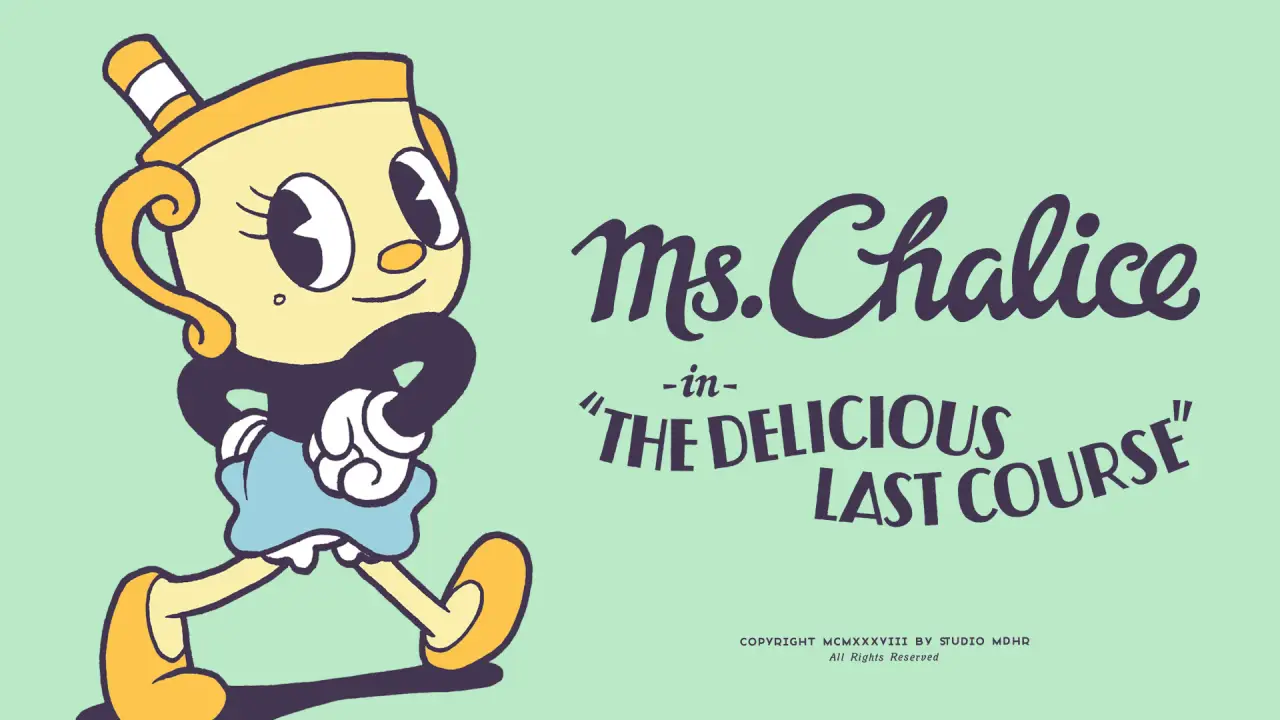
What pushed the content from strong to genuinely generous was the 2022 expansion, The Delicious Last Course, which added a whole new chapter at exceptional value. The DLC introduced Inkwell Isle IV with seven new bosses built to the same flawless standard as the base game, and it delivered what was widely regarded as roughly fifteen dollars of content for an eight-dollar price — a rare bargain in an era of overpriced expansions. More cleverly, it added Ms. Chalice as a new playable character with an altered moveset, and because she plays meaningfully differently from Cuphead and Mugman, choosing her effectively unlocks fresh replays of all nineteen base-game bosses, multiplying the value far beyond the seven new fights. This is smart expansion design: it not only adds content but transforms the existing content, giving veterans a compelling reason to return to fights they had already mastered and experience them anew. The DLC maintained the impeccable craft of the original without a single compromise, and it remains one of the better-valued expansions in recent memory, a substantial and lovingly made addition that deepened the package considerably.
Mastery, replay, and the honest limit
Beyond the raw content, Cuphead's runtime is extended significantly by its skill-driven replay value. The higher difficulty tiers, the grading system that rates your performance on each fight, the pursuit of flawless no-hit runs, and the simple drive to master encounters you once found impossible all give the game a long tail for the players it hooks, turning a single clear into the beginning rather than the end of the experience. Speedrunners and challenge-seekers have found enormous depth here, and the parry-and-grade systems reward continued investment well past the credits. The honest limit on the content score is simply one of scope: Cuphead is a focused, curated experience, not a vast open-ended one, and a player measuring content purely by hours or by world size will find it smaller than a sprawling RPG or sandbox. That is not a flaw but a design choice — the game trades breadth for an unbroken standard of quality — but it is the reason content is the lowest of its strong dimensions rather than another near-perfect mark. The 8.5 is the fair verdict: a tight, dense, beautifully made package, generously expanded and rich in replay for the skilled, that prioritizes the quality of every moment over the sheer quantity of them. For what it is, there is barely a wasted second. In an industry that often equates value with bloated runtime, Cuphead makes the opposite case persuasively: a leaner experience where every encounter is handcrafted can be worth far more than a longer one padded with repetition, and the years players have spent mastering its fights are the proof that quality, not length, is what truly sustains a game.




Comments 0
Share your game review
Join the discussion and share your review of this game.
No comments yet. Share your thoughts on this review.