


















Opening
Some games make you forget whether you are holding a controller or a katana.
Ghost of Tsushima is one of them. Sucker Punch took Kurosawa's black-and-white film grain, fields of pampas grass bending in the wind, and the clean reverse-cut that follows a perfect parry, then folded all of it into an open world you can ride across at will. Look at any frame and it reads less like a quest map than a living ukiyo-e print. The game stunned everyone on console in 2020; four years later, Nixxes — Sony's go-to porting house — brought it to PC with unlocked framerates, three upscalers, and triple-monitor support stretching to 48:9. The verdict was near-unanimous: this is now the best way to ride out its snowbound tale of revenge.
It is not a flawless masterpiece, and it never pretends to be. The camps waiting to be cleared and the collectibles scattered across the map will feel wearily familiar to anyone who has played a same-era open world. But stand in a blood-red maple grove, lock eyes with a Mongol warrior across a standoff, and watch the wind die and the world go quiet — waiting to see who draws first. In that single beat you understand what Tsushima is really offering: not a checklist, but a samurai film you get to act out yourself.
Story | 8.0/10
Story: 8/10How a samurai becomes a Ghost — the price of honour
The Mongol invasion of 1274 opens the story with a slaughter. Thirty thousand troops and nine hundred ships descend on Tsushima, and the samurai sent to meet them are cut down almost to the last man on Komoda Beach. Jin Sakai is one of the few who walks away, and the island's last real hope.

Here is the snag. A samurai's honour leaves no room for ambush, poison, or a blade in the dark — and those are precisely the only tools that work when one man stands against an army. So the spine of the campaign is never really "can you beat the Mongols." It asks how much of what you believe in you are willing to betray in order to win. Jin slides, step by step, from an upright warrior into the Ghost — a figure his enemies dread and his own people come to fear. That internal tug-of-war lodges in the memory harder than any duel does. Tsushima refuses to spread its plot thin across busywork; it keeps its teeth sunk into one theme — tradition at war with expedience — and digs. Every dishonourable act you commit charges you, emotionally, later on. The islanders thank the Ghost for driving out the invaders and flinch from the man who would break any rule to do it, and that double-edged gaze gives the word "hero" real weight.
Lord Shimura and Yuna — two people carry the tragedy
If the theme is the skeleton, the cast is the flesh and blood.

Lord Shimura, the uncle who raised Jin, is where the whole story's tension lives. He embodies the old, uncompromising code of the samurai, and he watches his nephew break that code again and again to save the island. The pride and heartbreak war on his face, and it drives the two of them toward a reckoning neither one wants. That thread stays taut to the final moment, and the ending's choice will leave a lot of players just sitting there, controller in hand. Pulling Jin from the opposite direction is Yuna, a thief who could not care less about honour and only wants to survive and find her brother. Her questline and the rescue at the Golden Temple are the most human footnotes the Ghost's grim logic ever earns. One uncle insisting on what should be done, one outlaw living by what has to be done — Jin is pinned between them, and slowly becomes the man he ends up being.
Iki Island and a soft opening — one chapter completed, one flaw left
The Director's Cut's biggest content boost is the Iki Island chapter, now baked into the base game.

The expansion turns the camera toward Jin's father and a past he would rather not revisit, completing the hero's childhood wound across a fresh journey that carries as much emotional weight as the main line. It is no lazy "new map, same fight" DLC; it genuinely mines the character's depths, and most who play it come away feeling it earns its place. There is a cost to balance the gain, though. The game's most common complaint is its soft first few hours — it is too eager to bond you with Jin before you have so much as warmed your grip on the sword, so the early gut-punches it swings for land a little limp. Next to the patient, slow-burning setup of a Red Dead Redemption 2, Tsushima's opening lurches off the line. The early hours load you with names and stakes before any of them have had time to mean something, so the first act leans on momentum it has not yet earned. Push past it, though, and the emotional payoff steadily settles the debt — by the back third, the choices Jin makes carry the kind of weight the opening kept promising and could not yet deliver. The campaign is at its strongest when it stops explaining honour and simply makes you pay for breaking it, and that is a lesson it learns the moment the training wheels come off. By the time the credits roll, the soft opening reads less like a failure than a slow exhale before the storm — though it is a stretch you have to be willing to wait out.
Audio | 9.0/10
Audio: 9/10Shakuhachi and taiko — the score says it before you feel it
Mute Tsushima for a while and half its soul drains out of the screen.
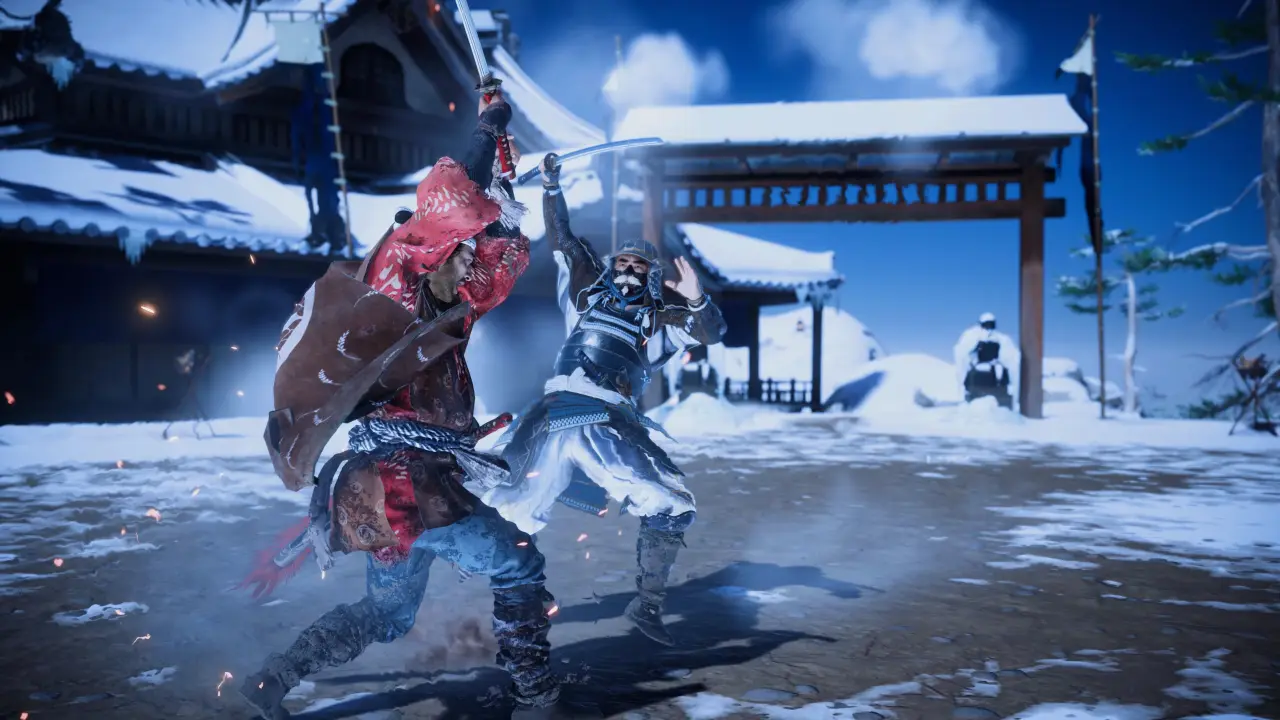
The score leans on traditional Japanese instruments — shakuhachi flute, taiko drums, shamisen — for melodies that run bleak and grand at once. Its smartest move is binding the music to Jin's transformation: while he is still the upright samurai, the themes carry a formal kind of sorrow; once the Ghost is dragged out of him, the music turns cold and airless. More often than not the score pulls you into a feeling before you have worked out where the plot is heading. In combat that loud-soft contrast is wrung dry. A brawl arrives on a flurry of drums and your pulse climbs with it; the instant a standoff begins, the sound is vacuumed away until only wind and your own breath remain — a "this next strike decides everything" tension the visuals alone could never deliver. The moment your blade lands and the enemy drops, the music surges back, exhaling on your behalf, and that build-silence-release rhythm lends every routine skirmish a small ritual weight. It is the difference between a soundtrack that plays underneath a game and one that fights alongside you. The composers understood that a single sustained note before a duel does more than a wall of orchestration, and they trust that silence to do the heavy lifting — a confidence most blockbuster scores never quite muster.
Japanese voice plus Kurosawa mode — tune the whole game into a black-and-white film
If you want the purest cut of Tsushima, there is a near-consensus on how to set it up.
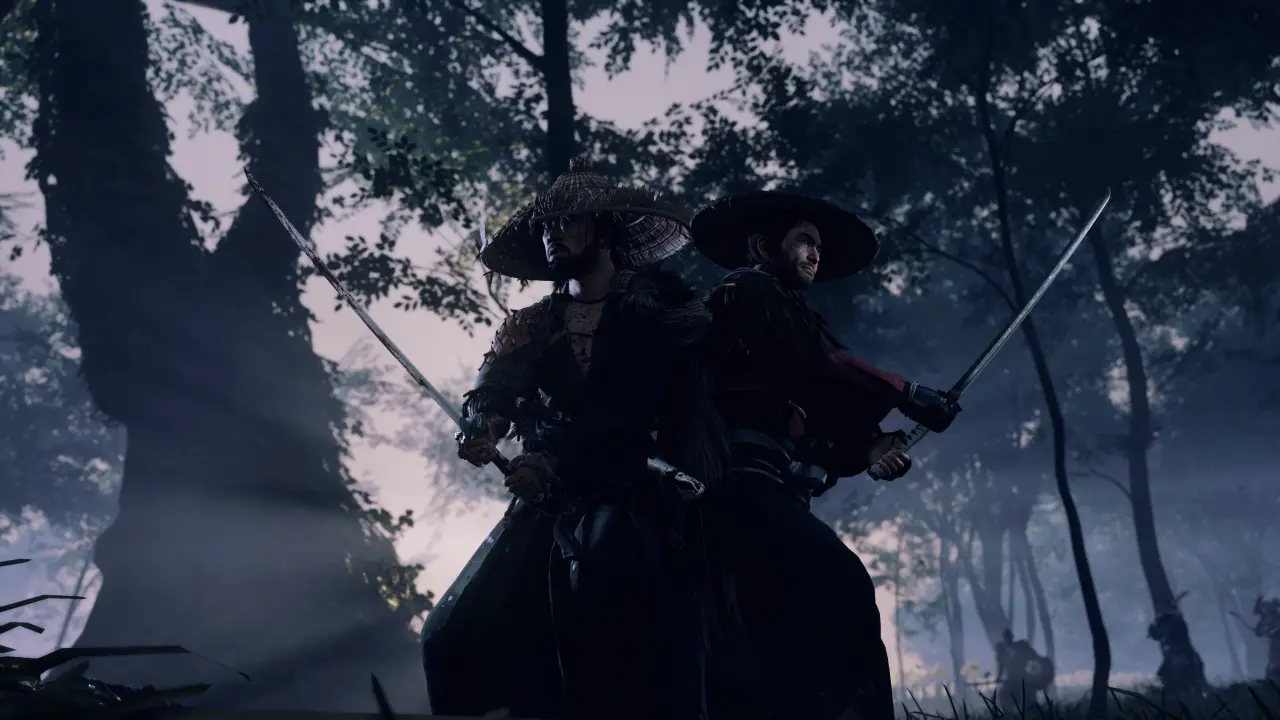
Switch the audio to the Japanese track first. The cast has real heft — Kazuya Nakai voices Jin, while Akio Otsuka plays Lord Shimura, both heavyweight names in Japanese voice acting. The cadence, the pauses, the sheer period texture of the Japanese lines are things an English dub struggles to reproduce, and for anyone chasing cultural immersion it is all but mandatory.
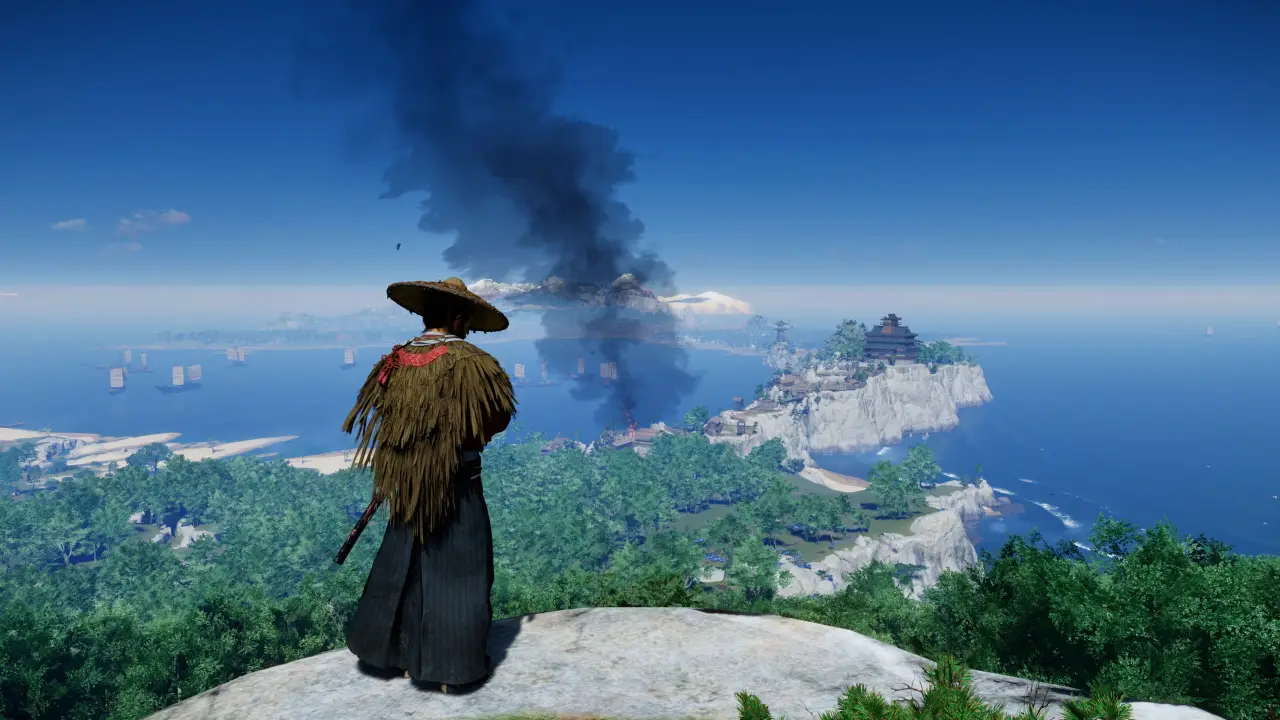
Then stack Kurosawa mode on top. Flip it on and the picture drops to black-and-white film grain, the audio deliberately aged — muffled, scratchy, faintly shaking, a dead ringer for a mid-century samurai picture. Japanese voice, weathered sound, traditional score: with those three in place, Tsushima stops being a game and becomes a Kurosawa film you happen to be performing. Layer on the near-ceaseless ambience — wind threading bamboo, distant surf, birds startling into flight, rain ticking off the eaves — and you realise you are navigating this land with your ears as much as your eyes. The wind that steers you toward objectives is not just a visual cue; you hear it rise and fall, so the audio and the navigation are the same gesture. That marriage of sound and image is a height the biggest budgets routinely fail to reach, and it is a large part of why Tsushima lingers in the memory long after the credits roll. Turn the music off and you do not just lose a feature — you lose the thing that made the island feel alive in the first place.
Visuals | 9.5/10
Graphics: 9.5/10A gust of wind is your compass — the art turns function into poetry
Most open worlds hand you a map bristling with icons and an arrow that never stops blinking. Tsushima hands you the wind.

Flick toward where you want to go and a gust answers, sweeping in that direction — bending grass, lifting leaves, tugging at Jin's robes. It takes the dullest verb in the genre, navigation, and rewrites it as something that breathes. You are not chasing a marker; you are being led by the land itself. That "nature is on your side" feeling is the single most praised stroke in the game's design, and it quietly redrew how an open world ought to guide a player. Then there are the frames you cannot forget — leaves spiralling overhead, a maple grove burning red, pampas fields churning into golden surf. The minimalist restraint owes an obvious debt to Shadow of the Colossus; it understands that subtraction is what makes a composition sing. Every so often you simply stop walking, just to look a moment longer, and reach for the photo mode before you have consciously decided to. The wind system is the headline, but it is the colour discipline beneath it that sells the whole picture — a palette that knows when to go monochrome and when to let a single red maple dominate the frame.
Kurosawa mode and ultrawide — the PC version pushes the spectacle higher
If the art is Tsushima's soul, the PC version is the cloth that polishes that soul to a brighter shine.
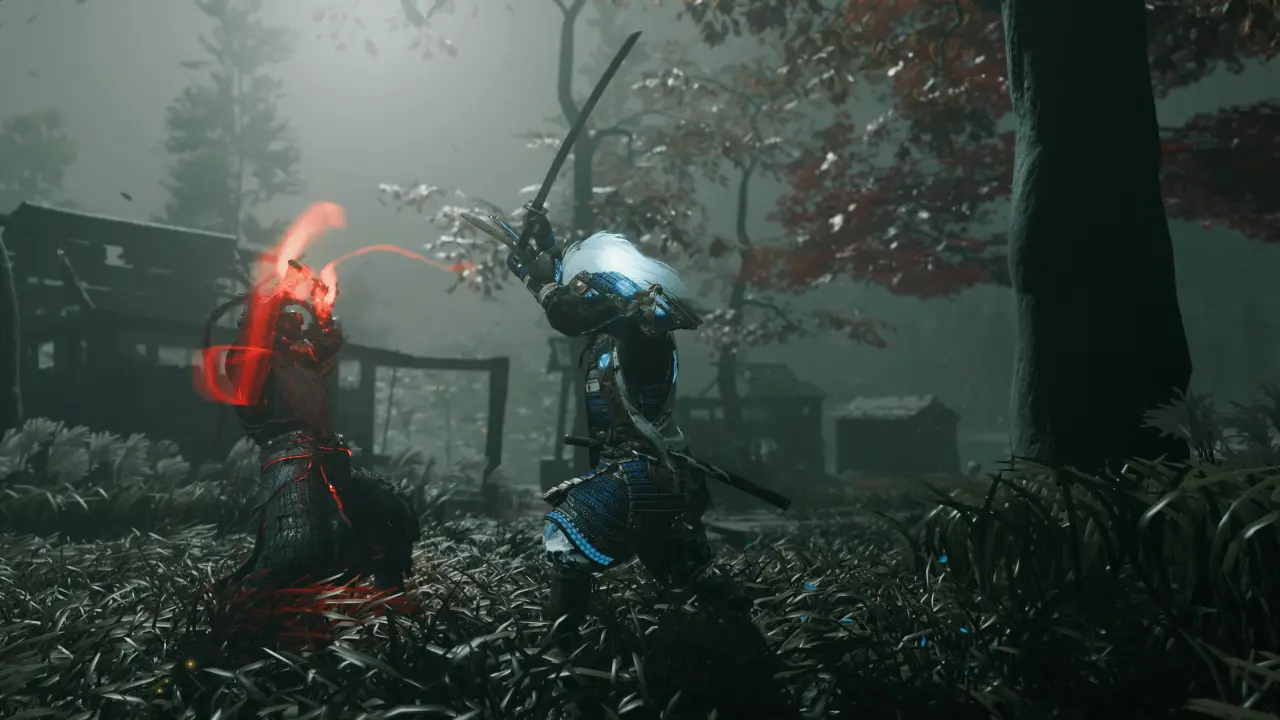
The standout is still Kurosawa mode: one toggle drops everything into black-and-white film grain, and the world instantly takes on the air of an old samurai picture. This is no slapped-on filter — it locks flush with the art's foundations, so switching it on never jars.

The real PC-exclusive treat is the screen real estate. Tsushima supports 21:9, 32:9, even 48:9 triple-monitor wraparound, and when those pampas fields and far ridgelines unspool across a canvas that wide, the sense of scale is something no console could grant. Stand on a peak and watch the whole island ripple in the wind and you nearly forget you are playing a game. Set against Assassin's Creed Valhalla — sprawling, crammed full, yet visually diluted — Tsushima goes the other way, trading restraint and negative space for a far stronger signature. One glance tells you this is Tsushima and could be nothing else. Plenty of games look good; the ones that make you want to screenshot every frame never get there by piling on detail. They get there on the nerve to leave things out. On a triple-monitor rig the effect tips over into something close to a diorama — the peripheral screens fill with grass and sky while the action stays dead centre, and the island stops feeling like a level and starts feeling like a place you could walk into. It is the rare game whose visual identity actually gains from the extra pixels rather than merely tolerating them — the wider you go, the more the composition has room to breathe.
The Nixxes port — this time there is genuinely nothing to flag
Sony's PC ports have lurched between triumph and embarrassment in recent years. This time, Nixxes turned in a near-perfect answer.
It unlocks the framerate ceiling and rounds up the major upscalers from all three vendors, along with native anti-aliasing and a low-latency mode for good measure. In practice: even older hardware holds a rock-solid 60fps, while a mid-range rig a few years past its prime runs maxed at 2K and stays near triple digits through busy scenes, with stutter and hitching barely registering. The settings menu is generous too, letting you tune textures, shadows, and draw distance to whatever your machine can spare. Shortly after launch the studio pushed a patch that ironed out a couple of frame-generation and dynamic-resolution quirks, which says something about the care on show. The press consensus lines up tightly: one of the best PlayStation PC ports to date, with almost nothing to fault on the technical side — a port that simply lets more people play a great game in the most comfortable way possible.
Combat | 9.0/10
Gameplay: 9/10Four stances — every fight asks you to read the enemy and switch blades
Combat in Tsushima runs on a read-the-room stance system.
Stone, Water, Wind, and Moon each counter a class of foe: Stone splits swordsmen, Water pries open shield-bearers, and later stances handle spearmen and brutes. Crucially, swapping takes a single tap, so a melee turns into the work of an actual swordsman — clock what the man in front of you is wielding, then change form on the instant. It keeps the fighting from collapsing into "just keep swinging" and turns it into a running act of judgement instead. What pushes the whole thing into greatness is the feel of attack and defence. The reverse-cut that follows a perfect parry is crisp and emphatic, the kind of hit you feel in your shoulders; and once the parry timing clicks, you can chain kills through a crowd, the fantasy of the master swordsman nailed dead to rights. The Flash of Insight that flags a parry window, the way each stance reshapes Jin's whole moveset rather than just swapping an animation, the satisfying finality of a Ghost Stance chain that drops several men in a single breath — these are the moments the system was built to deliver, and it delivers them with a clarity that never asks you to fight the camera or the controls to get there.
The standoff and the Ghost — honourable, or whatever it takes
If stances are combat's technique, Tsushima's real ambition is handing you two ways to be a hero.
One is the samurai's straight path: the standoff, a direct lift of the drawn-blade face-off from every samurai film. Hold the button, hold your breath, release the instant your opponent commits, and a clean read means a one-strike kill. The mechanic welds the romance of the genre into the moment-to-moment, and every success plays like a shot you just performed.
The other is the Ghost's shadow path: smoke screens, kunai, blowdarts, tripwires — a whole kit for slipping in, assassinating, and sowing chaos, clearing a camp without ever meeting it head-on. Pick off sentries one silent kill at a time, or toss a firecracker to peel the garrison away and gut it from behind. These styles are not décor; they map exactly onto the campaign's central conflict — upright samurai, or unscrupulous Ghost. Better still, the game never forces the choice, so you can open with an honourable duel and finish from the shadows, blending the two however you please. The systems and the story interlock so tightly that how you fight quietly answers, on Jin's behalf, who he ought to become. Clear a camp with an honourable opening duel and you feel like a samurai; thin it out with smoke and assassinations and you feel the slow corruption the narrative keeps warning about. The game never scolds you for either, but it remembers, and so do you.
Longevity and the wider field — long on catharsis, short on hardcore
Pull the camera back: where does Tsushima's combat actually sit?
Start with the weak spot. The standard knock is late-game repetition — the enemy roster and their AI only stretch so far, and by the mid-to-late hours, leaning on one approach grows stale. The game's answer is to nudge you into rotating stances and tools yourself, manufacturing variety through the player — a fix that works, but ultimately hands the job back to you. For a reference point, the other Japanese-blade heavyweight, Sekiro: Shadows Die Twice, is the natural foil. Sekiro builds its parry into a sheer hardcore wall — one slip and you die, its thrill earned through repeated suffering and pattern-memorisation that turns plenty of players away. Tsushima takes the opposite road, prizing "fun from the first hour," letting ordinary players taste the one-strike rush early and lowering the skill ceiling to widen the doorway. Want a boss that walls you for fifty attempts? Tsushima won't oblige. Want to feel like a sword saint after a long workday? It will look after you nicely. Neither road is objectively better, but they are plainly not the same game — and each rides its own road clean to the end.
Content | 6.5/10
Content: 6.5/10Length and side content — plenty to slow you down beyond the main line
Tsushima is not one of those hundred-hour behemoths, but there is more than enough island here to settle into for a good while.
The critical path runs around 25 hours; sweep up the side content, collectibles, and challenges and you are looking at roughly 55. For an open world that is genuinely restrained — long enough to tell the story whole, short enough not to grind you into burnout. There is none of that "padding for a bigger number on the box" bloat; nearly every stretch of road repays the time you sink into it. For most players — a day job by light, a couple of hours by lamp — that is a friendly size. You never have to fear you will simply never finish, and you get a clean full stop right where one belongs. The pick of the side content is the Mythic Tales. These are no "go to A, kill B" filler; wrapped in folk-legend framing, they bundle the unlock of legendary techniques and top-tier gear into the storytelling — you grow stronger while listening to a tale, motive and reward meshing cleanly. Each myth tends to open with a wandering bard's song, carry you through a half-true, half-fantastical journey, and finally place a legendary weapon in your hands — all of it dripping with ceremony. They are the part of Tsushima's content that holds up best to praise, proof that even a side quest, given real care, can land a moment you remember. The legendary armour and techniques they reward are not stat bumps buried in a menu either — they change how you fight, so chasing the myths feeds directly back into the part of the game you most want to keep playing. It is the rare open world where the optional content sharpens the core loop instead of merely padding the hour count.
Iki Island, Legends, and a post-port complete edition
The most concrete win of buying the Director's Cut is that you never have to pay extra to be made whole.
It folds the Iki Island chapter straight into the base game — its fresh story, enemies, and challenges amount to another little island's worth of content, with its own atmosphere and arc, so exploring it feels like an off-the-books expedition rather than a reskinned repeat. On top of that sits Legends, the online four-player co-op mode built around high-difficulty PvE and pitched in a far brighter, more arcade register than the brooding single-player campaign. The PC version's headline perk is cross-play: you can squad up directly with players on console, which fattens the matchmaking pool and smooths the early grind — no small thing for a multiplayer mode several years into its life. Want a quiet solo run or a rowdy co-op clear? This edition has both ready to go. For anyone coming fresh, the value proposition is simple: one purchase buys the campaign, the expansion, and the multiplayer, with no season pass or upgrade tier left dangling to nickel-and-dime you later.
The open-world formula — exactly where the score gets docked
After all that praise, the content has to be levelled with: structurally, it is bone-deep standard Ubisoft-template open world.
The map is dotted with camps to clear, collectibles to scoop up, and a talent tree to fill out at your own pace. The loop is fine to play, but it is awfully familiar — what you did in Assassin's Creed Valhalla you will feel doing here, and Tsushima never strays far from the well-worn template. Where it pulls ahead, working the same formula, is restraint. Against Valhalla's bloated hundred-hour slog of filler quests, Tsushima knows when to stop and refuses to pad. Its problem is not "so much content it repels you" but "structure too conventional" — it will not wear you down, yet it is hard to be wowed by the framework itself. If you came to this genre to have your expectations of structure overturned, Tsushima is not the game that does it. What truly holds you, in the end, is the pull of its art and its combat — the formula is the scaffold, not the reason you stay.



Comments 0
We'd love to hear from you
Welcome! Share your take on this game — being first might come with a surprise.
No comments yet — share your thoughts on this review!