
























Opening
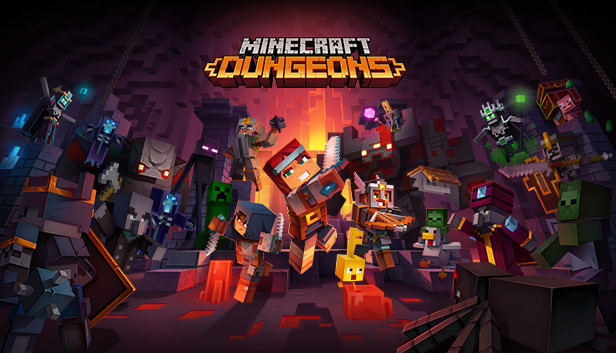
There is a moment on a narrow stone bridge above a lava pit where Minecraft Dungeons finally shows its hand. Four blocky heroes are crammed onto the span, an orange heat haze rolling underfoot, a knot of monsters jamming the far door while a straggler behind us still scoops up loot. The best thing about this game is not that it turns Minecraft into a grim dungeon crawler. It is that the game knows it should not try to be one. It takes farming, clearing, co-op, and level progression and serves each in a lighter portion. Less arithmetic. More immediate swinging.
Because of that lightness, its strengths arrive fast and its limits arrive just as fast. Lightning splits the night sky over a dark forest and suddenly the cube art has real theatrical punch, and then a few gear loops later you notice the systems are thinner than you hoped. It is exhilarating, and it is slim, often in the same hour.
This is not a fussy multi-course meal. It is a bucket of fried chicken, high on calories and easy on thought. With friends crowded around a screen it is genuinely delicious, but eat it alone deep into the back half and you start craving more seasoning, more depth, more reason to keep digging. The pages that follow weigh exactly that trade against itself.
Story | 5.5/10
Story: 5.5/10The main thread follows the Arch-Illager, a villain who stumbles into power and turns it on the world. The goal is clear, and so is the telling, almost to a fault. There is a beginning, a rising threat, and a final confrontation, and the plot moves between them in a straight line without much detour or surprise.

Glue Between The Levels
The narrative functions less like a story and more like glue between stages. It tells you why you are heading to the next place, hands your fight a background motive, and then steps briskly out of the way. That restraint is not unpleasant. At the very least it never plants itself in front of the loot loop or stops the momentum to deliver a lecture. The trade is that it leaves little behind. Think back a day later and you are more likely to remember which arenas overwhelmed you than any particular character beat.
Across the run, the Squid Coast opener through to the Highblock Halls climb all serve the same function, which is to keep the hero moving toward the Arch-Illager. They do it efficiently. None of them asks you to care about a personality, only about a destination, and the game is comfortable with that bargain even when it costs the campaign a memorable cast. The cutscenes that bookend the journey are brief and storybook-simple, narrated rather than acted, which fits the tone but rarely raises the emotional stakes beyond a children's-tale level of threat. It works as a frame, just not as a draw.
Where The World Speaks Instead
Environmental storytelling is the more effective channel by a wide margin. A plundered village, a shadowed forest, a dangerous dungeon each fill in a sliver of the world's state without a word of dialogue. In Creeper Woods at night, surrounded by the dead and lit by a burst of lightning, you do not need a script to understand that this is not a picnic. The art and the combat say a few sentences on the plot's behalf, and those sentences are enough to give the place weight, the kind of weight a paragraph of exposition would struggle to match.
That is the campaign at its best, and it is telling that the strongest narrative moments are the ones with no narration at all. The locations carry implied history. A toppled wall, a ransacked storeroom, the angle of light through a ruined doorway all suggest events you never see, and your imagination does the rest. It is a smart way to wring atmosphere out of a thin script, and it papers over a lot of the campaign's flatness. The best stages let you piece together a small tragedy from the wreckage alone, and that quiet inference does more for immersion than any spoken exchange in the game.
A Backdrop, Not A Reason To Return
The trouble is that the story itself is simply too slight. The Arch-Illager's motive and momentum cover the basic need for a villain to exist, but they never turn the journey into something you replay for its own sake. The impact on the experience is clear and specific. You will happily keep fighting, yet rarely because you want to know what happens next.
That is not fatal, because narrative was never this game's pitch. The pull has always been combat, loot, and company, and the plot is content to stand behind all three. It only looks weak by contrast. When the art, the music, and the level design are all working to make a cube world feel like a real adventure, the writing is the one pillar that lags behind, a placemat printed with lore that you glance at once and then clear away with the tray. Crucially, it never actively harms the experience. It stays out of the way, keeps the pace brisk, and asks for nothing, which for a farming-focused game is arguably the safer failure mode than an overwrought plot that keeps stopping the fun. You simply leave wishing the world it sketches had been given a little more to say, because the bones of an interesting setting are plainly there, just underused.
Audio | 7.5/10
Audio: 7.5/10The music never steals the scene, and that is a compliment. Minecraft Dungeons keeps the soft, open-air character of the original soundtrack but nudges the tempo a step toward dungeon adventure. It is the audio equivalent of giving a familiar old song a new live arrangement, the main melody still intact, only with the stage lights turned up a notch brighter.

Scores That Breathe With The Run
The dynamic mix is the smart part. While you explore, the score is in no hurry to flood the moment with emotion, leaving room for the quiet of a corridor or the open hush of a swamp. When a fight heats up, the percussion and melody rise to carry the pressure, lifting the tension exactly when the screen fills with enemies. Because the underlying systems are deliberately uncomplicated, the audio quietly takes on the job of signaling that the stakes are climbing, and it does that job with good timing rather than brute volume.
The late, high-risk levels lean into this hardest, and their music carries the most dramatic charge in the game. It suits the lightweight farming structure well. You are not meant to pause and admire a composition, you are meant to feel the room tilting toward danger, and the score reads that tilt and pushes you forward right when a push is needed. The transitions between calm and combat are smooth enough that you rarely notice the seam, which is exactly what an adaptive score should achieve. It guides the mood without ever announcing itself, letting the music manage your sense of risk while your eyes stay locked on the fight.
Ambient Detail That Builds The Place
Environmental sound design is just as important as the score, maybe more so. Mineshafts, dungeons, and villages would collapse into a string of interchangeable level skins if you could only tell them apart by sight. Sound restores the air that each place is supposed to have. Footsteps, the shuffle and growl of monsters, the crunch of a connecting hit, and the small incidental noises scattered through a scene all give the clearing process real layering. A hit sounds like a hit. Danger announces itself before you see it, and that audible warning is doing genuine combat work, not just decoration.
That feedback loop matters more in a game built around tempo and co-op advance than it would in a slower title. With four players talking over each other, clean attack cues and readable threat sounds keep the chaos legible. You can track what is happening to a teammate across the room by ear alone, which is exactly the kind of quiet support a fast clear depends on.
The weakness is consistency of memory. Plenty of melodies serve their scene capably and then evaporate the moment you leave it, so the soundtrack rarely leaves a specific, hummable impression behind. The problem is real but its impact is limited. The audio never lifts the game up a full tier the way a landmark score might, yet it also never drags. For a title that lives on clear-the-room pace and cooperative momentum, that is already a very practical, well-judged sound.
Visuals | 8.5/10
Graphics: 8.5/10The clearest win in Minecraft Dungeons is that the blocks were never abandoned. The team did not sand the original's low-resolution look into something glossier and unrecognizable. Instead they doubled down on cube texture, lighting, and biome contrast, so a single glance tells you this is unmistakably Minecraft, while a second glance tells you it has been staged like a piece of theater rather than left as a sandbox. That restraint is the smart call, and it carries every screen in the game.

Biomes That Read At A Glance
Scene legibility is the standout. Swamps, mountains, villages, mineshafts, temples, and canyons are not just the same corridor wearing a fresh color filter. Each region rebuilds the rhythm through terrain shape, light direction, and enemy placement, so movement feels different the moment you cross a threshold. In a ruined village you might find your hero wrapped in a golden shield bubble while distant archers keep pressing you forward, and in that instant the picture is not merely pretty. It is telling you the place has already been picked clean, that you are walking through an aftermath rather than a postcard. That is environmental information delivered entirely through art direction, and it lands without a single line of text.
The variety also keeps the eye from tiring. Because each notable location leans on a distinct silhouette and palette, the brain files them as separate places instead of one long brown hallway. It is a small thing that pays off across a full run, especially when you are several levels deep and still able to picture exactly where you fought a particular horde.
Lighting Does The Emotional Work
The lighting is where the presentation earns its higher marks. Lava radiates a believable heat. Lightning slicing through a dim chamber shifts the brightness in a way you feel in your shoulders, and colored projections layer the dungeons so they stop reading as corridors stacked from cubes. The trick is that none of this is showing off for its own sake. It is closer to clamping a desk lamp onto a model built from toy bricks. The structure has not changed at all, but the mood suddenly pours out of it.
That mood is doing quiet narrative duty too. A shaft of warm light falling across a battered doorway, the cool blue wash of a forest at night, the sickly green of a swamp all set expectations before any enemy appears. You read danger, or rest, or ambush, from the color temperature alone. For a game this committed to keeping its combat loop fast, letting light carry tone is an efficient, confident choice that asks nothing of the player while still shaping how each room feels.
It also scales nicely with the action. When a fight escalates, the lighting tends to escalate with it, flaring brighter as effects stack and dimming back down once a room is cleared. That ebb and flow gives the presentation a sense of pacing, so the screen feels like it is breathing along with the encounter rather than holding one flat exposure from start to finish. Small particle touches, embers drifting off lava or sparks trailing a struck enemy, add just enough motion to keep a static cube world feeling alive in the thick of a fight.
Where The Cube Language Caps Out
There is a ceiling, and it is honest to name it. The art's upper bound is set by the language of Minecraft itself. You cannot expect intricate material work or expressive faces to carry much weight here, because the building blocks simply do not bend that way. After a long enough session the sense of surprise tapers. New biomes still impress on first sight, but the vocabulary of shapes is finite, and you eventually feel its edges. Characters in particular stay simple, reading more as game pieces than as people, so the camera leans on environments rather than faces to carry any feeling.
None of that is fatal, and it is important to say so plainly. The goal was never photorealism or fine character acting. The goal was to take a familiar cube world and make it feel suited to an adventure, dramatic where it needs to be and readable everywhere else. Measured against that ambition rather than against a prettier rival, the presentation succeeds with real consistency, and it is comfortably the strongest pillar the game stands on. Even hours later, when the surprise has worn thin, the world still looks deliberate and legible, which is more than many busier-looking games manage to sustain across a full campaign.
Combat | 8.0/10
Gameplay: 8/10For the first half hour, Minecraft Dungeons feels almost too plain. You move, you swing, you fire off an artifact, you scoop up loot, and the loop is about as direct as an action game gets. There is no class screen to study, no twenty-minute tutorial to sit through, just a hero, a weapon, and a room full of things to clear. That bluntness is a feature, not an oversight, and it is the reason a newcomer can be useful to a party within minutes of pressing start.

When The Build Variety Clicks
The real fun only surfaces once you start swapping weapons, reading enchantments, and tuning artifacts. This is not the kind of depth that asks you to spend a whole night cross-referencing a spreadsheet of optimal setups. It is the lighter pleasure of noticing that a particular axe seems to invite a different playstyle, or that one enchantment quietly rewrites how you approach a packed room. Enchantments and artifacts are the entry point to a build, and they offer just enough rope to experiment without ever tangling you in obligation. Each weapon carries its own enchantment slots, so the same axe can become a crowd-sweeper in one run and a single-target finisher in the next, simply by spending your points differently. The system rewards curiosity rather than research, which keeps experimentation feeling like play instead of homework.
That looseness has a cost and a payoff. Compared with a heavyweight crawler like Diablo 3 and its sprawling progression systems, this game has no towering progression tree and far less late-game build pressure. You lose the long-haul obsession that hardcore farmers chase. What you buy in return is a remarkably low barrier. A friend joining for the first time does not need a lecture to contribute, and that accessibility is the whole point of the design.
The Rhythm Of The Clear
What the combat understands best is the spacing of gratification. Enemies arrive in waves, cooldowns are short enough to never feel punitive, and loot drops generously enough that you are always one room away from a small upgrade. Caught in an autumn wilderness, ringed by skeletons and evokers, you find dodging, crowd control, and counterattacks chaining into one another so your hands are never idle. It is short, it is brittle, and it is sweet, and that exact texture is what keeps a session moving.
Co-op is the amplifier that takes this loop somewhere the solo run cannot. Up to four players, locally or online, turn a quiet farming routine into a scramble for tempo. Half the time you are not even chasing the optimal play. You are diving to revive a teammate who rushed too far ahead, or rallying to shove a wave of monsters back together. It plays like a weekend board game night. The rules are simple on purpose, because the noise and the company are the real product.
The Cut That Defines It
The defining choice is what was left out. Minecraft Dungeons leans hard into action looting and keeps none of the mainline game's building or crafting. The decision is clean and a little ruthless at once. Players who arrive hoping for free-form creation will come away empty, while players who only want to hack through crowds and grab gear will feel right at home.
Whether that omission is a dealbreaker depends entirely on why you showed up. If you wanted a dungeon-crawler version of Minecraft, this is exactly on the menu. If you wanted a buildable take on the loot-crawler formula, it simply is not here. The game is honest about which appetite it is feeding, and within that lane the moment-to-moment combat holds up far better than its plain opening suggests.
The difficulty tiers are the quiet glue that keeps the cut from feeling thin. Clearing the campaign unlocks harder versions of the same levels, which raise enemy threat and sweeten the loot table in step, giving you a reason to revisit places you have already beaten. It is not the deepest endgame in the genre, but it gives the combat somewhere to go once the first run is done. Paired with the steady trickle of drops, those tiers turn what could have been a one-and-done campaign into a loop you can dip back into whenever the mood strikes, especially with a friend along to keep the pace lively. That, more than any single system, is what lets the streamlined design feel generous rather than bare.
Content | 6.5/10
Content: 6.5/10The base offering is not stingy. There are several distinctly themed regions, the enemies and drops vary between them, and a first run flows along smoothly. Pushing from the deck of a ship straight into a press of foes, the changing scenery carries enough freshness that you never feel stuck grinding one identical hallway. The levels do the work of laying track, and that initial momentum is genuinely satisfying. Each region also carries its own enemy roster and hazard set, so the threats evolve alongside the scenery rather than recycling the same handful of foes across every map. A first playthrough rarely feels like padding, because the game keeps introducing a new wrinkle before the last one has worn out its welcome.

What Brings You Back
Replay value rests mainly on loot drops, enchantments, and artifact combinations. Put another way, the levels pave the road, but the thing that actually pulls you back in is the promise that the next piece of gear might be more interesting than the last. It is a traditional design and an effective one. The hook is not the geometry of a stage, it is the slot-machine pull of the drop, and that pull is tuned generously enough to keep most players moving forward.
Co-op stretches that loop further than it would reach alone. Farming the same level grows tiring quickly in solo play, but with a party the fatigue is diluted by chatter, by reviving each other, by the casual division of labor. The same corridor you would resent on your own becomes a backdrop for a shared evening, and that social padding meaningfully extends how long the content stays fun. The loot itself becomes a conversation, too, as players compare drops, hand off gear they cannot use, and talk each other into trying a build nobody would have bothered with alone. That sociability is doing as much heavy lifting for replay value as any system on the screen, and it is the single biggest reason the same content can feel renewed on a second or third night out.
The Depth Gap
Set against a veteran like Diablo 3, though, the long-term drive is visibly thin. There simply are not as many layers to the systems, and the late-game farming goals are not anchored as firmly. The problem surfaces the moment you stop getting excited about new regions and stop rotating into fresh setups. Once that happens, the mechanical sameness of repeated levels floats up to the surface. Is it annoying? A little. Is it fatal? Not quite, but it is the honest ceiling on how long this will hold you.
The downloadable expansions help here without closing the gap. Packs like Jungle Awakens bolt on fresh regions and enemies, and the Ultimate Edition gathers the lot for players who want the full spread. They add breadth, and they are welcome, but they do not graft on the kind of seasonal, ever-renewing structure that mature peers in the genre now treat as standard. You get more game, not a different relationship with it, and that distinction is the whole story of the depth gap in a single line.
Built For Short Bursts
What all of this points to is a game best taken in short cycles. Pushing a few levels a night, or rounding up friends for a single evening, suits it far better than a long, high-intensity solo grind. A dungeon where enemies fire off beams while a pet holds the line beside you is a lively spectacle, but lively is not the same as endlessly farmable. The spectacle is front-loaded, and once you have seen each region's signature set piece a few times, the novelty that powered those early hours starts to flatten into routine.
The honest summary is that it has content and even some lingering aftertaste, just not the bottomless appetite that swallows hundreds of hours. Played in measured doses, with company, the supply feels ample and the pacing stays bright. Approached as a forever game to be ground into the ground, the well runs dry sooner than a dedicated looter would like. The healthiest way to treat it is as a rotation game, something you return to for a couple of levels between other titles rather than a single obsession that swallows your month. Handled that way, it stays fresh far longer, and the gap between its content and a marathon looter's stops mattering, because you were never asking it to be that in the first place. Set the right expectation going in and the supply lines up neatly with the experience the game is actually built to deliver.



Comments 0
We'd love to hear from you
Welcome! Share your take on this game — being first might come with a surprise.
No comments yet — share your thoughts on this review!