






















Opening
Northgard: Definitive Edition kills you with arithmetic, not armies. The first winter that wiped my settlement, I was thriving — woodcutters humming, a fame bar nearly spilling off the top of the screen — and then the cold arrived two loads of firewood short, and I watched the colony lie down in the snow one figure at a time. No last stand, no swelling music. Just the small, embarrassed sting of having miscounted a season.
That sting is the whole game, and it is why this Viking strategy from Shiro Games has moved two million copies and drawn three million players across seven years. Twenty-three critics on OpenCritic settled it at 79, a Strong rating; PC Gamer handed it 84 and called it one of the best strategy games of the last decade. The only verdict they share is that the story is dull.
What makes it strange is how patient it asks you to be. Most real-time strategy games reward the fastest hands; this one rewards the longest memory. The season bar crawls across the top of the screen like a debt coming due, and the player who started counting firewood two seasons ago is the one still standing when the snow falls. You do not win the early minutes here. You survive them, and then you spend the rest of the match collecting on the preparation you made before anyone threw a punch. It is a slower, stranger promise than the genre usually offers, and the rest of this review is an honest accounting of where the cold north pays it off and where it just leaves you shivering at the edge of the map, recalculating.
The Definitive Edition is why it is worth a fresh look. Shiro folded the Cross of Vidar campaign and the once-paid Snake, Dragon and Horse clans straight into the base game, free for anyone who already owned it. If the name is all you know, this is the most complete and lowest-barrier version that has ever shipped — and what follows is exactly who it hooks for hundreds of hours, and who it quietly sends away.
Story | 5.8/10
Story: 5.8/10Come to Northgard: Definitive Edition for a stirring Viking saga and you will leave hungry. The story is not so much a weak point as an absence of ambition, and the verdict is unusually unanimous: PC Gamer flatly called it a very dull story, and the wider OpenCritic consensus keeps circling the same phrase. Storytelling is the one thing every critic agrees to dock, and I scored it 5.8 — not because the game fumbles the narrative, but because it never really tries.
A campaign that teaches instead of tells

Open the Viking expedition campaign and what is billed as a tale of vengeance and northern conquest plays like an instruction manual cut into missions. One chapter walks you through logging and food, the next through fighting wildlife, the next through trade and diplomacy — each level hands you a mechanic or two and parades the military, trade, lore and fame victory paths past you in turn. As teaching, it works: a newcomer leaves with the full vocabulary of the game. As fiction, it barely shows up. Cutscenes are a few lines of text over a still image, the characters have no interior life, and the revenge thread advances with the warmth of a checklist. The Cross of Vidar campaign that the Definitive Edition folds in is set in a post-Ragnarök wasteland, a premise with real imaginative pull, yet it too spends its energy onboarding new systems while the narrative stays a thin coat of paint. You can feel Shiro deciding it has no business pretending to write screenplays, so it simply doesn't.
The names blur together within an hour, the stakes read as administrative rather than personal, and the climaxes land as mechanical checkpoints instead of dramatic turns. Finish a mission and the feeling is closer to passing a lesson than living a chapter of an epic. A genuine saga would have given those beats weight, some reason to care beyond the tooltip explaining the next system. Here the fiction is a courier for the tutorial, and once the lesson is delivered the wrapping is quietly set aside. It is competent teaching in saga clothing, and judged purely as instruction it does the job, but nobody finishes the campaign quoting a line of dialogue or mourning a fallen jarl. What they remember is the level where they nearly starved.
The real saga is the one you compute

Strip the scripted plot away, though, and the game is full of stories. A match tends to narrate itself: you grab a starting region flush with deer and iron, sprawl your economy with smug confidence, and then a neighbour's Snake clan guerrillas slip in and gut the fishing wharf you never garrisoned. You rebuild, only to find winter has come early, the granary is bleeding out, and you are selling the weapons you spent an hour stockpiling just to buy grain. That loop — prepare, get blindsided, live with the consequences — sticks harder than any written line, and the season-and-winter system is its engine. Northgard does not script your drama; it sets rules brutal enough that your own decisions become the drama, then makes you watch them ripen. Set it beside something like Civilization VI, which leans on leader personalities and civ identities to make you feel you are authoring a chapter of history, and the gap in ambition is obvious — the Dragon clan wages war through slavery and human sacrifice, a setup dripping with potential, yet the game tells no story around it; it is a stat block, not a character. That is not a failure so much as a refusal, and the upside is real: the game never yanks you out of the arithmetic with a long cutscene, so the pacing stays clean. Just bring your appetite for systems, not for sagas, and you will see what it is actually good at.
For players who genuinely want a story-driven campaign, then, this dimension stays thin, and there is no honest way to dress that up. But the trade has its logic. A heavier narrative would have demanded pauses where you wanted momentum and scripted drama where you wanted to write your own, and plenty of strategy games stumble precisely because they insist on telling you a tale while you are busy living one. Northgard has the discipline to stay out of its own way, and once you stop asking the campaign to be an epic it was never built to be, you walk out into the sandbox where the real sagas wait, one frostbitten match at a time.
Audio | 7.8/10
Audio: 7.8/10The sound design in Northgard: Definitive Edition is built to keep you company while you think, not to grab you by the collar. That suits a game of slow board-game calculation perfectly. It never swells up to announce an epic moment; it sits quietly in the background and only leans in when you need it to. I gave the audio 7.8 — restrained and capable, just short of a melody you would actually remember.
A Norse score that sets the mood without stealing the scene

The opening music is spare and faintly cold, a few strings under a thread of wordless chant, and it nails the loneliness of starting from nothing on a strange continent. It does not tug at you; it lays down a quiet floor so you can lose yourself in shuffling villagers between the lumber mill, the farm and the fishing wharf. In a game where a single session can run two or three hours, that restraint is a feature, not a shortfall — anything more insistent would wear thin long before the final winter.
As the match heats up and resources tighten or war escalates, drums and strings rise underneath you and your pulse climbs with them. The score is coupled to the rhythm of play: when the season bar is bearing down on winter and you are scrambling to stockpile wood, the music quietly amplifies the dread you already feel. It is a smart, decision-serving design — the only catch is that it stays at the level of atmosphere and never produces a single theme you would pull out to loop on its own.
There is a craft to that anonymity, even so. A score you can hum is a score that eventually competes with your own concentration, and Northgard would rather lose the awards than lose your attention to a hook. After a dozen matches you stop hearing it the way you stop hearing rain on a roof, and that, paradoxically, is the highest compliment its restraint could earn.
Ambient sound is the part that actually works
If the score is the backdrop, the ambient effects are the most informative sound in the game. When the wind and snow grow loud, you instinctively glance at the granary and the woodpile, because you know winter's footsteps are hidden in that gust. Wiring your ears straight into survival pressure like this is more natural than any pop-up warning. The labour sounds of chopping, mining and building gather into a rhythm over a long match, a little like the overlapping clatter of keyboards in an office, a constant reminder that the whole village is still turning over.
The campaign audio is the weaker stretch — events and music meet a touch flatly, with no dramatic peak to hang onto, which is the same root as the thin story: it was never meant to narrate through sound. Back in skirmish and custom matches, though, the whole soundscape keeps its weight on accompanying your math. It does not fight for your attention; it slips you into that focused, faintly sweaty-palmed state of staring at a progress bar. For a game built on calculation, that is exactly the right instinct — you can hear time slipping away without ever being shouted out of your own thoughts.
Visuals | 8.0/10
Graphics: 8/10Northgard: Definitive Edition does not impress with horsepower; it impresses by talking to you. A clean, cartoon-leaning art style and a restrained weather system turn the map into a board that is constantly telling you something — where it is getting cold, where it is dangerous, where you should go — rather than a landscape painting that just wants to be admired. I scored the visuals 8.0: strong on identity and readability, merely modest by today's technical bar.
A readable board, not a tech demo
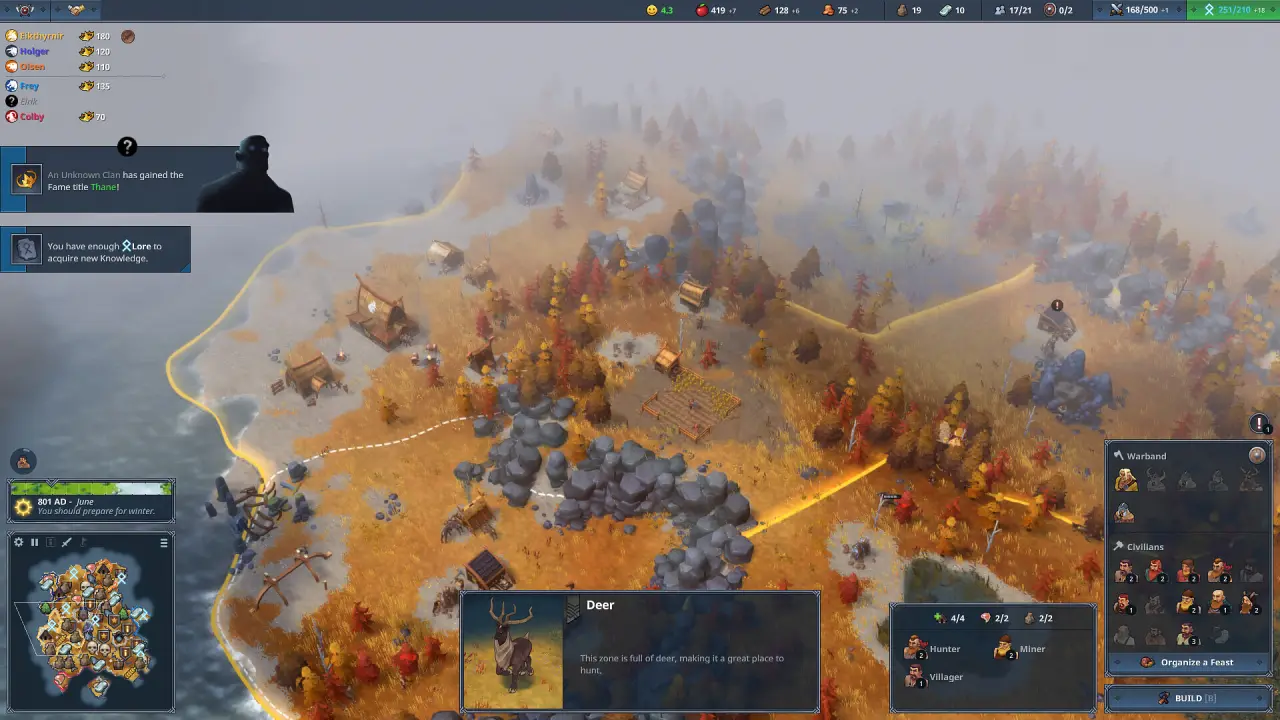
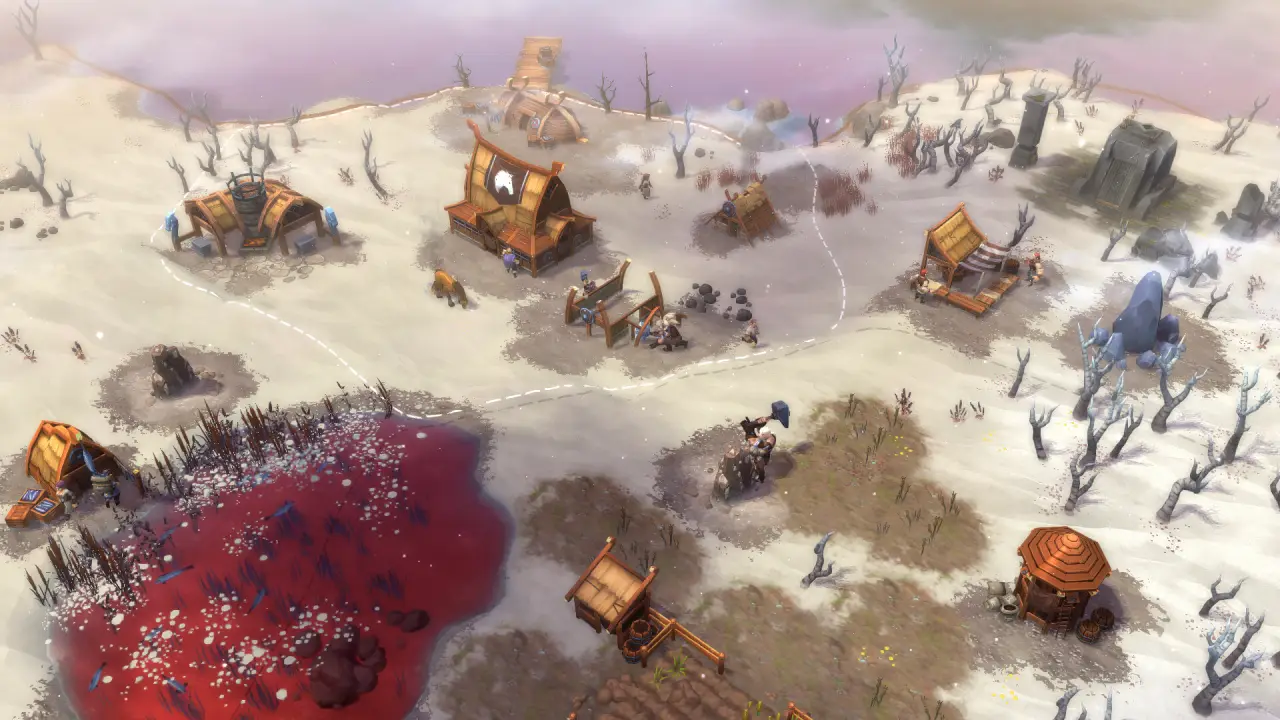
The look is built on tidy low-poly models lit with semi-realistic light, as if someone reshot those nineties history-themed strategy games on modern rendering stock. Buildings, villagers and terrain are stylised just enough to read at a glance — you can tell a lumber mill from a farm from a barracks without squinting — and that legibility is the whole point. There is no ray tracing, no 4K texture flex, and that is a deliberate, intelligent trade. In a strategy game where you spend hours scanning the entire map to make decisions, photoreal detail would only add visual noise.
Shiro spent its art budget on making information instant rather than on rendering a single hero's pores, and it pays off precisely in the moments you do not notice. When you are rapidly claiming three tiles in a row, the region borders, ownership shading and resource icons are bold enough that you never have to lean in and ask whether that patch is an ore vein or a hunting ground. Better still, the style ages gracefully and holds up across a punishing spread of hardware, from PC down to PS4, Xbox One and the Switch, where it never buckles on the handheld.
There is a quiet sophistication to choosing this over spectacle. A more realistic engine would have demanded constant performance compromises across that hardware range and, worse, would have buried the data you actually need under foliage and ambient clutter. By keeping its silhouette clean and its palette legible, the game lets you read the entire board at a glance even when six clans are sprawling across it at once. The buildings carry just enough Norse character — turf roofs, carved beams, longhouse proportions — to feel rooted in place without ever costing you a moment of comprehension. It is art directed by a strategist, not a cinematographer, and the discipline shows in every frame.
Weather as the visual layer of the rules

If there is one visual highlight, it is the turn of the seasons. Autumn washes the whole map in gold; winter crushes it down into grey-blue, and the air genuinely seems to change temperature. This is not a filter — it is fused to the season-and-winter pressure system, the picture using colour to warn you that the lethal part is arriving and to send your eyes back to the granary. Art here is not decoration; it is the visual interface of a mechanic, and that winter grey tightens in lockstep with your food and firewood readouts, so the screen going cold and your nerves going taut happen in the same beat.
The rest of the weather is just as disciplined, separating environments through fog, light and colour temperature instead of showy particle effects; on a fog-shrouded island map where you cannot see the whole board, a village campfire at night becomes a genuine psychological anchor, the one warm point of light you steer your scouts back toward when the dark closes in. That single design choice — letting light and shadow carry information rather than mere mood — is what gives the exploration its quiet, atmospheric weight. The interface and localisation are quiet bonuses on top — resource counts, the season bar and territory status all sit where you can find them, and the long-standing official Chinese support keeps the barrier low for that audience. The marks against it are purely technical: by current standards the unit animations and building destruction look symbolic, and there is no unforgettable cinematic set piece, because the game never aimed for one. Its beauty is functional, always in service of the strategy rather than the screenshot, and once you are deep in a match you stop noticing the difference at all.
Combat | 9.0/10
Gameplay: 9/10Gameplay is the soul of Northgard: Definitive Edition and the sole reason it earns a 9.0. It does something most real-time strategy games never dare: it puts the contest of fast hands away entirely and swaps in something close to a board game. When Gamereactor handed it a 9 it reached straight for Catan, noting that here trade and exploration matter as much as crushing a foe in battle — a line that pins the whole thing down. The real fight happens in your head, not under your mouse.
Tiles, ledgers and a countdown to winter

The bedrock is a clever piece of board-game logic. The map is built from tile regions, each one a card scrawled with resources, wildlife and terrain, and you do not open by rushing troops out the gate — you stuff villagers into the lumber mill, the farm and the fishing wharf and build a self-sustaining economic loop, snapping pieces together like Lego until the machine runs. The season-and-winter system then lays a countdown over the whole match: the bar at the top of the screen creeps toward winter, when villagers burn double the firewood, farms stop producing, and the wildlife turns nastier. So you start doing the math in autumn — is this much grain enough to outlast the cold, is the woodpile high enough, should you grab that iron-rich region while the warm season holds.
Claiming territory is where the tension lives. Every tile you take charges you something: military upkeep to police it, extra mouths straining the food supply, maybe a pack of beasts squatting on it. Expand now and you are stretched thin; wait until after winter and a neighbour may snatch it first. Northgard takes the most reflexive act in the genre — expansion — and turns it into a real decision you weigh every single step. Better yet, the calculus shifts with the season: a tile that is a bargain in summer becomes a millstone the moment the cold bites, because every extra region is another mouth to heat and feed through the freeze. The hard lesson of overreaching almost always gets taught by that first winter, and you only need it once.
Four win paths and a roster of clans

Replayability comes from stacking multiple victory conditions onto distinct clan traits. Military, trade, lore and fame run in parallel, each demanding a completely different growth plan: military wants you hoarding gear and population early, trade has you nursing ports, markets and diplomacy, lore pushes you to swallow tiles studded with ruins and stone circles. It plays like a deckbuilder — draft early, harvest late — and your opening choices decide which way the snowball rolls.
The clans pile another layer on top. The Snake clan the Definitive Edition folds in specialises in guerrilla raids, the Dragon clan wages brutal war through slavery and sacrifice, the Horse clan builds around its twin warchiefs, and each plays like a patch to the rules so that swapping clans means swapping playstyles entirely. Add the lore-and-fame talent nodes you unlock with fame, and a single map can be played as several different games — the same starting tile demanding a raider's aggression one run and a trader's patience the next. This is the smartest piece of differentiation laid over a standard RTS frame, and it is what keeps veterans drafting new combinations long after the novelty of the base game has worn off.
Slow is the flavour, and the filter
The honest caveat is that the slowness cuts both ways. Anyone raised on Age of Empires II — scouting at the gate, hitting Feudal in three minutes, finding the rhythm through early raids — will find almost none of that high-frequency sparring here; the first ten-plus minutes are heads-down economy. When both players turtle, the mid-game can sag into a standoff where neither wants to be the first to feed itself into a resource black hole.
It is not a fatal flaw, but it is what makes this a long game of chess rather than a fast-food fix. The saving grace is that, much like Banished, it manufactures a distinctive tension out of seasonal survival. Even staring down a quiet AI on a peaceful map, just watching winter close in tile by tile is enough to dampen your palms. Northgard trades part of the strain of fighting an opponent for the strain of fighting the environment — and the latter stands up without any reflexes at all. Make peace with that tempo and it consumes you; reject it and it will only feel like a slog. The line could not be cleaner.
Content | 8.5/10
Content: 8.5/10Content is the dimension that changed most this time around. Northgard: Definitive Edition was always a game that lived on replay value, and bundling seven years of paid additions into the base game — free for existing owners — pushes its bulk to the ceiling. I scored content 8.5: the campaign is the soft spot, but the real time sink was never in the campaign.
The campaign is short; the sandbox is bottomless

Clear the Viking expedition and Cross of Vidar campaigns once and yes, it is not long — a dozen-odd hours combined, and as noted they play more like functional tutorials. That is simply not where the volume is. The mass is hidden in custom skirmishes, multiplayer and the Conquest mode: per the Steam page, Conquest alone offers 100-plus hours of solo or co-op play, on top of Bifröst four-player co-op, PvP and PvE, and a map editor for building your own battlefields.
Put plainly, the campaign is the appetiser you finish so the main course can begin. The 84 percent overall Very Positive rating, the fifty-thousand-plus reviews, the two million sales and three million players are not the trace of people replaying a story — they are the trace of people pouring hundreds of hours into the sandbox. That is the right yardstick for a game like this: judge it by the volume of the systems, not the length of the scripted line, and the picture flips from thin to enormous. A single Conquest run can outlast an entire ordinary campaign, and the map editor quietly hands the community a tap for fresh scenarios that never runs dry.
Clans and random maps, a fresh hand every game

The replay engine has two sources. First, clan traits: the Snake, Dragon and Horse clans the Definitive Edition pulls in each bring different starting resources and growth leanings, a deeply modular toy box where this match's guerrilla Snake becomes next match's sacrifice-fuelled Dragon, and the experience flips. This is exactly why the Chinese player community treats clans-plus-multiple-victories as the main replay driver, talking almost entirely about clan opening strategies and never about the plot.
Second, random maps stack variance on top: resource distribution, wildlife placement and neighbour distance change every game, so each opening is like drawing a new board. Layer the four victory paths over that and you will rarely play two identical matches. Against the open-ended survival of something like Banished, Northgard adds a sense of purpose — you are not endlessly maintaining, you are sprinting toward a defined win condition, watching that bar inch upward, which is what turns "one more run down a different path" into a reflex. The combinatorics do the heavy lifting here: any clan crossed with any victory path crossed with any random seed produces a match that feels meaningfully its own, and that arithmetic of variety is the real reason players stay for years rather than weeks.
The Definitive Edition makes "owning it all" simple
The headline value is consolidation. The Cross of Vidar campaign and the Snake, Dragon and Horse clans — content that once cost extra, item by item — are now inside the base game, free to anyone who already owned the original. New players walk in with the most complete version there is, with no long and confusing DLC list to agonise over, and veterans simply pocket a generous clutch of clans and a whole campaign for nothing.
The one persistent weak spot is, again, the campaign: its level design reads as a chain of unlock-the-next-mechanic lessons rather than a stage for flashy play or memorable storytelling, and the thin narrative drags here too. None of that dents its standing as a long-haul strategy game. Seven years of support from 2018 to the 2025 Definitive Edition, alternating clan packs with free major updates such as Sword & Solace and Trials of Odin, is on the record, and multiple outlets framed this release as its final big epic update — a clean full stop on a very deep well of content. For anyone willing to live in the custom matches and multiplayer, it is a buy-once, play-for-years proposition, and the Definitive Edition makes that bargain more generous than it has ever been.




Comments 0
Share your game review
Join the discussion and share your review of this game.
No comments yet. Share your thoughts on this review.