























Opening
Most remakes ask you to remember an old game. Resident Evil 2 asks you to be afraid of a city again. Capcom dug the 1998 Raccoon City outbreak out of memory and rebuilt it inch by sodden inch — the dripping corridors, the stuttering emergency lights, the shape you can't quite name behind a door that won't stay shut. This is not a faithful retelling of a plot. It is a faithful reconstruction of a feeling: the one where your own breathing gets loud.
The remake drags the series back from the action-spectacle direction of Resident Evil 6 and plants it in scarcity. The camera drops to an over-the-shoulder frame, your supplies always run one notch short, healing herbs never quite stretch, and every decision becomes arithmetic — slip past the thing in the hallway to save a couple of resources, or backtrack the whole wing the safe way. Then a relentless pursuer in a trench coat starts pacing the floor above you, and the arithmetic curdles into a chase.
It is not flawless, and it never pretends to be. The dual-perspective story has visible seams, and the second campaign repeats itself until enthusiasm leaks away. But on the one thing that matters most — manufacturing pressure out of space and shortage — it reaches a height the genre still struggles to match. A Metacritic of 89, an OpenCritic average of 92, a 97 percent positive rating across more than a hundred and forty thousand Steam reviews: those numbers are not nostalgia glasses. They are the reward for survival design polished to the edge of cruelty, and the reason this game is the pivot on which the series came back to life.
Story | 6.5/10
Story: 6.5/10Two strangers, one collapsing night

The clock is nailed to September 29th, 1998, two months after the Spencer Mansion incident. A strain of the T-virus seeps into Raccoon City's water supply, and the city comes apart in a single night. Leon Kennedy is a rookie cop on his very first shift, still unsure which way the precinct doors swing. Claire Redfield is a college student who came looking for her brother Chris and walked straight into the end of the world. Two people who should have passed each other on the street are trapped instead in the same building, on the same worst night of their lives.
What the remake gets right is restraint. It does not open with a lecture of lore and acronyms. It lets you meet your first wrong-looking figure in the convenience store of a gas station, then lets the locked-down precinct quietly inform you that there is no longer a way back. Dread here is never announced; it is walked into, one footstep at a time. That is the storytelling instinct that separates it from much of its survival-horror generation — the fear arrives through your feet, not through a cutscene.
The real engine driving the whole catastrophe is the G-virus, developed by the scientist William Birkin. It is the prize every faction is grasping for and the source of every confrontation in the back half. Around that single MacGuffin the fates of Leon, Claire, Ada Wong, and Sherry Birkin are strung onto one thread; everyone wants it, and everyone is changed by it. The plot keeps its scope deliberately small — this is a story about two ordinary people learning to survive a single night, not a sprawling conspiracy thriller — and that smallness is a feature, because it keeps the focus where the game is strongest.
The split, and the weight of the second seat

The dual-protagonist structure is the script's signature idea. You pick one survivor for your first run, and the two paths overlap on the shared stage of the police station before splitting into private wings, different enemy placements, and separate supporting roles. Leon's route brings in Ada Wong, an agent of murky loyalties, and a stretch where you play Ada and reach across a gap with a hacking tool. Claire's route brings in Sherry Birkin, William Birkin's young daughter, and a section where you escort a frightened child through the most dangerous ground in the game.
Those companions are not set dressing. Ada's flirtation and double-dealing tint Leon's road with espionage; Sherry's fragility pulls Claire's into something close to maternal panic. The gameplay flips with them — ranged pressure one moment, defenseless stealth the next — and that is what makes the two campaigns feel genuinely distinct rather than reskinned. Clearing one protagonist unlocks the 2nd Run for the other, an in-theory mirror that sends you through a side door to finish the half of the truth you missed.
Where the mirror cracks

And the mirror is exactly where the design fractures. The original interlocked its two orderings so that items and events dovetailed across both runs. To let the remake be played in any order, that careful clockwork was removed, and the cost shows: the 2nd Run overlaps so heavily with the first that, beyond a few protagonist-specific beats, large stretches read as copy-paste. The novelty drains fast somewhere around your third lap of the same station.
The logical seams are worse. Leon and Claire barely share a frame, yet they speak and behave as if they are old friends, and their meeting on the train inflates that "intimate strangers" dissonance until the scene goes quietly awkward. Chinese outlets singled this thread out specifically: once the multi-perspective story loses the interlocking design that once justified it, clever slides into merely workable. Hold it against the series timeline and the picture sharpens — next to the later Resident Evil 3 and Resident Evil 4 remakes, this one's narrative ambition is modest. Its real strength was never the plot. It is the bodily fear stacked up while you pace that building. The story is the vessel, not the star; understand that and the crack stops being a dealbreaker, though it never stops being a crack.
Audio | 9.0/10
Audio: 9/10Fear you can hear

If the visuals tell you what the danger looks like, the audio tells you where it is and how close. It is the most underrated link in the whole chain of dread, and the most lethal. In a dead-silent corridor you can place a low moan to the left or the right, behind a closed door or already in the room with you. Sound here is built as locatable, layered information, not as background mood.
That soundscape rewires how you move. You stop and listen on instinct — is something stirring in the records office ahead, is the corner empty or occupied. The groan of the infected, the panting of a hunting dog, the drip echoing down a metal pipe; each one helps you sketch an invisible map of threat. Plenty of times you reroute out of pure fear before you have seen a single enemy, which is precisely the effect the designers were chasing.
The mix rewards a good pair of headphones in a way few horror games do. Directionality is precise enough that you can tell whether a shuffle is one room over or two, whether it is coming from above or from the floor you stand on. The game weaponizes that precision constantly, letting a small, distant noise plant a seed of dread that blooms long before any threat is actually in front of you.
The footsteps that never stop

The most famous sound in the game is, without contest, the stride of the trench-coated pursuer. Thud. Thud. Thud — steady, even, in no hurry at all. Its horror is not the jolt of a jump scare; it is the composure. You hear it pacing the floor above, hear it taking the stairs one deliberate step at a time, hear its direction closing on yours, and you cannot put it down. The sound is not decoration; it is the mechanic. You navigate by ear, then choose between holding your breath to slip past or abandoning the puzzle to run.
The same principle drives the fast enemy that locates you by noise and reacts to anything standing and moving. It barely sees, but it hears your steps, and it forces you to crouch, soften your movement, and thieve your way across its territory. Audio and stealth here are grown together at the root.
There is craft in the silence between those footsteps, too. The pursuer's theme does not blare; it lurks, swelling only as the distance closes, so that the music itself becomes a proximity gauge. You learn to read the audio the way you read a radar, and that learned literacy is what turns a simple stalker into a sustained psychological siege.
Restraint, and a shelf of awards
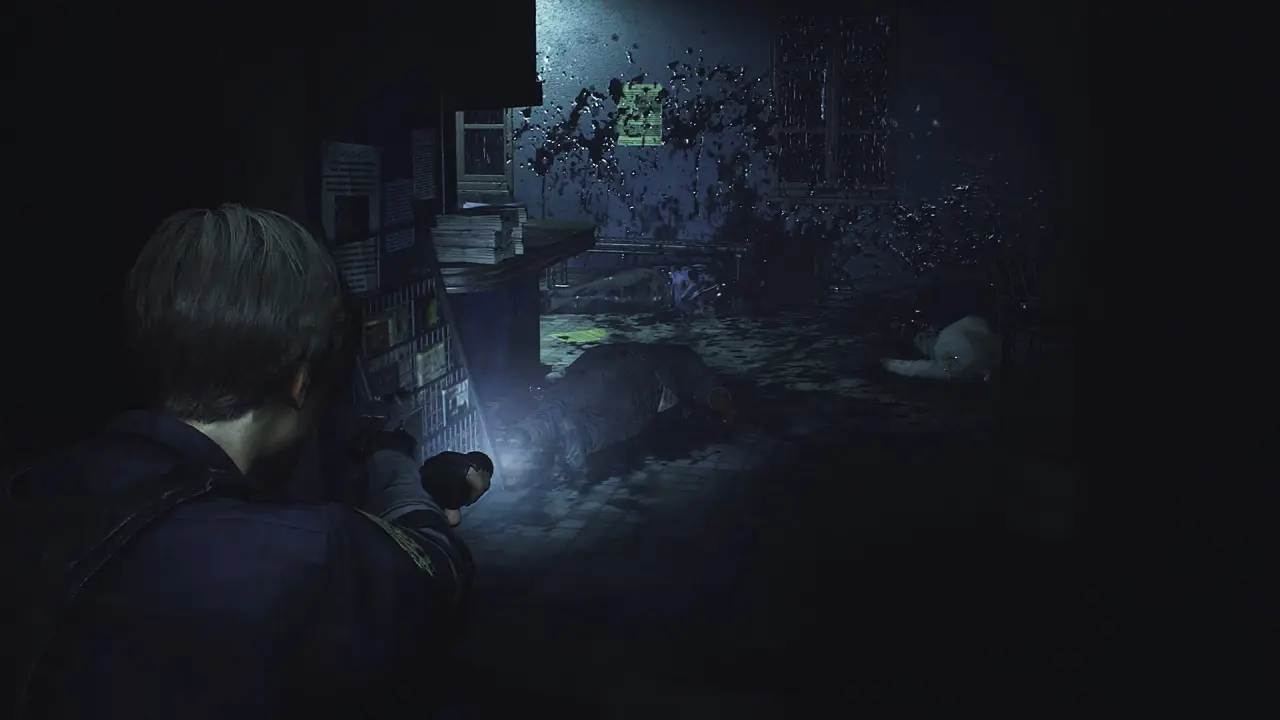
The score, led by Shusaku Uchiyama's team, shows rare discipline. It does not smother the horror in wall-to-wall strings; it leaves space, and many of the tensest passages are near silent, just your footsteps and that distant something. Only when a confrontation truly breaks does the music slam in. That quiet-to-eruption swing gives the pacing room to breathe — the music serves the beat of the scene rather than crowding it out. Because Capcom used a non-union cast, the original voice actors did not return, yet the performances hold steady and the localization carries its weight across every supported language. The proof landed on the awards table: Best Audio at the 2019 Golden Joystick Awards and a nomination for Best Audio Design at The Game Awards. Against the horror benchmarks of its day, this is a textbook case of building pressure out of sound — which is why so many players will tell you to play it in headphones, in the dark, alone, with the volume up just high enough to catch every distant footstep before it finds you.
Visuals | 9.0/10
Graphics: 9/10Raccoon City in the RE Engine
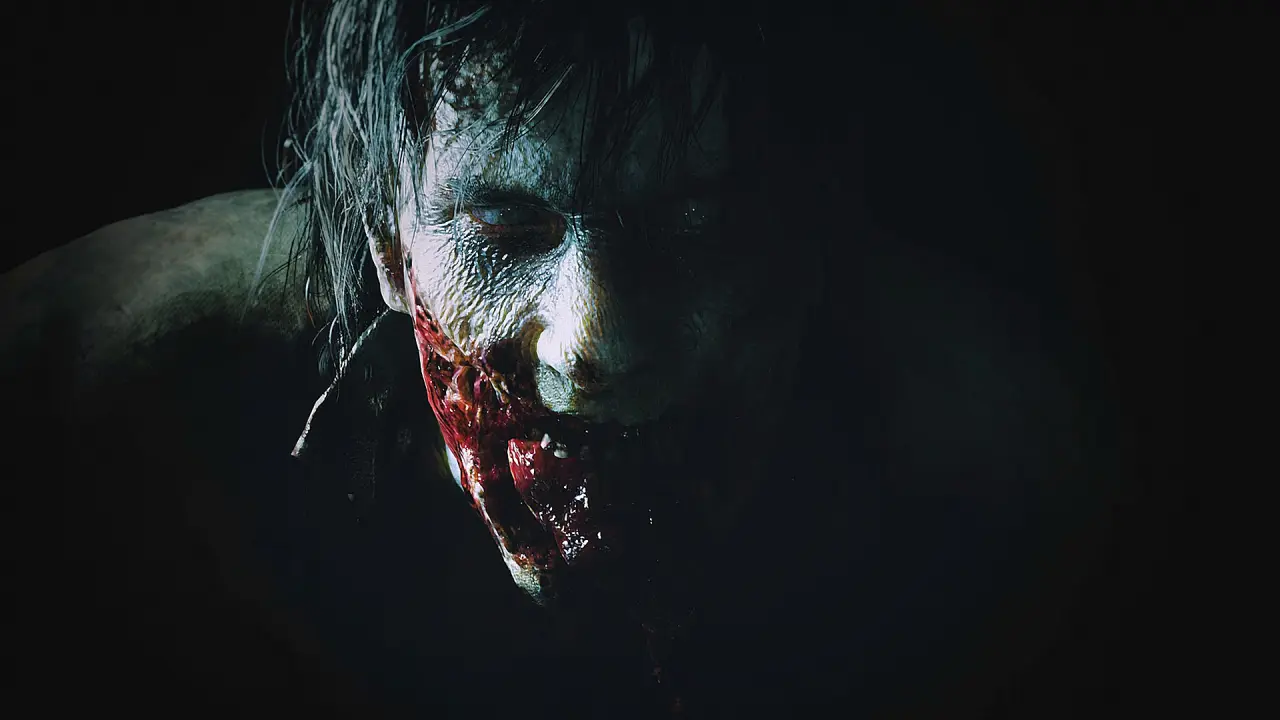
The remake runs on Capcom's in-house RE Engine, the same tech behind Resident Evil 7. Its great trick is rendering two things that are notoriously hard to put on screen: wet and dark. Rain-slicked asphalt throwing back the streetlights, standing water pooling in the precinct lobby, the mottled grime crawling up a corridor wall — pile those details together and Raccoon City stops being a horror backdrop and becomes a place you believe in and genuinely do not want to linger in.
Lighting is the soul of that visual storytelling. Vast stretches of the game are dim or pitch black, and you sweep a flashlight ahead of you so that only what the beam touches exists; everything outside it is open unknown. That "light it yourself" design hands the visual insecurity straight to the player. You only ever see a sliver, and your imagination fills the rest — and imagination is reliably scarier than anything modeled. The cone of the flashlight is, by itself, a piece of horror design.
The art direction leans hard into texture rather than spectacle. Surfaces look used and abused: peeling paint, water-stained ceilings, the dull sheen of old institutional tile underfoot. Nothing gleams for the sake of gleaming. That commitment to believable decay is what sells the precinct as a real building rather than a haunted-house set, and it is why a room can frighten you simply by looking like somewhere awful has already happened in it.
Faces, and the damage beneath them
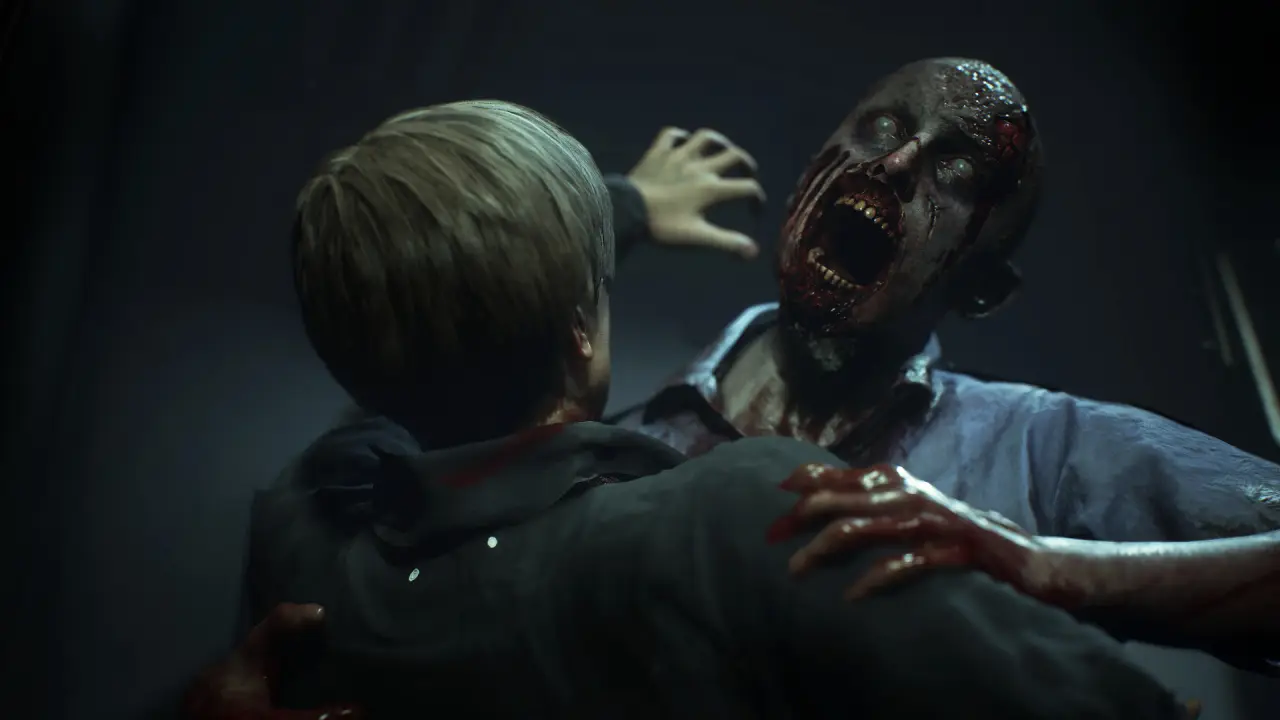
Leon, Claire, Ada, and the trench-coated pursuer carry the best character modeling the series had managed up to that point. Capcom built them from real-model scans — Leon from the actor Eduard Badaluta, Claire from Jordan McEwen — and paired with the engine's fine subsurface skin scattering and micro-expressions, the cast finally had faces that could hold a close-up. You read concrete emotion in Leon's first-shift nerves and Claire's worry for her brother, and it stands shoulder to shoulder with the performance-driven games of its generation.
More telling is the limb damage on the enemies. The infected do not simply drop when hit; they register feedback precisely at the point of impact. An arm shot away leaves one staggering and shifting stance as it keeps closing, and a body on the floor may haul itself upright again. That granular physical response gives every ranged hit a sense of weight — you are not plinking a target that vanishes, you are wearing down an opponent that visibly breaks yet stubbornly refuses to quit.
This modeling does real systemic work, not just spectacle. Because damage is local and persistent, you start aiming with intent — a knee to slow a charge, a head to gamble on a quick stop, an arm to buy yourself a window to slip by. The visuals and the survival math are the same conversation, and reading an enemy's condition at a glance becomes a skill the whole loop quietly depends on.
Versions, options, and the long polish

At launch the game already won people over with solid optimization and dense visuals, and Capcom kept refining it. A native PlayStation 5 and Xbox Series version arrived on June 13th, 2022 with 4K resolution and higher frame rates, and a patch the next day added ray tracing and 3D audio, sharpening water, glass, and light sources further — at the cost of removing DirectX 11 and forcing DirectX 12, which left a handful of older rigs to adapt.
The interface deserves a nod too. Inventory and map readouts are clean and immediate; explored and unexplored areas, opened and unopened doors all sit plainly on the map, which matters enormously for a game built on backtracking — you never break the carefully wound tension just because you got lost. Subtitle and aim-assist options soften the on-ramp for players of different skill, giving a hardcore survival loop a relatively welcoming door. Whether it is the depth of the engine tech, the nuance of the character work, or the steady post-launch upkeep, the visuals plant this firmly in the front rank of its generation's horror — and that is why it still holds up to a look years on.
Combat | 9.5/10
Gameplay: 9.5/10Over-the-shoulder, and never enough to go around

The remake throws out the original's clumsy tank controls for a modern over-the-shoulder frame — but do not mistake modernization for mercy. Aiming is more precise, so the designers simply clamped the resources tighter to compensate. The core loop here was never about spraying fire; it is resource management. You carry eight base inventory slots, widened slowly by hip pouches, and your ranged supplies, green herbs, key items, and the puzzle pieces you pick up all have to fight for that handful of squares.
So every encounter becomes a sum. The infected blocking the hall — do you spend two rounds of ranged fire to put it down, or hug the wall past it and bank the bullets? Your pack is full: do you drop a tube of herbs to make room for a key, or run back to the safe room to reorganize first? Crueler still is the adaptive difficulty, which quietly watches your performance and tightens supply drops when you play too cleanly, holding you forever at barely-enough. That sustained anxiety, manufactured by shortage, runs far deeper and lasts far longer than any cheap startle — a point Chinese outlets like 3DM hammered home: the essence of this game is resource management, not scares.
The pursuer that turns puzzles into a chase
If a single design has to capture this game's genius, it is the trench-coated pursuer. Its rule is brutally simple and brutally exhausting: it cannot truly be killed. Empty everything you have and the best you manage is dropping it to one knee for a few seconds before it stands and resumes its unhurried pace behind you. It tracks your position across nearly every area outside the safe rooms, and so the entire station turns into a moving field of threat.
The brilliance is how completely it rewrites the act of solving puzzles. You used to be able to stand calmly at a door studying a medallion lock; now you work it with one ear cocked to that stride, calculating how long until it rounds into this corridor. It injects a static "explore-and-solve" rhythm with the live pressure of "chase-and-flee," and time itself becomes a resource you have to manage. Set it beside The Evil Within 2, the contemporary survival horror from Shinji Mikami's hands: that game spreads its fear across relatively open spaces for you to maneuver in, and it lacks exactly this — the suffocation of an unkillable thing closing on you, step by step, inside an enclosed maze. This is the single hardest thing about it to copy.
A vertical maze, and the ritual of saving
The police station itself is a masterpiece of level design. It is not a linear hallway but an interlocking vertical maze: three medallions — ruby, spade, club — assorted keys, hidden compartments, and mechanisms, all sealing the building in layers. You backtrack again and again, burning the map into muscle memory, before you slowly pick its structure apart. That looping exploration, married to the cramped inventory, forces you to plot the shortest route, remember what is still locked and what loot is still waiting — pure, high-grade level craft.
The save system keeps the series' ritual intact: you reach a typewriter in a safe room to record progress. On standard difficulty saves are unlimited, but on Hardcore each one burns a precious ink ribbon, so "do I save now" becomes its own resource decision — save too soon and you waste the ribbon, too late and you may lose a long, careful stretch of progress to a single mistake.
From the basics of a hit decision, to the intermediate art of route planning, to the high-level pursuit of a flawless clear, the systems are tiered cleanly: easy to enter, bottomless to master.
Newcomers feel their way through the trade-offs on standard, while veterans squeeze every round of fire and every second of time on the harder settings, chasing S-rank clears that demand near-perfect routing and almost no wasted resources. That "simple to pick up, hard to perfect" philosophy is what lets the game pull in first-timers and battle-worn fans alike, and it is the sturdiest foundation under everything it does.
Content | 8.5/10
Content: 8.5/10Main length, and the hurdle of repetition
Taken as a single campaign, this is not a long game — HowLongToBeat puts a median run around nine hours. But Resident Evil 2 was never measured by length, and its content math runs differently. Leon and Claire each have a main route, plus a 2nd Run apiece, which on paper is four playthroughs; chase the perfect ratings and unlock every mode and a completionist run stacks up toward forty-seven hours. For a modestly priced single-player release with no live-service hooks, that is a substantial body of work to put in front of a player.
The trouble lies in the quality of those "four playthroughs." The 2nd Run is nominally a mirrored completion that sends you in a side door to see threads the first run left closed. In practice it overlaps with the opening campaign so heavily — large swathes of scenes, puzzles, and enemy placements are near copy-paste, bar a few protagonist-specific touches — that the freshness drains quickly.
The consensus is plain. Campfire flatly noted that "overly repetitive content lowers the appeal of the second perspective," and 3DM put it more sharply, saying the four routes "blur into one another." It is the most visible hurdle in the game's content design, and the one place where the seams of a compressed development cycle genuinely show through to the player.
Bonus modes and the generosity of free DLC
Capcom is unusually generous with the extras, though, and they claw back much of that replay value. Finishing the game unlocks The 4th Survivor: you take Umbrella mercenary Hunk and cut a single-breath escape route up from the sewers, with no saves and supplies stripped to the bone. It is the ultimate exam of your resource management and route planning, and the core arena where veterans grind scores and race the clock. On top of that sits the near-parody Tofu Survivor, which swaps the protagonist for a block of tofu armed only with a knife — punishing in difficulty, ridiculous in joy. GameSpot praised both modes as excellent and genuinely challenging.
More to its credit, three weeks after launch on February 15th, 2019, Capcom released The Ghost Survivors for free: four "what if they had lived" what-if vignettes following a gun-shop owner, a mayor's daughter, a special-ops soldier, and a sheriff. The "No Way Out" chapter alone strands you in a gas station holding off a full hundred incoming attackers, adrenaline pinned to the ceiling. Bundled with their own special enemy types and unique mechanics, this free content tangibly extends the game's life and shows off a kind of generosity that is increasingly rare.
Each Ghost Survivors scenario also remixes the rules just enough to feel fresh: armored variants that shrug off body shots, poison enemies that drain you over time, supply layouts tuned to a knife's edge. They are short, but they are designed, not padded, and they ask you to apply everything the main campaign taught about reading a room and spending resources. For a free drop, the care on display is genuinely disarming.
Cosmetics, and a long-running second life
The paid content stays admirably restrained — mainly the Extra DLC Pack's alternate outfits and a few Samurai Edge handguns, decorative flourishes that touch nothing in the core experience. Capcom even handed out the classic 1998 character models for free, for old hands who want a nostalgic swap. That sense of proportion — free what should be free, charge only for skins — feels distinctly precious in an age of microtransaction sprawl.
Stretch the timeline out and the longevity is staggering. It shipped three million in its opening week, cleared four million in the first month, and by the end of 2019 had sold 5.8 million, overtaking the lifetime sales of the 1998 original. As of May 2026 the cumulative total has climbed to 18.32 million units, making it Capcom's second-biggest launch on Steam after Monster Hunter: World. For a primarily single-player horror game with no live-service tail to lean on, a long tail like that is itself proof that the content density holds up to lap after lap — and it is why, years past release, new players keep getting drawn in and old ones keep coming back.




Comments 0
Share your game review
Join the discussion and share your review of this game.
No comments yet. Share your thoughts on this review.