










Opening
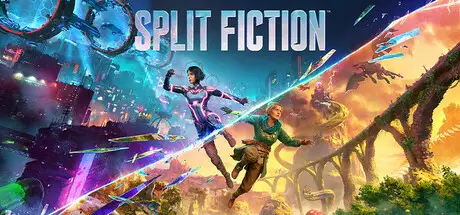
There is a moment, maybe three hours into Split Fiction, where you are riding a dragon — a big one — chasing your partner across a chain of crumbling sky-bridges, and the camera simply refuses to let either of you breathe. One second you are hunting for a foothold in a floating ruin; the next you are flung into something even louder. It is not noise for its own sake. The game knows exactly when to tighten its grip and exactly when to make you shout "go left, I'll take the right" at the person next to you.
The premise is small on purpose. Two writers with nothing in common — Mio, a hard-nosed sci-fi realist, and Zoe, a sunny fantasy dreamer — get trapped inside an experimental machine that pulls stories out of authors, and they are forced to claw their way out through each other's invented worlds. That setup never asks you to take notes on lore. It exists to carry the one thing this game does better than almost anyone: it makes two people play as one.
And it is that demanding little rule — you cannot play it alone, full stop — that turns Split Fiction into the hardest game of 2025 to copy. Hazelight took forced co-op, the thing other studios treat as a feature, and welded it into the spine. Pull one player out and the whole thing collapses. Keep that in mind through everything that follows.
Story | 8.0/10
Story: 8/10The smartest thing Split Fiction's writing does is hide in plain sight: it turns "two people playing together" into the actual plot, not a delivery mechanism for one.
Two authors, one extraction machine

You can sum it up in a breath. Two writers who could not be less alike get caught inside a machine and have to fight their way out through each other's fiction. Mio writes cold, hard sci-fi — neon sprawl, machine graveyards, gravity labs. Zoe writes warm fantasy — sunlit forests, dragon-riding canyons, storybook kingdoms. A contraption called the story-extraction machine drags them both inside, and the only way out is to clear it level by level, side by side.
None of this is going to send you hunting for a wiki. That is the point. The bar to entry sits on the floor: ten minutes in, you already feel the friction between these two and you spend the rest of the run watching it sand down into something like respect. It is a deliberately light frame, and it fits a fast co-op game perfectly — the story never elbows its way in front of the play, but it keeps feeding emotional fuel to whatever you and your partner are doing on screen.
The arc and the gameplay grow up together
Here is the move that lifts it above a cute buddy plot. Mio and Zoe's relationship and your mechanical reliance on each other escalate in lockstep. Early on the two leads talk past each other; by the end they finish each other's sentences. Meanwhile the levels quietly crank up how tightly the two players have to coordinate — from "split up and go" to "call this jump out loud or we both fall." The dependence in the systems and the closeness in the story are the same shape seen twice. You are not watching two characters become friends. You are performing it.
Director Josef Fares has said the word that kept circling back while he built this was friendship — specifically, how strangers become friends. That is not a hollow bit of warmth. The game forces two real humans, on a couch or across a connection, to keep talking and covering for each other, and that engineered dependence is the most direct dramatization of the theme you could ask for. Story and play are not two skins here. They are one thing wearing two faces.
A sharp edge under the cheer, and a missing punch
If you came expecting only feel-good co-op, there is a quieter blade tucked underneath. The villain, Rader, runs a machine that extracts and monetizes writers' stories — a clear jab at AI-driven idea theft and the industrial, capitalized churn of content. What keeps it from preaching is the form itself: nobody stops to lecture you. You simply pass through one borrowed genre after another, and the absurdity of creativity being mined, copied and packaged seeps in on its own. Every world you cross is, in the fiction, raw material a machine ripped out to sell.
For all that, I have to be honest about where it lands. Taken on its own, the story is solid rather than stunning. The stranger-to-friend arc is clean and well-shaped, but it never delivers a single gut-punch that stops you cold. Stacked against the daring of the play, the plot is a dependable container more than a headline act. Compared to the studio's previous game, It Takes Two, the narrative bones are nearly identical — twin leads, a repaired relationship, mechanics dragging the pace forward. The leap here is in genre range and spectacle, not emotional depth. That is the whole reason it lands at 8.0: good enough to hold the entire thing up, not the reason you will remember it. Put another way — if you came for a story that makes you cry or one you turn over in your head for weeks, this will read a touch plain. But treat the plot as the thread strung through every piece of lunacy the levels throw at you, and it is faultlessly competent. What you carry out of it, in the end, is the memory of fumbling through a finale shoulder to shoulder with someone, not a single line of dialogue. The writing here is an excellent supporting act that knows better than to upstage the lead.
Audio | 6.5/10
Audio: 6.5/10Audio is the lowest score I am handing out across these six categories, and I want to be clear about why: not because it is bad, but because it understands the job of a supporting player so completely that it almost never asks to be remembered on its own.
Sound that follows the cut
This soundtrack is dragged along by the edit, in the best way. Engine roar and wind pile up through a chase; the mix drops out for a beat of free-fall before slamming back down; a boss fight rides a drum line that pushes against your inputs. The sound design knows its assignment — not to steal the scene, but to shove that action-movie tension up another notch. When the camera leans in close, the mix tightens. When it pulls back, the mix opens up.
That matters more in co-op than people give it credit for. When two players are each staring at half a screen, fumbling to coordinate, the audio has to build a shared sense of timing — when to push, when something is about to go wrong. More often than not your ears clock it before your eyes do, and Split Fiction nails this; you rarely fall out of sync with your partner because you "didn't hear it." In the fastest split-screen stretches, where the visual information is literally cut in two, a single unifying score becomes the invisible rope yanking both of you back onto the same beat — it tells you whether this is a "sprint together" moment or a "watch your own lane" one.
Two worlds, two palettes, no signature

Since the plot keeps trading off between Mio's sci-fi and Zoe's fantasy, the ear has to be able to tell them apart too. Mio's neon sprawl runs cold and synthetic — synths, mechanical hum, scraping metal. Zoe's woodland swaps in warm strings and air that actually seems to breathe. Every time the genre flips, the score flips with it, handing you one more cue for whose world you are standing in beyond what your eyes report.
So why only a 6.5? Because for all its competence it never produces a theme that could become a calling card, and not one cue stuck with me after the credits. The voice work carrying Mio and Zoe from prickly to fond is genuinely good, and it does most of the heavy lifting on the emotional side. But the music itself stays at the level of "serving the picture, serving the pace" and never offers a hook that stands on its own. Picture a theme tune fighting for attention in every level — it would only collide with that breakneck rhythm. So rather than say the music is weak, it is fairer to say it chose not to show off. It has no flaw and no peak, and that even, restrained, always-on quality — missing only the ambition to be remembered — is the entire reason it sits at the bottom of my scorecard.
Visuals | 8.5/10
Graphics: 8.5/10Split Fiction's visual strength is not that any one screenshot detonates. It is the snap — the instant channel-change you feel every time it swaps one of its two art languages for the other.
Two worlds you read in half a second
Fantasy and sci-fi here are not blended into mush; they are two cleanly separated visual systems. Mio's sci-fi side runs cold, hard-edged, all metal and neon. Zoe's fantasy side is warm, soft-lit, full of natural texture and stray magic. Cross from one to the other and you know within a fraction of a second whose story you have entered and what kind of interaction to expect. That clarity sounds like a purely artistic flourish, but it pays off in your hands — you never stall because you cannot parse where you are.

What makes it rarer is that the legibility never costs information. Which objects react, where the danger zones sit, which way to run — the feedback is always plain. Co-op punishes visual confusion more than anything; two players reading different things and steering each other wrong is the failure state. Split Fiction holds a firm line: the spectacle can go wild, but the information never blurs. That discipline is easy to undervalue until you play a co-op game that lacks it, and your partner keeps steering toward a hazard you both somehow read as a path.
Spectacle as action, not scenery
What really lifts the visual grade is the sheer density of set pieces. Riding a dragon across shattered sky-bridges in a floating ruin; gravity flips and vehicle chases through a rain-soaked cyber city — these stretches impress not because they are big but because they tie the sense of space directly to your next move. Soaring over a whole canyon on dragon-back, you are not just looking at a spectacular view; you are reading where to fly and how to dodge the collapse ahead.

Chases, falls, flights and boss spectacles arrive back to back, and the camera behaves like a seasoned action director — knowing when to crowd you for pressure and when to pull wide so you can see the whole board. You rarely stop to admire the view, but you are constantly shoved forward by it. That is the gap between this and an ordinary co-op title: others set a pretty stage and let you look; this one turns the pretty stage into a level you are forced to cross.
What Unreal Engine 5 buys
Technically, this is Hazelight's first project on Unreal Engine 5 — It Takes Two and A Way Out ran on earlier versions. Fares is blunt about it: without Unreal's capabilities, this split-screen show would not exist in any other engine. Split-screen means rendering two completely different high-density scenes at the same instant, a brutal ask of both the engine and the optimization, and UE5 is what lets the studio push the scale and detail of that split up a full tier.
The spectacle rests on real money. A team of around 80 people, a budget close to double the previous game's — Hazelight bet the cash on creative density and scale rather than runtime, and the footage shows the wager paid off; every level reads as expensive, none of it reskinned filler. Worth flagging, too: the split-screen is not only a technical hurdle but an aesthetic of its own. When both halves of the screen show two color schemes and two styles at once, the full display becomes a single contrast painting — fire on one side, silent forest on the other. That is a visual punch single-screen games simply cannot land, and it earns the 8.5. The only thing holding it back from higher is that the stimulation runs so dense that some stretches lean on overall rhythm for their memory rather than one frame you would save — an acceptable trade for a blockbuster built on "good-looking and fun at once." This was never a game angling to be a landscape documentary; it is a fast-cut commercial spectacle, and on that brief it is one of the most assured-looking co-op titles you can put in front of two people right now. The art direction does not just decorate the play — it constantly tells you, at a glance, which set of rules the next ten minutes will run on.
Combat | 9.5/10
Gameplay: 9.5/10Gameplay is the soul of Split Fiction and the reason it earns my highest mark of the review, a 9.5. The best part is not how many tricks it has. It is that nearly every trick genuinely requires the two of you, together.
Pull one player out and it stops existing
Let me state the core flatly: the co-op here cannot be taken apart. This is not the "more fun with a friend nearby" kind of cooperation; it is the "lose one person and you literally cannot continue" kind. Division of labour, callouts, synced inputs — drop any link and the whole thing stutters. You pull the lever, I make the jump; you draw the fire, I flank; a mountain of gates only open if both players hit the same beat at the same instant.

It will not even let you cheat your way around it: no AI partner, no one-person-two-characters, you must find a real human and keep talking to them. That stubbornness was once read as a commercial risk; now it is the studio's deepest moat. Almost no other team is willing to stake every resource on "two people have to play together." It is also what makes the game impossible to clone — you can find a similar single mechanic elsewhere, but you will not find a second co-op adventure that commits this totally to "you are required."
The half-hour reinvention engine
Holding that co-op up is an almost extravagant density of mechanics. Roughly every half hour the game overturns its own core loop: one stretch you are doing gravity flips and vehicle chases through a cyber city, the next you are dragon-riding, shape-shifting and bending elements in a fantasy forest, and after that maybe a split-screen shoot-out in an industrial plant. These mechanics are nearly all use-once-and-discard — built for a single level, milked for everything they are worth, then dropped before they can wear out their welcome.

Fares has called the biggest design challenge the sheer number of mechanics, each of which had to be polished into something fun. The finished product clears that bar: you live in a constant "what is it going to become next?" and the twelve-hour run is almost free of creative fatigue. The density makes the whole game play like a tightly sequenced album — not every track is the longest, but there is barely any filler. And the foundation underneath is rock-solid; the platforming has clean landings, crisp feedback and a low cost to retry, so you keep wanting to try again. Steady fundamentals are what stop the constant churn from collapsing into chaos.
More inventive than the predecessor, less deep by design
Set side by side with It Takes Two, this pushes the action and mechanical complexity a notch further on the same co-op chassis. I agree with the common read: it is not harder, it is more inventive. The split-screen firefight in the industrial facility says it best — the point is not a reskinned shooting gallery but the offset coordination of two viewpoints, two angles of fire and two separate timings; whatever you cannot reach, your partner has to cover.
The cost is just as plain. With the loop swapping this fast, you can rarely dig deep into any one mechanic; over and over you finally get the feel of something, finally think "this is great," and it has already moved on to the next idea. For players who love drilling a single system to the bottom, that leaves a faint wish-for-more, like a tasting menu where every dish is delicious but no plate lets you take a second bite.
It is not a fatal flaw, though, because mastering one system was never the goal — keeping the co-op adventure's excitement from ever flagging was. Flip it around: that very restraint, dropping things before you tire of them, is exactly what keeps the conversation between you and your partner fresh for all twelve hours. Every new mechanic forces you to re-split the work and re-sync, and that constant re-negotiation is itself the fun. On that goal, it hits about the best the genre has, and the 9.5 is earned.
Content | 8.0/10
Content: 8/10On content, Split Fiction is a fun counterexample: the run is not long, yet almost nobody calls it short. The trick is that it pushes information density sky-high.
Twelve hours, every one of them packed
Main story only, skipping side stories, runs about twelve hours; completionists chasing every side story and achievement should plan on fifteen to sixteen. Twelve hours is on the short side for a triple-A package, yet hardly any review docked it for that, and the reason is simple — it does not pad runtime, it fills every hour to the brim.

The whole game, prologue included, runs eight main chapters that alternate between Mio's sci-fi worlds and Zoe's fantasy realms, each chapter splitting further into sub-segments. That alternating structure guarantees you never sit in one tone too long — crushed by the cold of the cyber city for a stretch, then thrown into the brightness of a fantasy forest the next chapter, the pace forever catching its breath. Against open worlds that prop up their hours with repeated side quests and fetch errands, this "tight but not watery" choice leaves the whole playthrough feeling cleaner and sharper. There is no dead air to skip, no stretch where you are clearly just walking from one beat to the next. Twelve hours that respect your time tend to beat forty that do not.
Twelve wild ideas behind portals
If the main story is a carefully sequenced meal, the twelve side stories are the dessert where it lets loose. Tucked behind portals, they are drawn from the leads' unfinished ideas from younger years — a pig-farming sim, a side-scrolling shoot-em-up, short concepts too odd to fit the main flow, none running over fifteen minutes. These are the wildest the game ever gets and the most concentrated showcase of its creative density: freed from any duty to advance the plot, they get to be fun purely for fun's sake.

Hunting all twelve down adds a couple of hours to the total, and the rare gift is how little of it feels like repeated filler — even a completionist going for one hundred percent stays at a high tempo, never grinding for the sake of collection. That speaks to a team with the judgment to subtract: they know what to keep and what to cut. Plenty of studios would have stretched these portal detours into a checklist; Hazelight treats them as a sketchbook instead, and the result is that hunting them down feels like discovery rather than chores. They are optional in the best sense — you lose nothing critical by skipping them, but you would be skipping some of the most inventive minutes in the whole package.
The Friend's Pass cuts the barrier to the floor
Forced co-op's biggest real-world barrier is rounding up two people in the first place. The Friend's Pass shaves that down to almost nothing: one owner of the full game can invite a friend to play the entire thing for free, and this is the first time Hazelight made it fully cross-platform — PC, console and Switch 2 players can all invite each other, progress earned on the pass carries into the full version, and local play needs no connection. You buy one copy and effectively buy the whole experience for two; for plenty of budget-conscious players that is real generosity and a real cut to the cost of "should we even try this."
It does not solve everything — crossplay leans on EA's account system, and a minority of players reported buying on Steam only to find the game missing from their account library or mislabeled, an issue stubborn enough to survive reinstalls, with onboarding that is not exactly newcomer-friendly. But these are connection-layer frictions, not a cut to the content itself: once two people actually sit down together, what they get is the complete, un-trimmed run. As a barrier-lowering mechanic it is already strikingly generous — generous enough to be the bar its peers should aim for. Add up the main story, the side stories and that pass, and I put the content at 8.0: not built on bulk, but every piece of it the real thing.




Comments 0
Share your game review
Join the discussion and share your review of this game.
No comments yet. Share your thoughts on this review.