






















Opening
# Opening
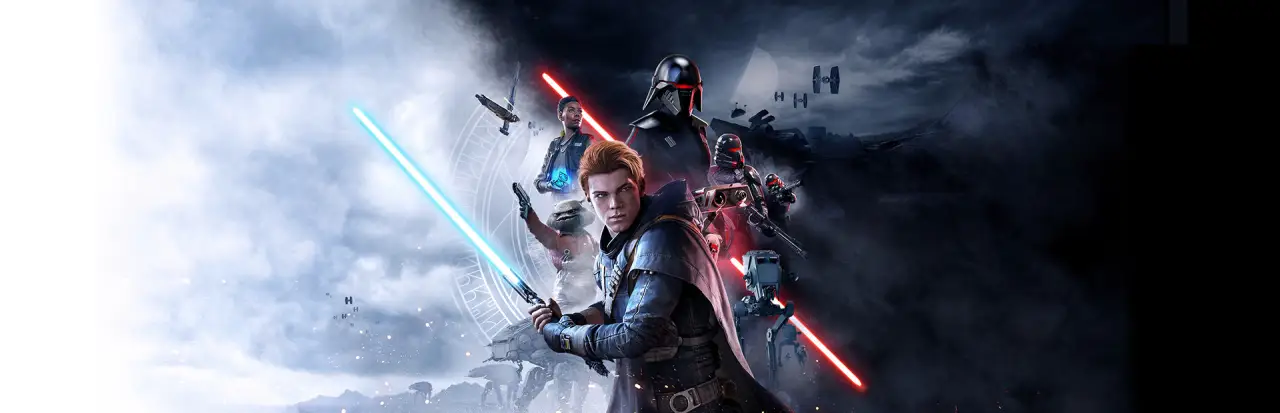
On November 15, 2019, Respawn Entertainment studio (developed) and Electronic Arts (published) launched Star Wars Jedi: Fallen Order simultaneously on PC, PlayStation, and Xbox platforms. This is Respawn's first Star Wars IP work and also Electronic Arts' attempt at "reactivation" of the Star Wars game IP after the 2012 acquisition of the IP rights — Electronic Arts' prior Star Wars Battlefront series faced strong player backlash over microtransactions, and Fallen Order as a "single-player narrative-focused, no microtransaction" work earned player goodwill.
Seven years later, Fallen Order has cumulative sales above 10 million copies, Metacritic aggregate score 81, OpenCritic Mighty rating with 89% recommendation, Steam reviews above 147,000 with "Very Positive" (91% positive). IGN gave 9 high, China's 3DM gave 8.9 (with the headline "Mysterious Force from the East" precisely pointing out the game's borrowed Sekiro: Shadows Die Twice parry system). Within 2 months of launch, the game became the 6th best-selling PC game of 2019 in the US, and was runner-up in US sales charts during November and December (behind only Call of Duty: Modern Warfare).
More historically significant is Fallen Order's revitalizing role for the Star Wars game IP — the April 2023 sequel Star Wars Jedi: Survivor, plus the anticipated 2026-2027 "Cal trilogy" third entry, have rebuilt player trust in Electronic Arts and Respawn for the Star Wars IP. Today we open Fallen Order to study how Respawn Entertainment studio, with Unreal Engine 4 plus Sekiro parry combat plus Metroidvania level design plus multi-planet scene exploration, transformed a "microtransaction controversy" Star Wars IP into 2019's 6th best-selling PC game phenomenon-level AAA work.
Story | 9.0/10
Story: 9/10# Story
Main arc: 14-year-old Jedi Padawan Cal's anti-Empire growth journey
Fallen Order's main arc is "14-year-old Jedi Padawan Cal's anti-Empire growth journey after Order 66." The story sets 5 years after Revenge of the Sith (2005 film) — the 5th year after the Empire's Order 66 purged the Jedi Order. At that time the Empire had taken complete control of the galaxy, the Jedi Order was nearly entirely purged, and only a few Padawans hid from Imperial monitoring.
Protagonist Cal Kestis was a child when Order 66 occurred — he watched his Master killed by clone troopers, hid through the Empire's purge, and ended up working as a scrapper on the planet Bracca. An accident exposed his Force ability (using Force push to save a coworker), and the Empire's Inquisitors (Second Sister and Ninth Sister) hunted him down. Cal was rescued by former Jedi Master Cere Junda and Captain Greez Dritus, joined the "Stinger Mantis" crew, and began a journey to rebuild the Jedi Order.
The main story driver is "Cal searching for clues left by Jedi Master Eno Cordova across the planets Zeffo, Kashyyyk, Dathomir, and Ilum." The "Holocron" is the key to Cere rebuilding the Jedi Order — it's a holographic map tracking every Force-sensitive child in the galaxy. But the Holocron is a double-edged sword — if it falls into Imperial hands, every Force-sensitive child gets purged. This "the Holocron is both hope and curse" narrative tension gives Fallen Order's main story a genuine moral dilemma.
Side density: 5 planet scenes plus BD-1 scan logs plus various hidden treasures
Fallen Order's "side density" lives mainly in three layers — "5 planet scenes' multiple exploration" plus "BD-1 scan logs" plus "various hidden treasures." Each planet has independent visual style — Bogano is desert plus crystal; Zeffo is snow mountain plus ancient ruins; Kashyyyk is towering trees plus Wookiee villages; Dathomir is dark swamps plus red caves; Ilum is glacier mountains plus Jedi Temple; Nur is underwater prison plus dark side tower.
BD-1's scan log is one of the game's most underrated side content — players let BD-1 scan scene items (ancient ruins, plants, animals, machinery, weapons, enemy corpses) to gain log entries. Complete scan log collection takes 5-7 hours of investment. These log entries reveal massive Star Wars universe details — Zeffo people's history, Dathomir Nightsisters' evolution, Bogano's crystal origins, Ilum's traditional Jedi Temple ceremonies, etc.
The game also features various hidden treasures — Cal's costume and poncho appearance skins (scattered in hidden chests), BD-1's color decorations, lightsaber appearance customization parts (color, texture, hilt), Force ability upgrade points (scattered in hidden rooms). Complete collection takes 10-15 hours of investment, the deepest side pursuit outside the main story.
Choice system: 4 difficulty tiers and Force unlock order
Fallen Order has no traditional RPG good-evil branching or multi-endings, but carries a playstyle decision through "4 difficulty modes" plus "Force ability unlock order."
4 difficulty modes: 1) Story Mode (narrative-friendly, enemy damage reduced); 2) Jedi Knight (standard); 3) Jedi Master (hardcore-friendly, enemy damage and attack tempo boosted); 4) Jedi Grandmaster (one-hit-kill hardcore, some enemy attacks deal instant death). The community has complete "Jedi Grandmaster clear guides" letting deep players chase the toughest challenge.
Force ability unlock order is also an implicit choice — players choose which planet to visit and which ability to unlock first. For example, going to Zeffo first to unlock "wall-run" lets certain hidden areas become accessible earlier, or going to Kashyyyk first to unlock "Force push" makes certain level combat easier. This "player-chosen ability unlock order" design gives Metroidvania level design genuine strategic layering.
The ending decision Cal makes — "actively destroy the Holocron" — is also an "emotional decision player invests in." Although the story has no branching choice, the player's accumulated emotional resonance throughout the game leads to Cal's tragic heroic decision to "protect innocent children."
Character work: Cal plus BD-1 plus Cere plus Greez plus Merrin five-person team
Fallen Order's character work lives mainly through the 5-person team ensemble — each character carries a complete arc and emotional tension.
1) Cal Kestis: protagonist 14-year-old Jedi Padawan, performed by actor Cameron Monaghan via motion capture plus voice acting. Monaghan was previously famous for Shameless's Ian Gallagher and Gotham's Jerome / Jeremiah Valeska. His performance gives Cal a genuine "young Jedi Padawan" temperament — both trauma from the past and resolve to rise again. The community universally regards Monaghan's performance as the underrated success factor.
2) BD-1: droid companion, originally Jedi Master Eno Cordova's escort droid. BD-1 helps players open chests, unlock terminals, and provide healing — Cal's most loyal companion. BD-1 also carries complete personality design — reacting to player actions (nodding, shaking head, beeping), forming a "human and droid companion" emotional bond with Cal. The community universally rates BD-1 as "2019's most beloved droid companion."
3) Cere Junda: former Jedi Master who once fell to the dark side after temptation, regretted, then rejoined Cal's journey. Cere's narrative core is "atonement" — she betrayed her own Padawan Trilla Suduri under Imperial interrogation, getting Trilla converted into a dark side Inquisitor. Mid-story Cal discovers this truth and becomes disappointed in Cere, and the ending sees Cere reconcile with Trilla at her dying moments — Fallen Order's most emotionally resonant design.
4) Greez Dritus: captain, four-armed alien, pilot of the Stinger Mantis. Greez is the team's comic relief — he loves gambling, complains constantly, but is loyal to the crew. His comedic energy brings necessary lightness to the team.
5) Nightsister Merrin: a Dathomir Nightsister survivor who joins the team and becomes Cal's spiritual companion. Merrin's narrative core is "finding belonging after losing her people" — her family was wiped out in the Empire's purge, and joining Cal's journey is her way of finding "home" again. Merrin develops into Cal's romantic partner in the sequel Survivor, a long-game hook Fallen Order plants.
6) Antagonist Trilla Suduri (Second Sister) is Fallen Order's deepest antagonist — she was Cere Junda's Padawan, and because Cere betrayed her under Imperial interrogation, Trilla was converted into a dark side Inquisitor. This "former Master-Padawan became enemies" narrative gives Trilla genuine human depth. In the final battle Cal defeats Trilla, and she reconciles with Cere at her dying moments — one of Fallen Order's most memorable narrative moments.


Audio | 9.0/10
Audio: 9/10# Audio
Score theme: epic orchestral tribute to John Williams
Fallen Order's soundtrack was composed by Stephen Barton and Gordon Thompson together, with an overall style mixing "tribute to John Williams's classic Star Wars score" plus "modern cinematic orchestral." From the opening "Cal's Theme" through to the closing "Light of Hope," the entire score circles Star Wars's classic epic orchestral themes — brass, strings, choir, and brass fanfare mixed together to immediately bring players into the Star Wars universe auditorily.
This "tribute to John Williams plus modern cinematic orchestral" composition strategy fits Star Wars IP tradition — all Star Wars films and games use similar epic orchestral styles. But Fallen Order doesn't simply replicate Williams's melodies; it composes original themes for Cal, BD-1, Cere, and other main characters — these original themes carry both Williams-style epic feel and Fallen Order-exclusive character emotion.
Each planet has its own tonal foundation — Bogano features melodic crystal resonance plus electronic synth (mysterious atmosphere); Zeffo features deep epic orchestral plus icy chill (ancient ruins atmosphere); Kashyyyk features tribal drumbeats plus Wookiee growls (primal forest atmosphere); Dathomir features dark choir plus surreal electronic (Nightsister atmosphere); Ilum features melodic crystal resonance plus choir (Jedi Temple atmosphere); Nur features underwater low-frequency plus tense electronic (final battle atmosphere).
Voice design: Cameron Monaghan lead plus complete NPC voice acting
Fallen Order represents EA-Respawn era Star Wars game voice acting craftsmanship. Cal is performed by American actor Cameron Monaghan via motion capture plus voice acting. Monaghan's performance gives Cal a genuine "young Jedi Padawan" temperament — his subtle facial expressions, voice trembling, and motion hesitation across cutscenes precisely convey Cal's psychological trauma after Order 66.
Other main NPCs all ship fully voiced — Cere Junda by Debra Wilson (previously involved in multiple Star Wars animations and films), Greez Dritus by Daniel Roebuck, Nightsister Merrin by Tina Ivlev, Trilla Suduri by Elizabeth Grullon, Eno Cordova by Tony Amendola. Each character's voice acting precisely reflects cultural background and emotional arc.
BD-1's "droid language" is Fallen Order's most beloved voice design — BD-1 doesn't speak human language but emits "beeps," "clicks," "hums," and other droid audio cues — but each cue precisely expresses emotion (excitement, curiosity, fear, anger, concern). Cal and players both understand BD-1's emotions from droid language alone — this "droid language plus body language" emotional delivery is one of Fallen Order's most beloved character designs.
Fallen Order has no official Simplified Chinese voice acting — a minor regret for Chinese player communities. EA also did not add Chinese voice in the 2023 sequel Survivor — a reflection of EA's limited Chinese localization investment. But Simplified Chinese subtitles quality is solid, with specialized terminology consistent and matching Chinese player conventions.
Environmental sound: authentic soundscapes across 5 planets
Fallen Order's environmental sound design is the AAA underrated layer — all 5 planets carry independent ambient beds. Bogano features crystal resonance plus distant water drops plus cave echoes; Zeffo features snow wind howling plus distant avalanche rumbles plus stone tablet resonance; Kashyyyk features towering tree wind plus Wookiee language dialogue plus distant bird songs; Dathomir features dark swamp steam plus distant Nightsister whispers plus red cave echoes; Ilum features glacier mountain wind plus distant Jedi Temple crystal resonance; Nur features underwater prison water flow plus distant Imperial alarms.
Combat sound effects are also a Fallen Order craft highlight — lightsabers' "humming buzz," "high-frequency sparks when colliding with another lightsaber," "crisp ring when slashing metal," "low thud when slashing flesh" all precisely recorded. Force ability audio also independently designed — Force push is "energy impact," Force pull is "energy attraction," Force slow is "time freezing," wall-run is "shoe-sole friction," double-jump is "energy burst." Each Force ability has independent audio feedback, giving players clear sensory signals when using Force.
Imperial enemy audio is also carefully designed — clone trooper dialogue (command compliance, position reports), Inquisitor lightsaber "dual-blade rotation" audio, AT-ST walker mechanical gear sounds, Bounty Hunter jetpack thruster sounds. These audio cues let players judge "enemy type and threat level" through hearing before combat.
Console platform audio differences
PC defaults to 5.1 / 7.1 multi-channel surround. Headphone players precisely locate enemy directions, Force ability effects, distant story cues. PlayStation and Xbox console builds share comparable audio bottoms, with Dolby Pro Logic II 5.1 the era's standard console spec. PlayStation 5 (November 2020 next-gen patch) supports Tempest 3D spatial audio with DualSense's adaptive triggers and haptic feedback — letting players "feel the force feedback of lightsaber collisions."
Steam Deck speakers are narrow but the headphone jack and Bluetooth fully reproduce the 5-planet environmental audio layering. After the March 2024 Steam Deck compatibility patch, the PC build's audio on Steam Deck stays stable.
Chinese player communities have produced extensive OST derivative work — NetEase Cloud Music's Fallen Order OST comment threads exceed 50,000 entries, and Bilibili regularly serves million-view "Cal's Theme piano cover" and "BD-1 Theme saxophone arrangement" videos. Turning AAA action-adventure BGM into mass-music subject matter is relatively rare in indie. Stephen Barton and Gordon Thompson's "tribute to John Williams plus modern cinematic orchestral" composition craft gives Fallen Order's music its extra cultural dividend, propagating well beyond the gaming audience into mainstream music fans.

Visuals | 8.5/10
Graphics: 8.5/10# Visuals
Art direction: realistic Star Wars universe plus 5-planet scene diversity
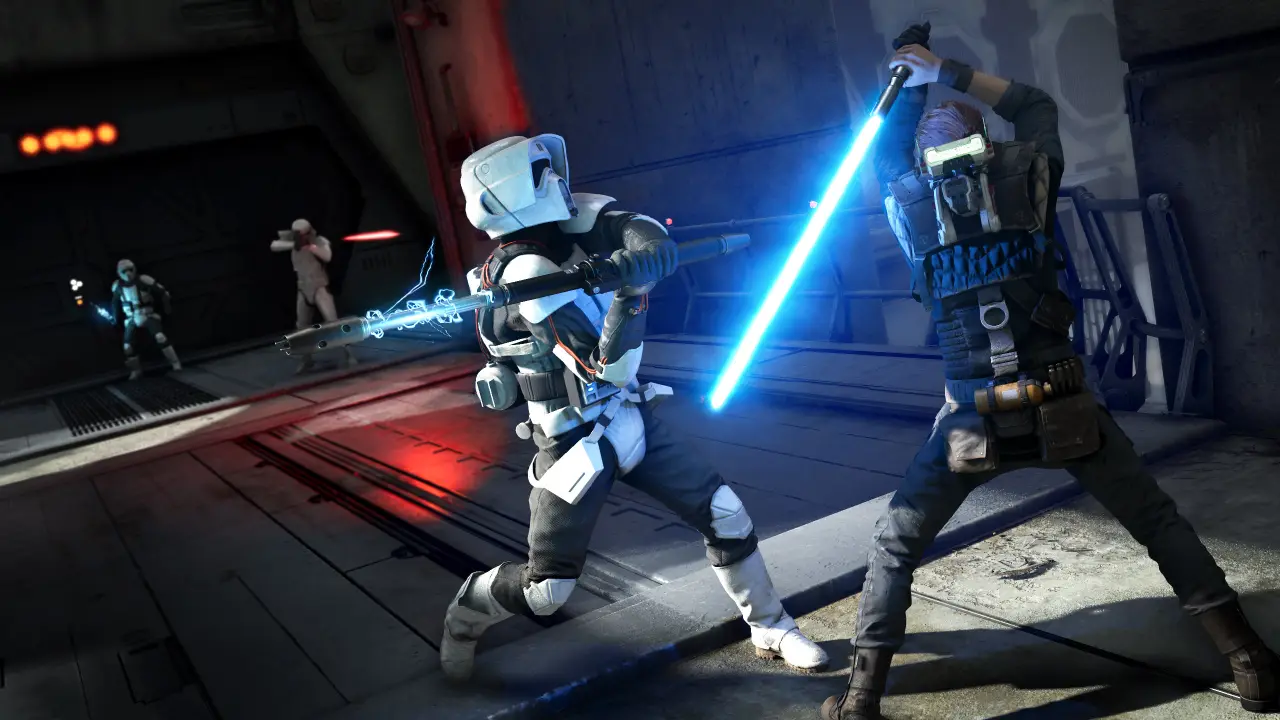
Fallen Order's visual style represents the AAA scene's most concrete recreation of the Star Wars IP — Respawn studio centers visual design entirely on the visual language from 1977 through 2019 Star Wars films and TV series. Lightsaber colors and light effects, clone trooper armor details, Imperial AT-ST walker mechanical structure, Wookiee captivity village, Dathomir's red wasteland, Ilum's traditional Jedi Temple — all visual elements precisely recreate Star Wars canon.
The 5 main planets each carry independent visual style — Bogano is desert plus crystal (referencing Star Wars Episode III's Kamino and Lucas film concept art); Zeffo is snow mountain plus ancient ruins (referencing Star Wars Episode III's Hoth and Episode VIII's Crait); Kashyyyk is towering trees plus Wookiee villages (referencing Star Wars Episode III's Wookiee captivity scenes); Dathomir is dark swamps plus red caves (referencing Clone Wars animation's Dathomir Nightsister wasteland); Ilum is glacier mountains plus Jedi Temple (referencing Clone Wars's Jedi lightsaber crystal ceremony scenes); Nur is underwater prison plus dark side tower (Fallen Order original scene).
Cal's character modeling is also a craftsmanship ceiling — Respawn studio used actor Cameron Monaghan's 3D scan data to give Cal a genuine "young Jedi Padawan" temperament. Cal's facial expressions, motion capture, costume details (poncho, belt, boots) all precisely render. BD-1's modeling also carefully designed — mechanical gears, screen brightness, antenna motion, scan beam all have independent physics simulation, giving BD-1 a genuine "small droid" temperament.
Engine tech: Unreal Engine 4 plus launch technical issues
The game engine is Epic Games' Unreal Engine 4 — the 2014 release of the popular game engine, widely used across late-2010s AAA and indie. Respawn studio chose UE4 for its "graphics quality plus cross-platform porting friendliness."
The engine delivered key capabilities in Fallen Order — 1) physics-based material rendering lets lightsaber reflection, Force glow, planet surface details all precisely render; 2) dynamic lighting and global illumination let Bogano's crystal caves, Zeffo's snow mountain ruins, Dathomir's red wasteland all carry rich lighting layering; 3) high-density environmental detail lets each planet scene carry "Star Wars IP immersion"; 4) smooth Cal animations — Cameron Monaghan's motion capture data provides the engine with authentic character performance.
At November 2019 launch the game had serious technical issues — PC version had stuttering, texture loading delays, intermittent crashes; PlayStation and Xbox console versions had "texture pop-in" issues (texture loading lagged behind models in some scenes, showing players untextured models); some scenes had excessive loading times. Respawn studio released multiple patches between December 2019 and March 2020 to gradually fix these issues — but Metacritic user scores still reflected launch-period player dissatisfaction (user score around 7.5 vs critic score 81).
The November 2020 next-gen compatibility patch let PlayStation 5 and Xbox Series X run at 4K 60 fps — Fallen Order's first "modern console version" experience. The August 2022 "next-gen edition" additionally added ray tracing support, letting the game rejuvenate on modern hardware.
Platform version differences
PC (Steam, EA Launcher, Epic): 1080p to 4K, 30 to 144 fps, mouse-keyboard plus controller all supported, Steam Deck Verified (after March 2024 patch).
PlayStation 4 (November 2019 launch): 1080p 30 fps, PS4 Pro upgrades to 1440p 30 fps.
Xbox One (November 2019 launch): 1080p 30 fps, Xbox One X upgrades to 4K 30 fps.
PlayStation 5 (November 2020 next-gen patch): native 4K 60 fps plus Tempest 3D spatial audio plus DualSense adaptive triggers and haptic feedback.
Xbox Series X (November 2020 next-gen patch): native 4K 60 fps.
Steam Deck (Verified, March 2024 patch): 1280x800 at 30 fps stable, battery life 2.5-3 hours (AAA action-adventure power draw is higher).
Cross-platform Metacritic spread is small (PC 80, PS4 81, Xbox One 81, PS5 84, Xbox Series X 84) — next-gen versions score slightly higher because launch-period technical issues were resolved in next-gen patches. This means players entering after November 2020 directly enjoy Respawn's year of optimization fixes, skipping all the 2019 launch-period issues.
The game's graphics demand mid-tier hardware — minimum config Intel Core i3-3220 plus GeForce GTX 660 plus 8GB RAM runs at 1080p 30 fps; recommended config Intel Core i7-6700K plus GeForce GTX 1070 plus 16GB RAM runs at 1080p 60 fps; 4K 60 fps needs Intel Core i9-9900K plus GeForce RTX 2080 Ti plus 16GB RAM. This "mid-config runs smoothly" makes Fallen Order relatively friendly to mid-low-end PC players.
UI and accessibility
UI is a "Star Wars IP plus modern AAA" hybrid aesthetic — main menu features classic Star Wars "lightsaber plus Imperial insignia" style, pause menu uses "Jedi holographic map" style, map interface uses "Jedi Holocron map" style, equipment interface uses "lightsaber workbench" style. Every UI surface is not a generic functional layer but participates in "the player enters the Star Wars universe" immersion.
On accessibility, Respawn studio provides full key remapping, subtitle size adjustment, rumble intensity adjustment, colorblind modes, and 4-tier difficulty modes (Story, Jedi Knight, Jedi Master, Jedi Grandmaster). Simplified Chinese and Traditional Chinese subtitle translation quality is solid — EA's localization team handled translation, with consistent specialized terminology matching Chinese Star Wars community traditional translation conventions ("Jedi," "Sith," "Force," "Lightsaber," "Clone Trooper," "Empire" all match community usage).
But the game has no official Chinese voice acting — Cal and all NPCs use English voice with Chinese subtitles. This is a minor regret for Chinese player communities, but EA also did not add Chinese voice in the 2023 sequel Survivor. The community has fan-made Chinese voice mods but stability is poor. The "film grain" option is Respawn studio's tribute to old Star Wars films — when enabled the picture displays the film grain effect unique to old films, letting players choose between "modern clear picture" or "old film nostalgia atmosphere."


Combat | 8.5/10
Gameplay: 8.5/10# Combat
Combat system: lightsaber soulslike parry plus Sekiro borrowing
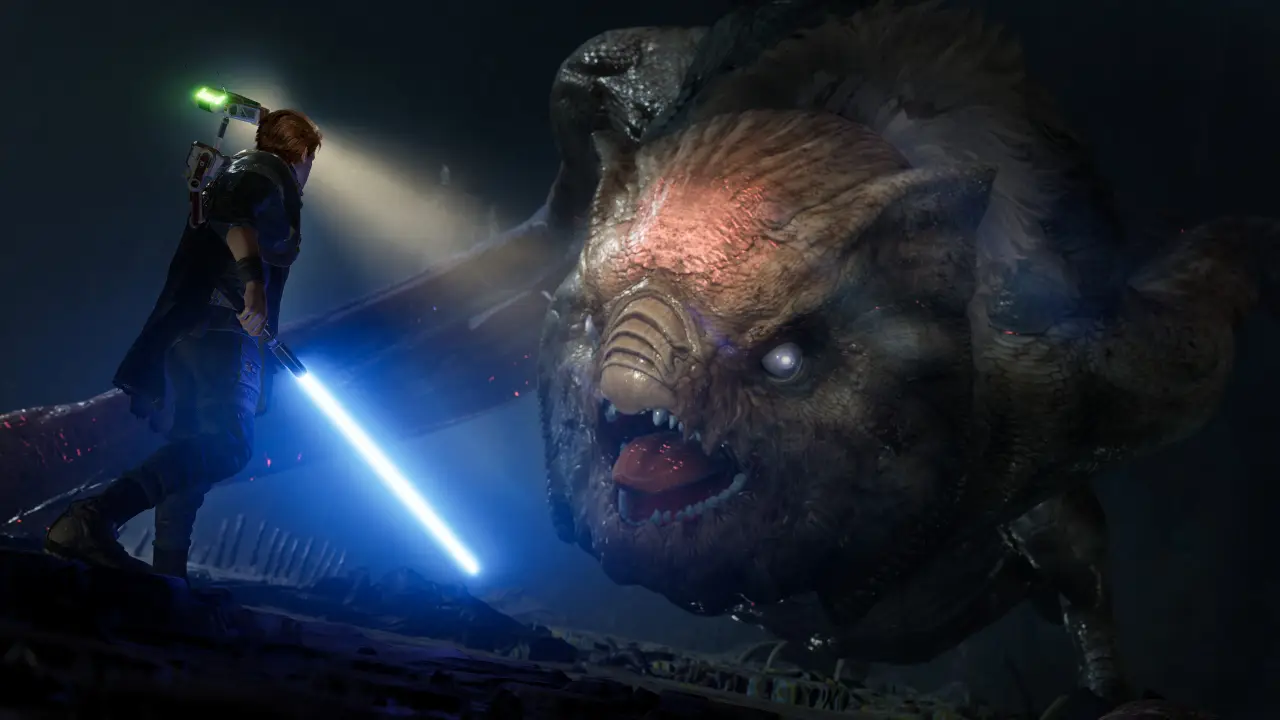
Fallen Order's core gameplay is "lightsaber soulslike parry plus Sekiro borrowing" hybrid. The lightsaber combat system directly borrows from Sekiro: Shadows Die Twice (2019)'s parry system — players hold the block key to deflect attacks, consecutive hits drain the block meter, and precise parry (blocking at the moment an attack lands) triggers parry counter — staggering melee attackers and reflecting blaster fire back at sources. 3DM's review describes this borrowing as "training with the Mysterious Force from the East."
Combat rhythm cycles through "block plus dodge plus attack plus Force" four phases. Players hold block to deflect enemy attacks (about 12 i-frames), dodge to evade unblockable attacks (about 8 i-frames), attack key for lightsaber slashing, Force key for releasing Force abilities (push, pull, slow, jump). This "four-phase rhythm" makes Fallen Order's combat broader than pure Sekiro — adding Force abilities as a "combat strategy layer."
The lightsaber can upgrade — single saber, dual sabers (mid-game), double-bladed saber (late game, spinning double-bladed lightsaber form). Each form has independent attack rhythm, damage type, and combo paths. Players upgrade lightsaber appearance (color, texture, hilt) plus combat stats at the workbench. The community maintains complete "strongest lightsaber form" guides — single saber is steady, dual sabers are burst, double-bladed saber is area-attack.
Force ability unlock system: Metroidvania level design core
Players start with "Force slow" ability, gradually unlocking more Force abilities — wall-run, double-jump, Force push, Force pull, Force jump, air dash. These Force abilities form the Metroidvania level design core — players unlock new abilities and revisit previously inaccessible areas to find hidden treasures, new main quest routes, new side NPCs.
The game officially designs the Force system as a "lock-and-key mechanism" — each Force ability corresponds to a type of "lock" (green plants for Force pull, energy fields for Force push, elevator mechanisms for Force slow, high walls for wall-run, distant platforms for double-jump). This "ability equals unlock" logic is the precise realization of classic Metroidvania design in 3D third-person view.
At least 3 planets (Bogano, Zeffo, Kashyyyk) must be visited twice — first visit unlocks part of the area, second visit unlocks the rest. This "forced revisit" design gives Metroidvania level design genuine "Aha moments" — players discover with delight on the second visit that "I couldn't enter here before but now I can." Veteran players often plan their route around future revisits, intentionally leaving certain chests untouched until they have the relevant Force ability unlocked, turning the entire game into a self-imposed completionist puzzle layer.
BD-1 droid companion: scan plus unlock plus heal trinity
Players are accompanied throughout by a droid named BD-1 — BD-1 helps players: 1) open chests (scan function identifies chest contents); 2) unlock terminals (hacking function infiltrates Imperial terminals); 3) medical healing (Stim Canisters restore player HP, similar to soulslike "estus" healing). BD-1 also carries complete personality design — reacting to player actions (nodding, shaking head, beeping), forming a "human and droid companion" emotional bond with Cal.
BD-1's Stim Canisters are Fallen Order's most critical survival mechanic — players start with 2 Stims, can upgrade up to 10 at the workbench. Each meditation point (similar to soulslike bonfire) restores Stim count and player HP, but all enemies respawn. This "healing item plus meditation point" design directly borrows from soulslike, but adds BD-1 as the "healing executor," giving players a more emotional healing experience.
BD-1 can also scan scene items (ancient ruins, plants, animals, machinery, weapons, enemy corpses) to gain log entries. Complete scan log collection takes 5-7 hours of investment. These log entries reveal massive Star Wars universe details — Respawn studio's most concrete contribution to Star Wars IP immersion.
5 planet scenes: Metroidvania multi-planet exploration
Fallen Order covers 5 main planets — Bogano (Jedi Padawan's starting point), Zeffo (main quest required), Kashyyyk (Wookiee captivity), Dathomir (Nightsister wasteland), Ilum (traditional Jedi Temple), Nur (final level, underwater prison). Each planet has independent visual style, independent main quest line, independent enemy types, and independent environmental sound design.
Each planet's level design is precise — Bogano's crystal caves feature extensive "jump plus wall-run plus double-jump" hybrid stages; Zeffo's ancient ruins feature extensive "Force push plus Force pull" mechanism puzzles; Kashyyyk's Wookiee village features extensive "platform combat plus tree climbing" vertical stages; Dathomir's red wasteland features extensive "Force slow plus dodge" high-intensity combat; Ilum's glacier mountains feature extensive "lightsaber crystal ceremony" narrative stages; Nur's underwater prison features extensive "stealth plus combat plus puzzle" composite stages.
At least 3 planets must be visited twice (Metroidvania design requirement), letting players repeatedly revisit during main quest progression. This "multi-planet plus multi-visit" structure gives Fallen Order's level design depth far beyond traditional linear AAA action-adventure — but also makes some players feel "scenes are repetitive." The sequel Survivor (2023) responds to this complaint with significantly larger open-world areas, but Fallen Order's tightly-designed multi-visit structure remains preferred by Metroidvania purists for its puzzle-like satisfaction.
4 difficulty modes: from Story to Jedi Grandmaster
The game includes 4 built-in difficulty modes — Story (enemy damage reduced 50%, narrative-friendly), Jedi Knight (standard), Jedi Master (enemy damage boosted 25%, enemy attack tempo accelerated), Jedi Grandmaster (some enemy attacks deal instant death, similar to Sekiro's "Ultra-Hard" difficulty).
The community maintains complete "Jedi Grandmaster clear guides" letting deep players chase the toughest challenge — estimated only 5-10% of players have cleared Jedi Grandmaster. This "difficulty filters players" mechanism gives Fallen Order genuine "soulslike action" position in the hardcore action scene.
At Jedi Grandmaster difficulty many boss battles become "precise-parry-only clearable" extreme challenges — for example Second Sister Trilla's final showdown, Ninth Sister's Ilum encounter, Dathomir's Tomb guardians. The community has detailed "each boss parry timing" guides — players need to watch videos to repeatedly learn each boss's attack rhythm to clear at Grandmaster difficulty. This "extremely steep learning curve" makes Fallen Order a beloved "next-gen soulslike masterpiece" among veteran soulslike action players.
The game also has a hidden challenge — "no-Stim clear" (complete main quest without using any BD-1 medical items). This "self-imposed challenge" gameplay is celebrated in the community as "the true Jedi Grandmaster credential," estimated only 1-2% players achieve.
Cross-genre feel comparison: differences from Sekiro, Uncharted, Hollow Knight, God of War
Against Sekiro: Shadows Die Twice (2019), Fallen Order clearly borrows Sekiro's "parry system" and "difficulty filters players" pacing, but adds Metroidvania level design and Force ability unlocks, broadening gameplay. Sekiro is pure hardcore action, Fallen Order is action-adventure plus Metroidvania hybrid.
Against Uncharted 4: A Thief's End (2016), Fallen Order clearly borrows Uncharted's "cinematic cutscene" and "character-driven narrative," but adds soulslike combat and open exploration elements. Uncharted is pure linear action-adventure, Fallen Order is more open planet exploration.
Against Hollow Knight (2017), Fallen Order's Metroidvania level design clearly borrows Hollow Knight's "ability equals unlock" logic — but Fallen Order is 3D third-person while Hollow Knight is 2D side-scrolling. Target audiences overlap (players who love "unlock abilities to revisit old scenes") but view perspective differs.
Against God of War (2018), both are 2018-2019 action-adventure masterworks. God of War takes the "Kratos and son companion interaction plus Norse mythology" path, Fallen Order takes the "Jedi Master-Padawan companion interaction plus Star Wars" path. Target audiences overlap (players who love "character-driven narrative plus realistic action-adventure") but IPs differ completely. The community frequently pairs the two as recommended sequential playthroughs for AAA fans who want both Norse and galactic mythology represented in their year of action-adventure gaming.

Content | 7.5/10
Content: 7.5/10# Content
Main campaign length and pacing
Fallen Order's main story flow averages 25-30 hours (How Long to Beat data), with full completion (all hidden treasures, all BD-1 scan logs, all planet map fully revealed) requiring 40-50 hours. Deep player investment of 60-80 hours is normal — primarily pursuing Jedi Grandmaster clears, full lightsaber appearance unlocks, full Cal costume unlocks.
The first 5 hours of main story run extremely tight — Cal exposes Force on Bracca, gets hunted by the Empire, rescued by Cere and Greez, joins the "Stinger Mantis," first arrives on Bogano to find BD-1 and Eno Cordova's Holocron starting point. These 5 hours are 2019 AAA action-adventure's most "Star Wars IP-immersive" openings.
Main story pacing enters the "Metroidvania multi-planet exploration" phase between hours 10-20 — players repeatedly explore Zeffo, Kashyyyk, Dathomir, Ilum and other planets, unlocking new Force abilities and revisiting old scenes for hidden items. This is Fallen Order's core gameplay experience — the hybrid pacing of main quest progression and side exploration.
The final-level Nur underwater prison is Fallen Order's pacing climax — Cal infiltrates the Imperial underwater base, fights Trilla Suduri, obtains the Jedi Holocron, briefly encounters Darth Vader before escaping. The ending leaves players both feeling tragic (Cal's active Holocron destruction) and hopeful (the team continues anti-Empire struggle).
Side-content type distribution
Fallen Order's side content lives mainly in three layers — "5 planet scenes' multiple visits" plus "BD-1 scan logs" plus "various hidden treasures." Each planet has independent side content — Bogano features extensive "crystal cave exploration plus ancient ruins archaeology"; Zeffo features extensive "ancient tombs plus Force burials"; Kashyyyk features extensive "Wookiee villages plus Imperial outpost battles"; Dathomir features extensive "Nightsister ruins plus red wasteland exploration"; Ilum features extensive "Jedi Temple plus lightsaber crystal ceremonies."
BD-1's scan log is Fallen Order's most underrated side content — players let BD-1 scan scene items (ancient ruins, plants, animals, machinery, weapons, enemy corpses) to gain log entries. Complete scan log collection takes 5-7 hours of investment. These log entries reveal massive Star Wars universe details — for example Zeffo people's history, Dathomir Nightsisters' evolution, Bogano's crystal origins, Ilum's traditional Jedi Temple ceremonies.
The game also features various hidden treasures — Cal's costume and poncho appearance skins (scattered in hidden chests), BD-1's color decorations, lightsaber appearance customization parts (color, texture, hilt), Force ability upgrade points (scattered in hidden rooms). Complete collection takes 10-15 hours of investment, the deepest side pursuit outside the main story.
DLC and extension content
Fallen Order released no traditional paid DLC — Respawn studio and Electronic Arts focused on "patch fixes" and "next-gen compatibility" rather than "DLC content expansions" after the 2019 base game launch. This relates to the 2017 Star Wars Battlefront II microtransaction controversy — Electronic Arts decided to make Fallen Order a "no microtransaction, no DLC, pure single-player narrative" clean work.
The November 2020 next-gen compatibility patch let PlayStation 5 and Xbox Series X run at 4K 60 fps — Fallen Order's first "modern console version" experience. The August 2022 "next-gen edition upgrade patch" additionally added ray tracing support, letting the game rejuvenate on modern hardware. These two free patches put Fallen Order's "cross-generation upgrade" at the front of the 2019-2022 AAA scene.
In September 2024 Fallen Order joined EA Play subscription service — $5.99 monthly subscription lets Chinese region players access the most value-for-money onboarding path. EA Play subscription also includes other AAA titles from Electronic Arts (Apex Legends, Titanfall 2, Need for Speed series). Subscription access has become the most popular onboarding route in 2025 — many players try Fallen Order through subscription, complete the main story over a single month, then unsubscribe without spending the full purchase price.
Sequel Survivor and "Cal Trilogy"
The April 2023 sequel Star Wars Jedi: Survivor inherits Fallen Order's gameplay framework and substantially expands — larger open world (Koboh planet as open exploration main hub), more Force abilities (lightning, force push enhancement), more complex lightsaber configurations (5 stance switching including single saber, dual sabers, double-bladed saber, cross-guard saber, blaster lightsaber combo), deeper narrative (Cal and Merrin develop into romantic partners). Survivor's first-month sales exceeded 6 million copies in 2023, further proving Respawn's success in the Star Wars IP.
Electronic Arts and Respawn studio revealed in 2025 that the third entry of the "Cal trilogy" is in development — expected to launch 2026-2027. This means Fallen Order is the starting point of the "Cal trilogy" — Electronic Arts' core product line for sustained investment in the Star Wars IP between 2019 and 2027. The community has many players specifically "waiting for the Cal trilogy third entry" by replaying Fallen Order and Survivor — a 7-year long-lived IP player community rare in indie-era AAA. Fan theory videos speculating about the third game routinely cross a million views, and several content creators have built their entire channels around dissecting Cal's narrative arc across the trilogy.
Mod ecosystem and 7-year long-tail operation
The PC platform Fallen Order mod ecosystem is fairly complete — 3DM Mod Site, Nexus Mods, Steam Workshop all carry rich graphics enhancement mods, new skin mods (Cal's costume replacement, BD-1 color customization, lightsaber color customization), frame-rate unlock mods, font replacement mods, translation patches. Bilibili "Fallen Order mod recommendation" videos exceed 1,500 cumulative entries.
Respawn studio's 7-year long-tail operation pace is precise — November 2019 launch, December 2019 to March 2020 consecutive performance fix patches, November 2020 next-gen compatibility, August 2022 next-gen edition plus ray tracing patch, April 2023 sequel Survivor release, March 2024 Steam Deck compatibility patch, September 2024 EA Play subscription joining. This "continuous tech upgrade plus cross-platform extension" operational strategy keeps Fallen Order's player community steady across 7 years.
Overall, in 2026 Fallen Order remains "2019 AAA's most successful Star Wars IP revival" — exceeding contemporary action-adventure games in IP immersion, lightsaber combat, and Metroidvania level design. But it shows slight age compared to 2023's sequel Survivor in graphics, gameplay breadth, and narrative depth. Community consensus: "Fallen Order is the entry point, Survivor is the advanced essential." Newcomers who want to fully experience Cal's character arc are advised to play Fallen Order first then Survivor, since story beats and emotional payoff land best in chronological order.





Comments 0
We'd love to hear from you
Welcome! Share your take on this game — being first might come with a surprise.
No comments yet — share your thoughts on this review!