






















Opening
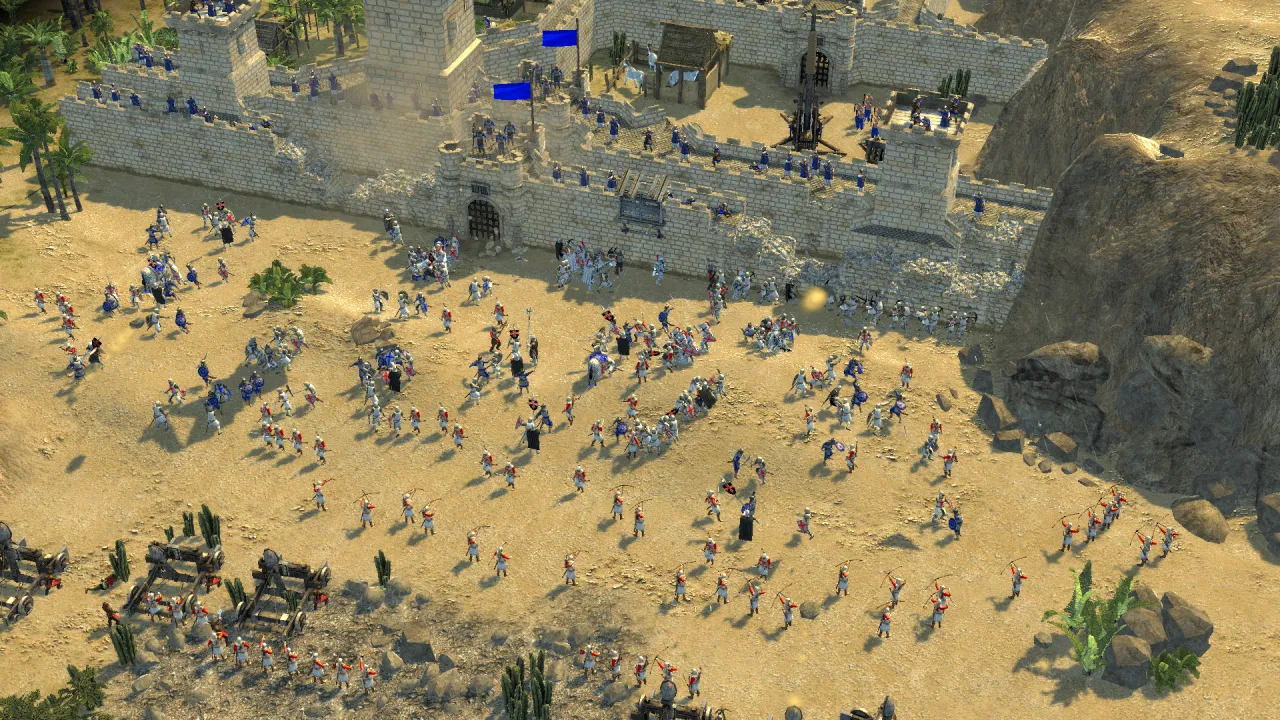
Blue flags line the city walls, while trebuchets pound away round after round below. When the desert fortress is under siege, the best aspect of this game isn't "how intense the battle is," but rather that even through these static images, you can sense the hard edge of old-school RTS. Not delicate. Solid.
The problem lies precisely here. Existing materials say almost nothing substantial about the gameplay, story, or music of Stronghold Crusader 2, and even visual assessments have long remained in a state of incomplete information—some sources are simply defunct, others barely relevant to this title. You can't dissect it system by system, pacing by pacing, narrative by narrative like you would a contemporary AAA game; more often, you can only work backwards from those images of desert castles, siege engines, and dense garrison forces to infer what atmosphere it's trying to convey to players.
This makes this review somewhat special. It's not an "evidence-rich" analysis, but more of a cautious calibration: facing a work with wildly divergent media scores—some giving it a 7, others dropping it to a 1—I'm more inclined to acknowledge that its clearest aspect is the inherent appeal of the medieval siege theme itself; while its most ambiguous part is how much solid content remains beyond that theme.
Content Quality | 4.0/10
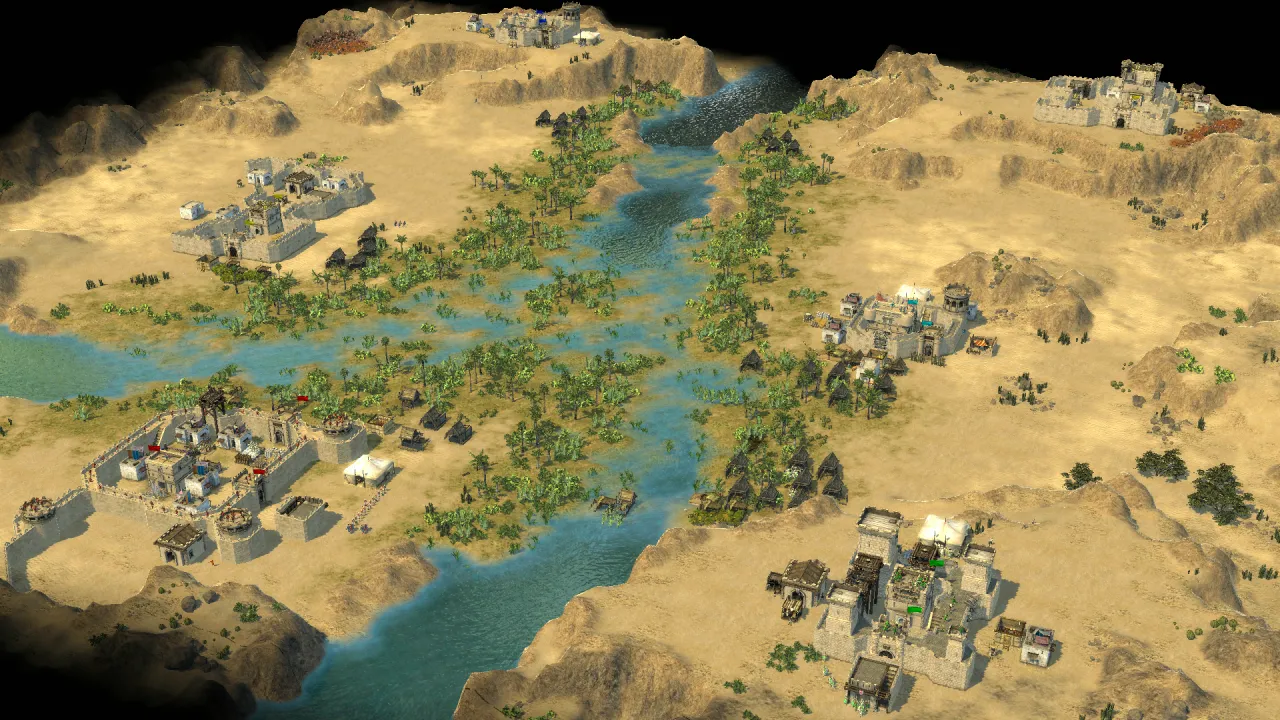
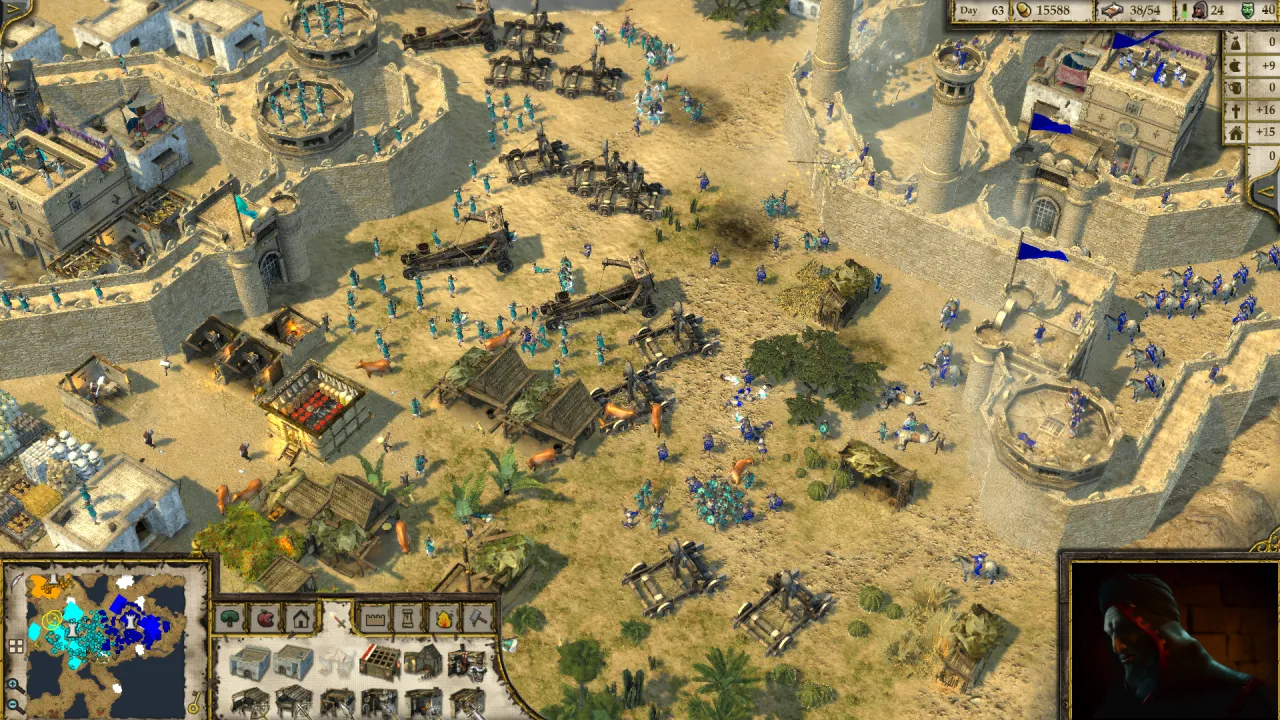
Content: 4/10If you only look at the screenshots, this game can be deceiving. Multiple castles and strongholds are scattered across the desert valley, and when the map unfolds, it feels like looking at an unfinished historical war sandbox. On the other side, Crusader ships are docked by the coastal castle, with the port, water surface, and fortress all in one frame—that moment does easily evoke associations with "grand battlefields." Unfortunately, what the available information can confirm stops right there. That's it. Existing sources provide almost no effective information about mode variety, campaign length, or repetition control, which directly affects experience judgment—what you see is "potentially large," but it's hard to confirm whether it's "truly replayable." This gap is critical. Because what RTS or castle management games fear most isn't lack of content, but appearing abundant while ultimately offering the same flavor after extended play.
I'm unwilling to pass a death sentence on this dimension—after all, the theme is there, and castles, siege warfare, and desert battlefields have inherent visual appeal. But the information gap has grown too large to speak in its favor. By today's actual experience standards, this uncertainty of "not knowing how long it lasts or how repetitive it gets" directly lowers purchase intent. It's not completely untouchable. Just hard to buy with confidence.

Picture Quality | 3.5/10
Graphics: 3.5/10Outside the desert castle, a massive army lays siege, with trebuchets and archers filling the frame to capacity—this sense of "fullness" is one of the few visual impressions that still holds up in this title. Look at the stone castle in the canyon: towers, garrisons, and defensive structures stacked layer upon layer. You can sense it's not selling scenery, but the military layout itself. That's pretty old-school. Like a hard loaf of bread served straight to the table—no plating, just whether you can taste the wheat. The problem is, regarding art style, modeling quality, technical performance, and optimization status, almost all existing media materials are completely out of focus. The gap is too large. The impact on experience is also very direct: you can't confirm whether the grandeur in these screenshots will "hold up consistently" in actual gameplay, or just "look good in select scenes."
This doesn't necessarily mean the visuals are terrible—it's just that no one can provide sufficiently reliable evidence to say how good they actually are. For a title that has lost the advantage of its era and lacks authoritative scoring basis, this ambiguity itself is a deduction. Especially over five years post-release, players will be more forgiving of a game's style, but not of an information vacuum. It at least has clear thematic recognition. But if calibrated against today's actual experience, a 3.5 score already factors in "the presentation of castle siege warfare."

Gameplay | 2.5/10
Gameplay: 2.5/10Catapults smashing city walls, cavalry charging wooden palisades, defenders densely packed atop the ramparts—these scenes easily trigger mental associations with gameplay depth, as if resource management, unit counters, and the thrill of attack-defense rhythm exchanges will emerge in the next second. The scene of large cavalry forces besieging coastal defenses is the same—it looks like a war anthem with heavy drumbeats, the visuals alone pumping up the adrenaline. But there's an entire chain of review evidence between "looks fun" and "actually fun." Existing sources provide almost no effective information about this game's mechanics, combat, or system design, and this isn't a minor issue—it directly causes the core evaluation to lose its foundation. You can't verify the control feel, can't verify the strategic layers, can't even verify whether its most critical loop actually works. For strategy games, this is nearly fatal, because theme and presentation are just the facade—what truly retains players is always the system integration.
So this low score isn't asserting it's "inevitably terrible," but emphasizing "it cannot prove itself trustworthy." That's the frustrating part. You can clearly see the outline of siege warfare and guess what it's probably trying to sell; but once you enter the realm of "is it actually worth spending time on," the information immediately collapses. This dimension gets a 2.5, not as an emotional put-down, but as a penalty for information poverty. When core mechanics can't be articulated, purchase risk gets infinitely amplified.

Audio | 1.5/10
This dimension is almost impossible to discuss. Not because it's necessarily bad, but because existing sources have formed absolutely no reliable description of the music, sound effects, or voice acting. No representative tracks, no battlefield sound effect feedback, no judgment of ambient sounds—even the most basic cross-verification is missing. Blank. Completely blank.
This kind of void might be tolerable in other genres, but it's especially unfortunate in war-themed games. Because the sense of weight in siege warfare often relies half on visuals and half on sound: whether the catapult landing conveys that "stone really has tonnage" feeling, whether the dense shouts of defenders on the walls can sustain tension, and even whether menus, prompts, and unit feedback are clear—all affect the actual experience. Without this information, you can't even confirm "whether it at least sounds like a war."
I don't want to substitute speculation for evaluation. That's not fair. But scoring is for players' actual decision-making, not to preserve a work's dignity. With information missing to this extent, the audio dimension can only receive a judgment close to the lower limit. 1.5 points—not because it's necessarily unpleasant to hear, but because before purchasing, you simply don't know what you'll be hearing.
Plot | 1.0/10
Story: 1/10This is even more straightforward than the audio. All sources provide no valid information about plot, narrative, or character development, and even the worldbuilding and single-player campaign quality cannot be confirmed. There's no main storyline to discuss. No characters worth naming. Not even a single memorable story hook.
What impact does this have? Simple—you can't expect it to leave anything on an emotional level. Even if it's fundamentally more system-driven and story isn't the main course, it should at least let players know why they're fighting, who they're defending, and what this battle means in the broader context. The problem now isn't "weak story," but "almost non-existent in any evaluable sense." This is no longer a matter of taste—it's content absence.
For some players, this might not be fatal. Some play these titles purely for troop formations and walls, not characters and dialogue. But when considered as part of the complete gaming experience, the absence of a narrative dimension still drags down the overall impression. Especially today, even hardcore strategy titles make an effort to provide basic narrative packaging. This title hasn't even crossed that threshold at the material level. 1.0 score. No room for negotiation.




Comments 0
Share your game review
Join the discussion and share your review of this game.
No comments yet. Share your thoughts on this review.