
























Introduction
Released in Early Access on August 26, 2020, *Townscaper* operates on a single premise: drop a swatch and watch a coastal settlement generate itself. It holds a 7.6/10 aggregate rating, with PC Gamer assigning 8/10. That score reflects a deliberate design choice, not a traditional city-builder framework. There are no blueprints, utility grids, or progression meters. The game simply demands a surrender of control.
Players need no knowledge of structural engineering or infrastructure planning. An adaptive grid absorbs random clicks and stitches them into coherent architecture. Arches and spiral staircases materialize from a single input, ignoring your intended layout. The engine handles the cleanup while you supply the chaos. This design explains the absence of progression systems. Nothing requires optimization. The experience asks you to watch the scene settle, finding value in the quiet inevitability of each placement.
Content | 8.5/10
Content: 8.5/10The idea of "clearing the main quest in 40 hours" is a false premise, because this game doesn't have a main storyline at all. It completely erases the concept of "goals." No achievement pop-ups. No collection progress trackers. You just sit in front of the screen. Time moves forward on its own. In today's gaming landscape, this design is practically unconventional. It feels more like a boundless digital sandbox. From compact fishing village cabins to sprawling clusters of colorful buildings, the scale is entirely up to you. No resource anxiety. No countdown timers breathing down your neck. You can spend ten minutes building a lighthouse, or half an hour reshaping an entire coastline. Start whenever. Stop whenever. It reduces "playing" to its most primal state. It doesn't judge efficiency. It doesn't reward grinding. It's like playing with building blocks as a child. Glance at your creation when it's done. Knock it down without a second thought. This burden-free freedom is precisely what makes it so luxurious. You never need to stress about "getting your money's worth." The moment you put down the mouse, the town remains exactly as you left it. The wind keeps blowing. The clouds keep drifting. It doesn't rush you to return, but you know you'll open it again. It's not a toy meant to be cleared. It's a sanctuary to quietly pass the time.
Visuals | 8.2/10
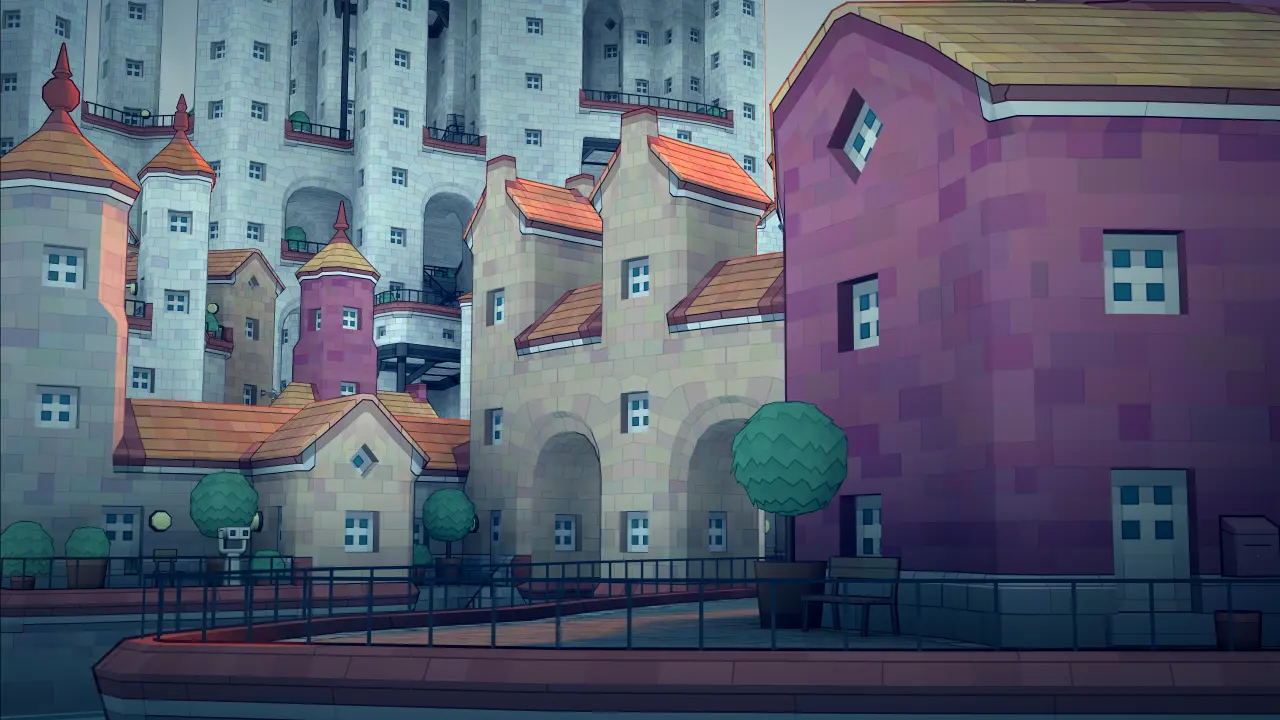
Graphics: 8.2/10The first time you drag a warm yellow onto the palette, the lights across the entire district illuminate all at once. The game’s colors aren’t just “beautiful.” They “breathe.” The developers hid details in unassuming places. Shirts on a clothesline sway with the wind. Seagulls circle the rooftops twice before taking flight. As dusk falls, windows automatically glow with a warm light. These dynamic elements don’t tax performance, yet they quietly fill the empty spaces in the scene. The color palette is remarkably restrained. With just a dozen or so swatches, it can evoke entirely different atmospheres across districts. Cool-toned ports feel crisp and quiet. Warm-toned markets feel lively and bustling. You don’t need to know color theory. Your intuition will handle the rest. Its lighting and shadows don’t chase cinematic realism. Instead, they build atmosphere through layered blocks of color. Like the negative space in a watercolor painting. Less is more. The adaptive grid acts as an invisible brush behind the scenes. You simply apply the colors. It handles the contours. Staggered eaves. Randomly generated steps. Everything snaps into alignment the moment you place them. You never see the seams of the models. You only see a town that has come alive.

Gameplay | 7.0/10
Gameplay: 7/10There are only two operations: Place. Delete. No traffic routing. No power management. No pipe planning. It strips away the most daunting parts of the simulation genre, leaving only the pure act of "placing." The smart modular logic is the core delight. Click a single brick on the water, and the system automatically fills in the foundation. Stack three layers up, and stairs and roofs generate themselves. Tear down a wall, and the adjacent archway smoothly transitions. No manual alignment. No grid snapping. For the first ten hours, you might feel like you're just placing things randomly. After twenty hours, you'll start enjoying that seamless, pinpoint responsiveness—exactly where you point, exactly where it builds. It doesn't teach you how to play. It just hands you a blank slate. The rules reveal themselves through the feedback of every click. You'll quickly pick up the knack, but you'll never grow bored, because every attempt generates new combinations. This minimalism isn't laziness. It's precise subtraction. It knows players don't want to simulate reality. They want to simulate the sheer thrill of "building" itself.
Sound Effects | 7.5/10
Audio: 7.5/10The moment the block drops. It lets out a crisp "pop". The sound effect isn't complex. But it's deeply addictive. There's no grand symphonic backdrop. No intense battle score. The entire auditory space is filled with just two things. The short, sharp feedback of each tap. And the ceaseless sea breeze and gull calls in the background. The former delivers the satisfaction. The latter sustains the mood. When you tap rapidly and continuously to build. The dense "pops" weave into a random electronic rhythm. Like fingers tapping a light drumbeat on a desk. The ambient sounds pull your focus outward. Gulls occasionally skim past the eaves. A breeze lifts the white noise of the waves. They never steal the spotlight. They simply and quietly anchor your attention. The volume balance is finely tuned. The feedback is crisp but not harsh. The ambiance is soft but not sedating. Play with the lights off. The sound will take over the rest of the immersion. It doesn't try to tell a story with music. It just uses sound to build an afternoon you can simply sit and unwind in.
Plot | 4.8/10
Story: 4.8/10There is no protagonist. No villain. No world that needs saving. Boot up the game, and you are met with a flat, empty expanse of water. The developers deliberately set aside any narrative ambition. No character arcs. No lore mysteries to unravel. They don’t even spare a single line of instruction. The entire burden of storytelling has been outsourced to the architecture itself. A crooked wooden cabin. A moss-covered stone staircase. A half-open shutter. These static details speak for themselves. They don’t drive the plot. They merely craft the illusion that "someone used to live here." The lack of traditional narrative drive is undeniable. For players expecting a structured plot with rising and falling action, these dozens of hours might feel hollow and emotionally adrift, making it easy to quit midway. Yet this flaw isn’t fatal. It simply shifts the experience from "reading a novel" to "flipping through a photo album." You don’t need to decipher the next page; you just need to remember the lighting on this one. Choosing not to tell a story is, in fact, the smartest decision. After fifty hours of play, you may not have built any groundbreaking masterpiece. But you will remember a specific twilight spent staring blankly at your screen. The experience defies quantification, yet it feels undeniably real. It isn’t a race car built for the mainstream circuit. It’s a park bench. Those who aren’t in a hurry will instinctively know to stop and rest. It doesn’t demand your undivided attention; it only fills in the cracks of your free time. You can pause whenever you want, and return whenever you’re ready. Your progress is always there, neither advancing nor fading. When is the best time to open it? On a weary subway commute after work. On a couch on a weekend afternoon when you’d rather not think. It doesn’t measure efficiency. It doesn’t reward grinding. It simply hands you a clean canvas. Is it worth buying? That depends on whether you treat games as a task or as a form of rest. It’s worth it at full price, and an even better deal on sale. It doesn’t test your skills. It only tests your ability to relax.






Comments 0
Share your game review
Join the discussion and share your review of this game.
No comments yet. Share your thoughts on this review.