
Notizia
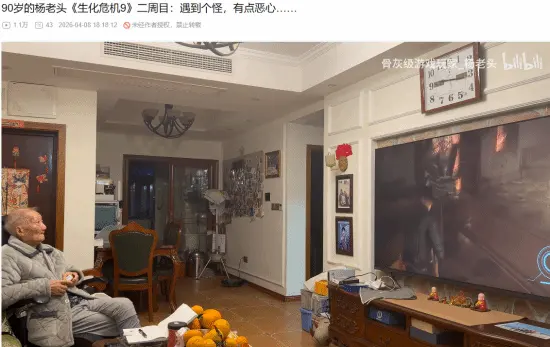
73-Year-Old Grandma Rushes to Switch 2 After Xenoblade Genesis Reveal
After Nintendo Direct revealed Xenoblade Chronicles Genesis and a Switch 2 version of Xenoblade Chro
















They made a very interesting trade-off here: on one side was a public safety care system for the elderly, and on the other was the attention-capturing power of video games. The result was that reality turned into something like a highly immersive experience test, directly crashing these two mechanisms into each other. According to foreign media outlet dexerto, a mix-up recently occurred in Westlake, Ohio, USA, when a 91-year-old woman missed her check-in call because she was so absorbed in a game, ultimately prompting the police to come to her home to check on her. On the surface, this news sounds pretty funny, but from a design perspective, it actually says a lot about just how powerful games can be at holding attention.

First, the chain of events: the elderly woman was participating in the local government’s “Are You OK?” public welfare program. Its core function was not complicated—it provided seniors with free daily wellness check-in calls as a low-cost way to confirm their safety at home. On the day of the incident, she did not answer the call on time. After staff failed to reach her multiple times, they notified the Westlake Police Department. When officers arrived, they knocked on the door and called out, but got no response. Unable to confirm her condition, they had no choice but to enter the house to check on her. In itself, this response process was actually quite professional and consistent with emergency assessment logic.

The twist was a classic one: the woman had not suffered any medical emergency at all. She was safely in her bedroom, completely focused on playing a video game, and at the time was apparently trying to beat her personal high score. Police later said that once they found her safe and sound, the tense atmosphere at the scene quickly dissolved and everyone started laughing. The only detail still unconfirmed is exactly which game she was playing. For now, it is only known that it was a title featuring a running-based gameplay mechanic.

From a design perspective, the reason this kind of “running gameplay” so easily pulls people into a flow state is usually not because of complex storytelling, but because it repeatedly stimulates players through extremely short feedback loops. Every action immediately produces visible changes in score, distance, and rhythm. This is a very textbook example of an instant-reward structure, especially well suited to repeatedly challenging one’s personal records. Technically speaking, these games have a low input threshold, high feedback density, and low failure cost. Even very elderly players can quickly understand the objective and stay engaged, which precisely shows that games are not a medium exclusive to younger people.

But this incident also serves as a reminder for public services: the traditional phone check-in model may no longer cover every real-world usage scenario today. From a business logic perspective, the gaming industry has spent the past few years talking about the potential of silver-haired users, yet the interaction design of public systems still clearly remains stuck in the old assumption that “a phone call will definitely reach someone.” A more reliable solution might be a combined verification system involving phone calls, text messages, door sensor alerts, or even TV-side confirmation, rather than directly equating “didn’t answer the phone” with “must be in danger.” Otherwise, the cost of false alarms will only keep rising.
For the player community, the most interesting part of this story is not the surface-level contrast of “even a 91-year-old woman plays games,” but the fact that games, as an everyday entertainment tool, are increasingly penetrating across age groups. Unlike many hardcore AAA titles, lightweight games with clear rules and direct feedback are actually more friendly to older users, and this is also one reason the casual category has remained steadily popular in recent years. If there are older family members at home who want to get into gaming, I would actually recommend starting with these kinds of games—ones with a clear rhythm and simple goals. Don’t throw them straight into a complex system from the start; that kind of onboarding design is often extremely discouraging.
In the end, this misunderstanding became a heartwarming little episode, but it also very realistically illustrates one thing: when a game can make a 91-year-old player forget about phone calls and knocking at the door, it becomes difficult to keep viewing it simply as “a way to pass the time.” Professionally speaking, it means the interactive feedback was done right; realistically speaking, the relevant alert systems also need an upgrade. There is nothing wrong with the game. The real issue is that the notification mechanisms of the real world have not yet kept pace with changes in user behavior.




Commenti 0
Ci interessa la tua opinione
Benvenuto! Raccontaci cosa pensi di questo gioco: chi arriva per primo potrebbe avere una sorpresa.
Ancora nessun commento. Scrivi il primo.