

























Opening
Punch a hole through a building, watch it fold into a corridor of splintered wood and pulverised concrete, and you have already seen the one thing Teardown does that nobody else has caught up to.
This is not a game that earns its keep through story or character. Its entire appeal rests on a single fact buried in the engine: every voxel in the scene is part of the physics simulation. Which wall you carve, the shape of the hole you leave, the angle from which you hollow a house — all of it is yours to decide, not a handful of pre-baked shatter animations the developer chose for you. That freedom is no cosmetic flourish. It is the payoff of Tuxedo Labs' bespoke engine, and it is the only reason this small indie has any business standing where it stands in the sandbox genre.
The clever part is that it refuses to let the freedom stop at catharsis. Every level is wrung into an optimisation problem of space and time — an untimed planning window to lay your route, then a 60-second clock that dares you to run it clean. Demolition stops being a thrill and becomes a tool for solving the puzzle. Over the next six dimensions — story, audio, graphics, gameplay, content and the verdict — this review traces exactly where it soars, where it falls short, and why, four years on, it is still worth a look.
Story | 6.0/10
ストーリー: 6/10A thin thread that exists only to start a level

If you arrive hungry for narrative, the first thing to make peace with is simple: Teardown barely tells a story at all. There is a thread — you play a contractor taking on demolition and theft jobs, from wrecking the Lee Chemicals plant to lifting valuables out of the Villa Gordon estate — and that thread stitches nine levels into a loose sequence. But the thread has exactly one job: to hand each level a motive and a backdrop. Nothing more.
You will meet no character whose name you need to remember, no twist worth turning over later. The nine levels sprawl across quarries, islands and towns, and what carries you forward is the change of scenery, never the arc of a person. There are emails and briefings between jobs, but they read as flavour text — a sentence of motive, a target circled on a map, and you are off. The plot here is scaffolding, not a load-bearing wall. It is present, and you are free to ignore it the instant you set off after the spatial puzzle waiting inside the level. Skip every line of text and you lose nothing the game actually cares about.
This is a clear-eyed trade, not a failure of nerve. Every scrap of effort went into the mechanics, and the narrative blank is deliberate, not a gap somebody couldn't fill. Once that lands, recalibrate every expectation you hold for this dimension. The game does not want you to feel for it. It only wants to hand you a reason to start tearing — and on that narrow brief, the thin story is exactly the right amount of story, neither more nor less than the levels require to get going.
The one stretch of plot the multiplayer patch added

The only obvious helping of fresh story showed up late. The March 2026 update — the largest free drop since launch — bolted multiplayer onto the game and tucked in a mini-campaign set in the quiet village of Tilläggaryd: five brand-new heist jobs.
That this stretch exists says more than anything it actually depicts. It tells you the studio knew full well that a threadbare campaign was the complaint trailing the game everywhere, and answered it with a free new playground rather than a free new yarn. The five jobs keep the familiar rhythm and grow no sudden web of relationships, but they give veterans a reason to drop back into the voxel world and hand co-op a stage built for it, instead of recycling old levels for online play.
Even here, expanding the story means, at bottom, expanding the puzzles — for this game, a new tale is almost always a new arrangement of space. The quiet, scattered layout of Tilläggaryd handed the level designers fresh room to work: different structures mean different teardown routes and different timing pressures. The plot wrapping is incidental; the spatial problem underneath is the point. Across the whole life of the game, a "new story" has meant a new set of walls to read, and this late chapter is no exception.
Where it parts ways with Subnautica

Set it beside Subnautica, another small indie that lives or dies on a single mechanic, and its stance on storytelling snaps into focus. Subnautica also runs on one core idea, yet it leans on environmental narrative to apply pressure — the dark beneath the surface, the oxygen gauge bleeding red, the silhouette of something enormous. The story is squeezed out of the world, and dread pushes the player toward competence.
Teardown takes the opposite road. It all but abandons the narrative leg and stacks its full weight on the playability of the physics itself. This is no ranking of better and worse; it is two survival strategies. One holds you with atmosphere, the other with mechanical purity. Strip the story and mood from Subnautica and half the experience collapses; delete the contract thread from Teardown and the core barely flinches — which is the surest proof of how light its narrative weight really is. That is precisely why GameSpot capped it at 7 over thin campaign content. On this dimension it turned in a blank page, and the blank was on purpose.
Audio | 7.5/10
サウンド: 7.5/10Every material breaks in its own voice

The bulk of Teardown's sound is the noise of materials coming apart, and its finest trick is that those noises are kept distinct. Wood snaps with a bright crack. Concrete comes down on a dull, heavy thud. Metal gives up under a sharp, grinding screech. Close your eyes and the audio alone tells you roughly what you just cut through.
That reads like a detail; it is in fact load-bearing for the whole sense of immersion. The core pleasure is tearing things open with your own hands, and if every material answered with the same muffled crunch, the conviction that you are wrestling with a real physical world would crumble on the spot. The studio clearly understood this, so the grain of the material audio matches the grain of the voxel physics. On the physics side each block carries its own material properties; on the audio side each material carries its own breaking signature. The two grids are cut to the same resolution, and that parity is what sells the fiction. Hear the right crack at the right moment and your brain stops questioning whether the wall was ever solid in the first place.
A score that serves the tension, nothing more

If the sound effects supply the realness, the score supplies the pacing. Outlets tended to call the music "tight," and the word fits — it never grabs the spotlight, working start to finish in service of the swing between calm and panic.
The method is exact. Through the untimed planning window the music stays low and restrained, almost receding into the background so you can study the map, weigh the route and stage your vehicles in peace. The moment you touch the first objective and the 60-second clock starts, it snaps into a taut, quickened tempo and shoves you out of "lay it out at leisure" and straight into "every second counts." It is a textbook piece of musical pacing — it moves you not through melody but through the switch in rhythm, marking the exact pivot where play tips from slow to fast. The beauty is that you need not even glance at the timer; the shift in the score from soothing to urgent makes the body tense and the hands speed up on instinct. The music is not décor here. It is part of the loop. Paired with debris scattering under ray-traced light, sound and image push that 60-second sprint to its full charge.
How it differs from Red Faction in the audio layer
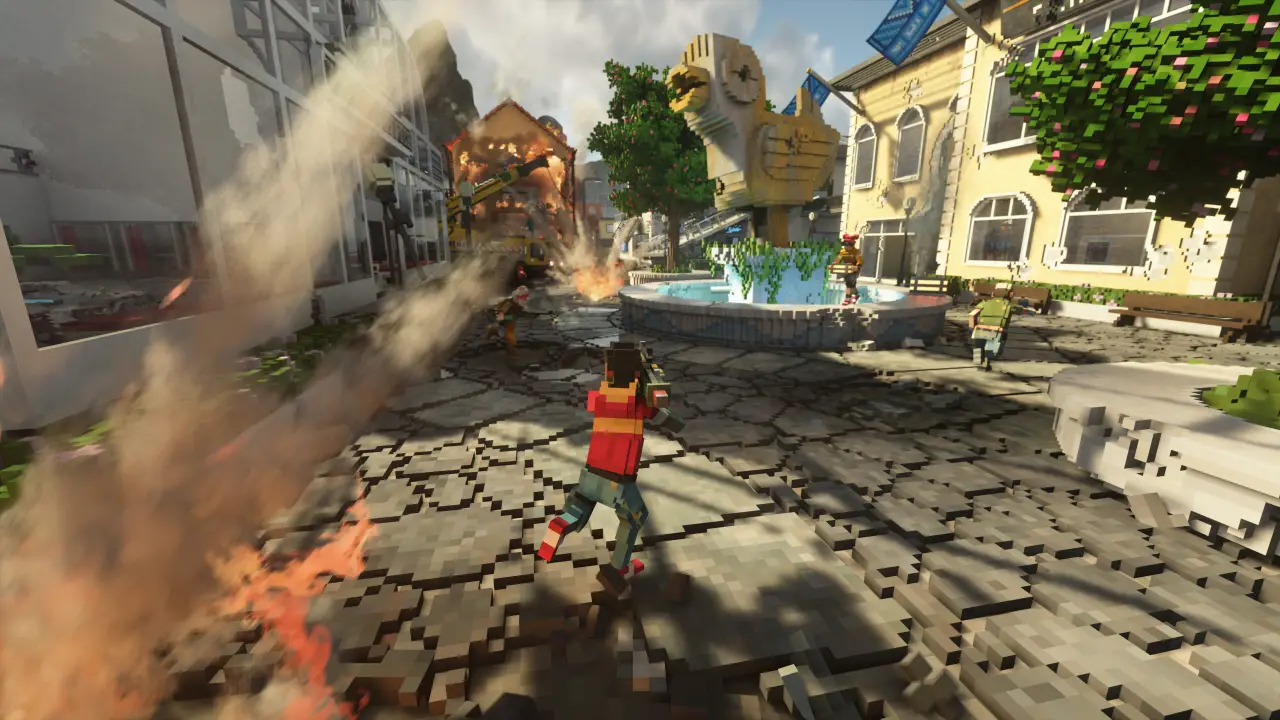
Listen to it next to the demolition sandbox it is most often measured against — Red Faction: Guerrilla — and the gap hides down in the tech. That generation's destruction audio leaned more on pre-built sound libraries matched to a handful of fixed break types. Teardown, because the destruction is generated live from the voxel physics, fires its material audio live off the physics event, at a finer grain.
None of which means the recordings dazzle in raw fidelity. Its edge is not the lushness of any single tone but how tightly sound is bolted to physics. Every breaking noise answers precisely to the action you just took, and that three-way lockstep — image, sound, input — is what makes the audio hold up. You cannot judge this game's audio by the old yardstick of epic scores and heartfelt voice work. It has no voiced plot to carry and no theme you'll loop on repeat. Its sound has one goal: to convince you the voxel world in front of you is real and ready to be touched. Against that goal it does the job, and does it without ever stealing the scene.
Visuals | 8.5/10
グラフィック: 8.5/10Voxel art, where a colour leads a double life
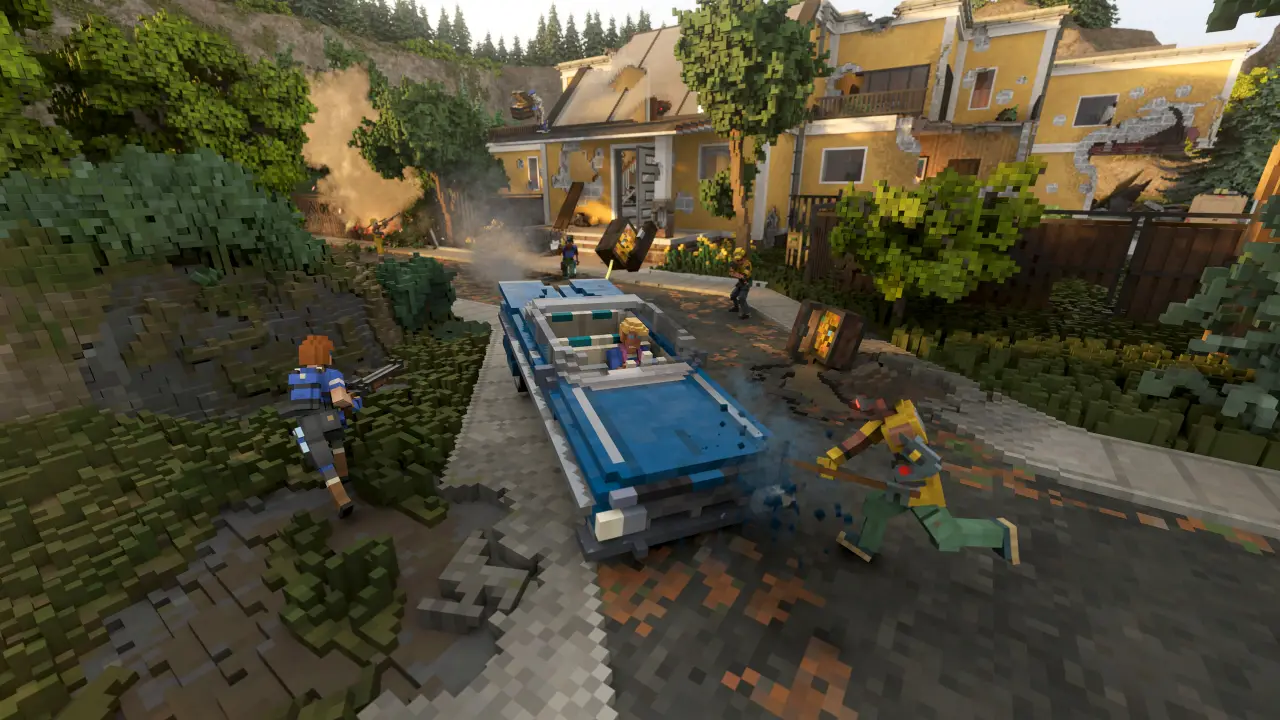
Teardown's world is built from voxels — read them as three-dimensional pixels. It runs an 8-bit palette: coarse, blocky, instantly recognisable, on a completely different aesthetic wavelength from the photoreal blockbusters chasing realistic materials today.
But the palette hides a neat design that is easy to miss: colour is never only colour. It also fixes the material's physical properties. Whether a voxel is wood, stone or metal is encoded in its colour, and material in turn governs how it behaves under force — wood gives way to a single swing, metal demands a heavier tool, stone sits between the two. What you see and the handling you are about to feel are two faces of the same data. That "what you see is what gets computed" unity makes the art more than a style pick; it is part of the play, and it is the sort of clean diegetic legibility that photoreal blockbusters, for all their texture work, often cannot match. Glance at a wall's colour and you can already read how hard it will be to bring down and which tool to reach for, with no extra HUD prompt needed. The coarse pixel look turns into an asset: the simpler the blocks, the cleaner the colour, the faster a player reads the world's material rules. Legibility, not fidelity, is the goal, and on that count the blocky palette wins outright.
A bespoke engine and real-time ray tracing
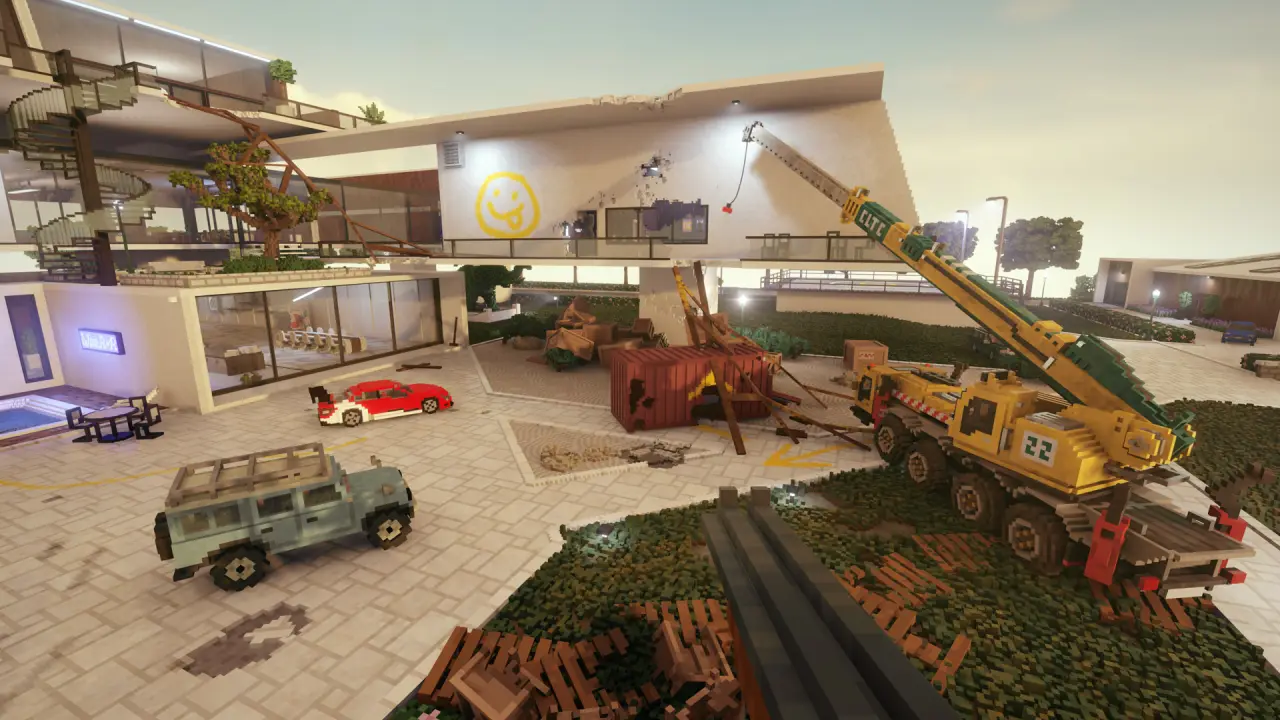
What lifts this voxel art from "retro throwback" to "technical showcase" is the lighting. The developer, Dennis Gustafsson, wrote a bespoke engine almost single-handedly in C++, and its headline feature is real-time ray tracing driving the global illumination.
What does that buy you? It means that even when you carve a building open and send a cloud of splinters and steel beams into the air, every flying fragment still wears accurate light and reflection. The light does not break just because the world was pulled apart — which is the whole point of real-time global illumination. Coarse pixel blocks set against lighting precise down to the reflection make a hard contrast, and several outlets reached for "unbelievably beautiful" to describe it, treating the look as a technical breakthrough for voxel aesthetics rather than nostalgia in pixels.
Better still, the lighting is live: carve through a wall and sunlight pours instantly into a room that was dark a moment ago, the whole space's tonal balance recomputed on the spot. The light is not just pretty; it reports back, faithfully, on what you just did to the world. That feedback loop is rarer than it sounds — most games bake their lighting in advance, so a freshly punched hole would leak no new light at all. Here the glow that floods through your shortcut is earned, computed the instant you make the opening, and it quietly doubles as confirmation that the space really did change shape.
The cost of all that, and how it runs on an ordinary machine

By platform, the PC 1.0 release landed in 2022, with the PS5 and Xbox Series X|S versions following in 2023. More telling than the platform spread, though, is the optimisation work underneath it.
A voxel world sounds lovely; the cost is concrete. Filling every object with dense blocks that each take part in the physics produces an enormous data load, demanding far more memory and compute than an ordinary polygon game. Gustafsson wrote a great deal of low-level optimisation to make a world where every block can come apart run at a stable frame rate on a regular PC. That unseen engineering is the real reason the industry kept singling the game out for "best technology" — behind the striking image is the hard graft of dragging an idea that should not run into something playable. Stand it next to Minecraft, another blocky world, and the ambition is plain: that game makes blocks a canvas for building and survival, with the blocks themselves largely staying out of fine-grained collapse, while Teardown pushes further, folding both ray tracing and live demolition into its voxels so the blocky world can glow in detail and still be pulled apart at will.
Combat | 9.5/10
ゲーム性: 9.5/10The bedrock: every voxel has its own temper

To grasp why this game plays so well, start with the bedrock: a fully destructible voxel world where each block carries its own material physics. Wood gives way to one swing, metal demands a heavier tool to shift at all, stone's hardness sits between them.
The crux is that the rule is foundational and uniform, not scripted for a few chosen set pieces. A traditional polygon game handles destruction by pre-building a couple of broken states for an object and swapping them in on cue, which keeps the ways things can break severely limited. Teardown is different. It fills objects with dense voxels, each computing physics in real time, so any angle and any shape of teardown can be generated on the fly. You can cut a hole of any outline in a wall, hollow a house from any point — and that freedom comes straight from the data structure, not from a developer's script. This, more than anything, is what opens the gap between it and every peer in the category.
The planning window and the 60-second clock

A destructible world alone is not enough, though; what makes it work is the structure wrapped around it. Every heist level splits into two phases, slow then fast. The first is an untimed planning window: at your leisure you cut through walls, ram barriers with vehicles, lay ramps and park the getaway vehicle exactly where you want it, running the whole route in your head and on the map at once. The second kicks off the instant you touch the first alarm-linked objective — a 60-second clock starts, and you must grab every target and reach the getaway vehicle before the helicopter arrives.
That slow-then-fast tension is the soul of the loop. The calmer the planning, the more the execution feels like a timed sprint you choreographed yourself. It sews two opposite states — ease and dread — into the same level. The neatest part is that whether you survive those 60 seconds depends almost entirely on the homework you quietly did beforehand. It hands the verdict back to the player's head, not their reflexes.
Demolition as a puzzle — the real brainwork
Here is Teardown's most underrated and most central design: destruction is not catharsis, it is the tool you solve the puzzle with. Inside the planning window you are facing, at heart, an optimisation problem of space and time. Targets are scattered across the map, the getaway vehicle sits in a fixed spot, and the clock gives you only 60 seconds — an honest route that takes the long way around simply cannot be finished.
So which wall a vehicle should punch through, where to throw down a ramp, along which line to clear a straight shortcut becomes the true key to clearing a level. Late maps routinely ask you to combine tools and vehicles: open a main artery with an excavator or truck, blow a flank shortcut clear, and compress a route that could never fit inside 60 seconds down into something that can. This is the concentrated form of its puzzle depth, and the root of what separates it from a category of pure release-valve sandboxes.
Tool tiers, vehicles, and multiplayer's late arrival
A whole laddered set of tools and vehicles props up that puzzle. Your kit climbs from sledgehammer, extinguisher and spray can up to heavier breaching charges and a demolition launcher; the vehicles cover cars, trucks, cranes and excavators. As levels advance the map grows, targets multiply and the tools get stronger, the difficulty climbing with them and forcing you to keep digging up new combination solutions.
The game's oldest weakness — loneliness — was patched out in that March 2026 update. Up to 12-player multiplayer arrived, letting players divide a single heist: one rams a wall to open the way, one rushes in for the targets, one holds the escape route. Beyond co-op campaign there are competitive modes like Deathmatch and Capture the Flag that turn the destructible scenery into a board for attack and defence — blow yourself an escape tunnel, or drop the floor out from under a rival. Against the Red Faction: Guerrilla it is forever measured against, the edge stays clear: that game's destruction is still bound by pre-set structure, while here every single block can come apart, a full tier of freedom higher.
Content | 6.5/10
ボリューム: 6.5/10A short campaign, propped up by challenge modes
The ugly truth first: count only the campaign proper and Teardown is short on content. The 1.0 release holds nine levels, hardcore players clear it across a few evenings, and sweeping every achievement and detail runs to roughly eighteen hours. For a game that lives on its mechanics, that length cannot carry an expectation of playing forever.
The first layer patching that shortfall is a set of standalone challenge modes. Mayhem asks you to flatten as many voxels as you can inside a time limit, a pure contest of teardown efficiency; Hunted has you gather items while something chases you, the tension dialled to maximum; Fetch is a 60-second collection sprint. None of them tells a story or hands out a campaign objective, and that is the point — they are leaderboards in disguise, built for the player who has already wrung the nine levels dry. Each lifts the core teardown-and-timer mechanic out on its own and shapes it into a short, sharp test, handing players who want more after the credits a reason to stay. Their design philosophy is uniform: strip away the heist dressing of the campaign, leave only the bare mechanical core, then interrogate you with a different rule each time. Score-chasers and execution perfectionists find the replayability the campaign withholds — one map, run again and again to shave the route and push the number higher. It is the classic indie longevity trick: trade mechanical depth for runtime length.
DLC and the build-your-own creative mode
The second layer is official expansion. Beyond the free Art Vandals add-on sit paid DLC packs — Time Campers, Folkrace, The Greenwash Gambit — plus Relics of Barkuna, slated for June 2026. Each tops up an hour or two of new scenes and play; none is large, and they read more as periodic novelty for veterans than as a body of content that shifts the game's scale.
The real turning point for content, though, is creative mode. It lets you assemble 3D models out of voxels like building bricks, save them across levels and reuse them, and even import from MagicaVoxel. For a slice of the audience this turns Teardown from a game you finish into a pure voxel-sculpting and physics-lab tool — they build models, test materials, watch how things come down, with barely a connection to the campaign. That "be your own maker" value never shows up on the official content list yet genuinely stretches the game's life. Build a structure of your own design in creative mode, then drop into the sandbox and pull it apart piece by piece to see how your design collapses under the physics. For the engineering-minded the build-it-then-break-it loop is the reward in itself, needing no level objective to drive it.
The Workshop is the real ocean of content
What actually keeps a 2022 game alive today is its Steam Workshop. Across the game's life the community has submitted over 6,000 mods, backed by Lua scripting and a built-in level editor. Workshop fare runs wild: people recreate famous real-world buildings and scenes from film, or simply rebuild the game into a racer, a tower defence, even a straight physics laboratory.
Ordinary players start by tweaking a car or adding a tool and, through the editor, work their way up to complete custom levels. This is exactly why so many call it "a voxel Garry's Mod" — like that game, the base is only a framework and the community is the real ocean of content.
For anyone willing to dive headlong into the Workshop the content is near-endless; for a player who never touches a mod, the floor really does arrive after nine levels. That is the most honest two-sidedness of its content, and it is worth flagging plainly before purchase. Your mileage depends almost entirely on one question: are you the kind of player who browses a Workshop page, or the kind who never leaves the main menu? The first will sink hundreds of hours in; the second should price the game as a tight, nine-level showcase and judge it on that alone. Both readings are valid. They are simply not the same game, and the Workshop is the line between them.






コメント 0
ご意見をお聞かせください
このゲームについての感想や評価をお寄せください。
まだコメントはありません。このレビューへの感想をぜひどうぞ。