























Opening
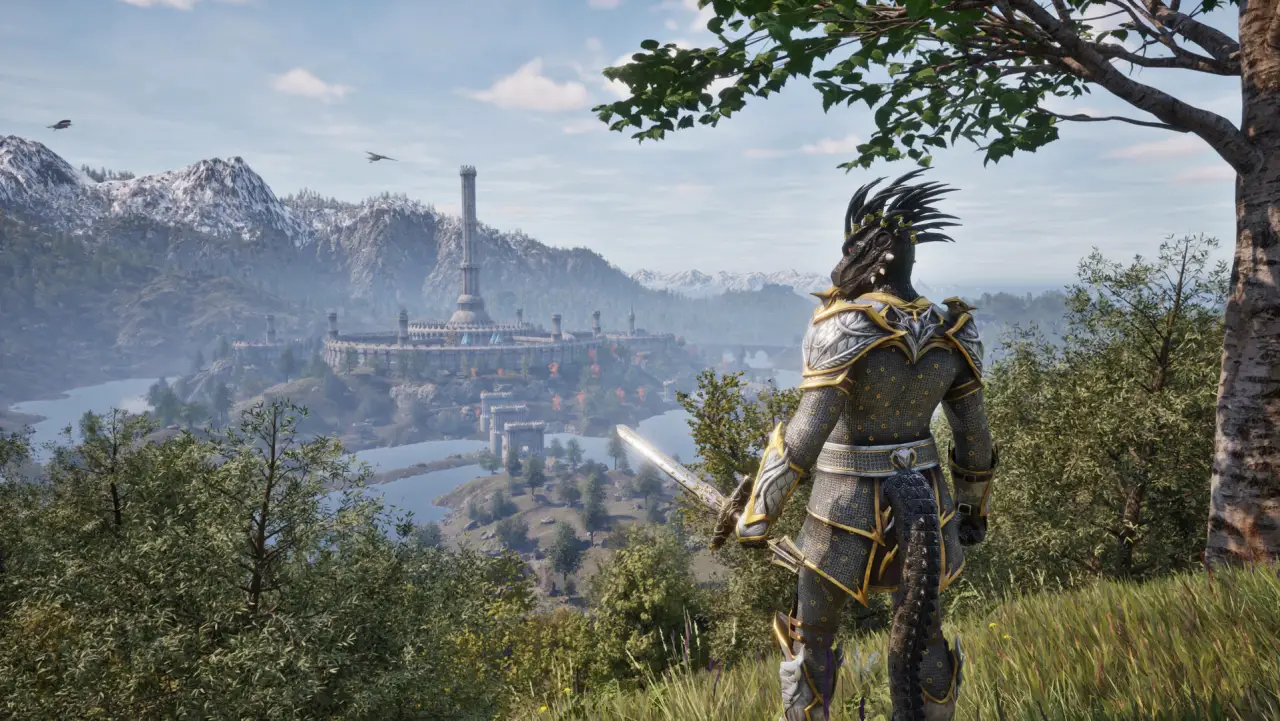
The smartest thing Oblivion Remastered does is refuse to become a new game. Virtuos repaints every leaf and shadow in Cyrodiil with Unreal Engine 5.1, then lets the nineteen-year-old Creation Engine keep running the logic underneath — the Emperor, the gates, the four guilds, all untouched. So the first time you crest a ridge and see the Imperial City sitting on its lake, two things land at once. One is brand new: ray-traced daylight pressing down on the mountains. The other is ancient: that old itch to abandon your quest and wander into the dungeon by the road, preserved exactly as it was.
It is not a clean piece of work, and you can list the flaws inside an hour. Enemies level up alongside you. Combat is stiff. Above 1080p even an RTX 4090 stutters. These are real deductions, and every section below will lay one of them out in full.
None of it stopped anything. The game shadow-dropped with zero warning, sold at least four million copies in four days, topped April's US sales charts, and crashed into the third best-selling slot of 2025 to date — all of it achieved while it sat free on Game Pass the entire time. This review is about that contradiction: how a nineteen-year-old RPG, warts and all, talked four million people into falling for it all over again.
Story | 9.0/10
ストーリー: 9/10The main quest is a stubborn straight line — and that is exactly why it holds

Emperor Uriel Septim VII is assassinated, Oblivion gates tear open across Cyrodiil, a daedric army pours through, and you have to find the lost heir and seal every gate before the world burns. As premises go in 2026, this is almost defiantly old-fashioned. There is no narrative trickery here, none of the grey-area moral fence-sitting that modern RPGs love to perform. The chosen outsider saves the kingdom. That's the whole pitch.
But stubbornness has its rewards, and the reward here is clarity. Within your first hour you know exactly what the crisis is and where you are running. You never have to dig through three menus to understand the world. The main quest works like a load-bearing beam: plain to look at, but it stands Cyrodiil up and gives every side story a wall to hang on.
What seals it is the opening performance. Patrick Stewart's monologue as the doomed Emperor remains one of the most memorable scenes the series has ever produced — a Shakespearean actor handing fate, in dead earnest, to a prisoner he has never met. The remaster keeps that performance whole, and the gravity it establishes pulls you into the role in a single breath.
There is a lesson in that scene about restraint. The main story never tries to out-clever you; it simply commits, fully, to its own straightforward mythology and trusts the performance to carry the weight. The main story wins by being steady, and that steadiness starts the moment the Emperor speaks.
The blood and warmth live in the faction lines you wander into

If the main quest builds the skeleton, the flesh of this world is entirely in its factions. The Thieves Guild, the Dark Brotherhood, the Fighters Guild, the Mages Guild — four self-contained novellas that never tread on one another. Their writing density is the highest in the entire series. You are not grinding a promotion bar; you are reading stories with beginnings, turns, and people who stay with you.
The Dark Brotherhood line in particular is untouchable. Cold in tone, sharp in its choices, it pushes moral decisions on you that the main quest would never dare, and many veterans still rank its writing as the best Oblivion ever wrote. The Thieves Guild, by contrast, spins stealth and larceny into a legend about the Gray Fox — light on its feet, with the humour hiding in the moment after each clean getaway. Together they prove a quiet truth: Oblivion's finest stories were never on the road to saving the world. They were down the side paths you took by accident.
The two expansions push that depth another notch. Shivering Isles drops you into the realm of the Mad God Sheogorath, a whole surreal arc soaked in black comedy and large enough to stand as its own game. Knights of the Nine offers something more solemn, a crusade with a holy theme. Crucially, both ship inside the standard edition of the remaster — you never pay a cent extra for the complete narrative.
Its character is something the whole game grows, not a single twist

Oblivion has a texture that is genuinely hard to clone: it is not always polished, not always serious, and now and then it produces a clumsiness that makes you grin. An NPC will discuss a trivial errand in absurdly grave tones; a sober quest will suddenly tip into the ridiculous. That strange streak of humour is precisely what separates it from the more buttoned-up open-world RPGs that followed.
This character is not bolted on by some main-quest reveal. It grows, slowly, out of the dialogue, the voice work, and the quest design all at once. It makes Cyrodiil feel less like a carefully tuned set of levels and more like a slightly old, slightly odd place you simply want to stay in. Set it against the polished maturity of The Witcher 3's storytelling and Oblivion looks rough — but that vintage-fantasy-serial flavour is the one thing polish can never buy back.
So story earns a high mark here, and not because the main plot stuns you. It earns it because the world is alive — alive enough that you push your bedtime back to hear one more line, take one more side quest. That is why it survived, and why four million people happily sank back into it.
Audio | 6.5/10
サウンド: 6.5/10Sound is the stock at the bottom of the pot: invisible, until it's gone

Audio is not this remaster's sharpest selling point. It behaves more like stock at the bottom of a pot — rarely the star, instantly missed if you drain it. The ambient layer and the overall sense of adventure still work: out in the wild, wind and distant birdsong tell you the woodland is alive; in a town, market chatter and echoing footsteps build the space; underground, a damp, pressing reverb makes you slow your movements without thinking. Stacked together, these sounds hold up the feeling that you are genuinely on a journey. The audio rarely announces itself, but it is constantly doing quiet structural work — telling you whether a space is large or cramped, safe or watched, alive or abandoned. Strip it away and the world would not look worse, but it would feel hollow, like a stage set with the house lights left on.
The music and effects mostly serve the overall mood rather than leaping out to demand attention. That is a deliberate posture, and not entirely a flaw — the soundtrack works in the background and lets the visuals and the exploration take the lead role. Its themes still swell at the right moments, on the open road and at the mouth of a fresh dungeon, but they are content to underline a feeling rather than become one. It is a soundscape built to be lived in, not listened to in isolation, and on those terms it does its job without a single false note.
Critics barely mentioned it, and that silence is the verdict

Worth noting: critics largely glossed over the audio, and that itself says plenty. It never formed an overwhelming upgrade memory the way the visuals did. You would struggle to point at one cue and say "that's the thing that kept me here," but you would also struggle to name a track that broke immersion. It is that breed of soundtrack — fiercely functional, faintly present. There when you need the atmosphere, retreating behind you when you don't. That is the reason audio cannot score high here: it is competent and capable, but short on the moment you single out to praise. Read another way, the restraint is honest — it does not try to paper over the game's age with over-production, the way a lesser remaster might bolt on a bombastic new score to feel current. It trusts the original work to carry itself, and mostly it can. The trade-off is that audio becomes the one category where "perfectly fine" is the ceiling rather than the floor — and in a game whose visuals reach for spectacle, fine starts to feel quiet by comparison.
The voice cast keeps a classic alive — and keeps its age audible

Voice work is the most interesting and most contradictory slice of the audio. The remaster keeps the original performances whole, including Patrick Stewart's celebrated monologue as Emperor Uriel Septim. That is a huge plus — the grave, faintly fated Shakespearean cadence is a major source of the game's character, and the nostalgia rings completely true.
But keeping the classic performances also means keeping the whole period acting cadence. Beyond a handful of standout moments, a great many NPCs sound plainly old: the tone, the timing, that slightly stilted delivery peculiar to early open worlds — it occasionally pulls you out of the present. To veterans that grain reads as flavour; to newcomers it can read as a barrier. The conclusion is simple. If you can take a little vintage texture, treat it like film grain on an old serial, it is more than enough and rather charming. If you can't, it becomes a small, recurring scuff you should brace for going in — not a dealbreaker, but a thing you will notice every few hours, and worth knowing about before you commit.
Visuals | 7.5/10
グラフィック: 7.5/10Unreal 5 rebuilds not just the textures, but the way you look at the world
Virtuos took an unusual route here. Unreal Engine 5.1 is layered on top of the old Creation Engine: Creation keeps running the logic, the AI, the physics, while UE5 swaps out the entire visual presentation. It is a strange hybrid on paper, but in practice it explains both the game's biggest strength and, later, its biggest weakness — the brain is old, the skin is new. What reaches your eyes is the real deal — ray-traced global illumination, rebuilt foliage, new fluid simulation, and fully remade character models and materials. Together they haul Cyrodiil out of 2006 and into a modern visual standard without stripping away its fantasy soul.
This is not the kind of facelift that only shows up in side-by-side comparison shots and means nothing in motion. It genuinely changes how you read the world. You start tilting the camera up to follow a ridgeline; you slow down in the wild; you take the long way round for a good sunset. Crest a hill and look down on the lakeside Imperial City, its white towers stacking up under ray-traced sky, the mountains pressing the horizon, and you understand instantly where OpenCritic's 81.8 comes from. The flat, layerless lighting of the original is gone, replaced by daylight with volume and a real sense of time of day — golden hour actually feels golden, and a storm rolling over the Jerall Mountains looks like weather rather than a texture swap. It is the rare remaster where the lighting alone justifies the project.
What this remaster does best is not faces or showpiece set-dressing, but atmosphere in its natural scenes. Riverbanks, woods, distant peaks, stone bridges — assembled, they carry an old-fashioned fantasy-cinema mood that is restrained yet endlessly watchable. The denser foliage matters most: the original's sparse, repeating shrubs become thick, layered growth, and the woodland finally feels like somewhere you could lose your way.
This dovetails with the exploration itself. The better the wild looks, the more potent that "just a few more steps" pull becomes — you are not driven forward by a quest marker so much as lured by the scenery itself. Where Kingdom Hearts reaches for bright, cartoon fantasy, Oblivion goes for something weighty and realistic: mist, low sun, the damp light of a forest floor, all of it serving the single idea that this is a real journey. Visuals here are not a flex; they are the bedrock the exploration rhythm stands on, the reason a map full of unmarked points still feels worth walking.
But that beauty is something you buy with frames
The price is just as clear, and severe enough to belong in any buying advice: performance. The dual-engine stack brings structural stutter, and this is not the ordinary "low-end can't run it" problem — it is "high-end can't save it." The pattern players keep reporting is brutal in its consistency: the moment you push past 1080p/60fps, even on an RTX 4090, the open world hitches; drop back to 1080p and most of the stutter finally clears.
Underneath sits the inherent overhead of two engines exchanging and streaming data across a boundary they were never designed to share, and the community broadly treats it as an architectural problem — not something user settings can root out, and not something a single patch is likely to flatten. People have tried every trick in the book, from capping framerates to editing config files, and the consensus is that you can soften the hitching but never fully kill it. PCGamesN puts it bluntly: performance issues are forgivable in games at the frontier of design, but in the remaster of a nineteen-year-old RPG they are inexcusable. That is not an unfair bar, since the baseline expectation for any remaster is simply that it should run smoother than it once did. The visual upgrade is, most of the time, both necessary and genuinely lovely — but you need to read the bill. The picture is its highlight, and the performance is the main reason Steam sits at a 77% rating. Before you buy, make sure your machine and your patience can both absorb the cost of looking this good.
Combat | 8.5/10
ゲーム性: 8.5/10What hooks you is not a single system but a rhythm that keeps pulling you off-course
The first few hours of Oblivion carry a faint awkwardness, the feeling of adjusting to an old game. Then a deeply addictive rhythm takes over: you accept a quest, you get pulled off the road by a fork, the fork ends at a dungeon, the dungeon spits you out beside a village, and someone in the village hands you a new thread. By the time you surface, an hour later, you have completely forgotten where you were originally going, and you do not particularly care.
That rhythm is the real core of Oblivion's design. It leans on no single clever system — only the density of the map and the chain reaction of curiosity. The remaster does not break the loop; it greases it. A modernised interface and a new sprint button make the whole thing tactile, so you slip into "play first, think later" instead of fighting the menus. Sprint sounds trivial until you remember how the original made you trudge a few hundred metres on foot every time. Against Starfield, whose exploration gets diluted by loading screens and empty planets, Cyrodiil feels compact — almost no stretch of road is wasted, because the map always hands you a fresh reason to stop.
The 12-virtue leveling rework finally cures the original's masochistic flaw
Anyone who played the original remembers the punishing logic: how much your attributes rose at level-up depended on which skills you had trained that level, which forced players to deliberately grind useless off-class skills just to land the full +5 bonus. Critics flatly called it a fatal flaw.
The remaster tears the whole thing out and replaces it with a hybrid model closer to Skyrim. Every skill now feeds your character level, and each level-up simply hands you 12 virtues to spend across your attributes — you no longer warp your own playstyle in service of an optimal number. You want to be a brawny mage who also picks locks? Go ahead; the system no longer punishes you for the build it didn't expect.
The magic schools get a clever tweak too: experience now scales with the base magicka cost of the spell you cast, so pricier spells advance the skill faster, killing the old exploit of spamming the cheapest spell on repeat. Athletics, similarly, now climbs faster while you sprint. None of these are flashy on their own, but together they remove the spreadsheet anxiety that used to sit between a new player and Cyrodiil. This is the most substantial, and most welcome, change the remaster makes.
Factions are the core loop, but level scaling caps the payoff
The four guilds form the gameplay loop outside the main quest. The Thieves Guild wants you sneaking and stealing, the Dark Brotherhood wants you killing, while the Fighters and Mages Guilds offer their own paths through open combat and arcane study. They run independently, so you can be master thief, assassin, champion, and mage at once — and that parallel roleplay depth is part of why nothing has quite replaced it.
But gameplay carries one unavoidable wound: enemy level scaling is left completely intact. Monsters grow stronger as you do, which means all the time you sink into leveling rarely delivers the feeling of getting visibly stronger — the world is forever catching up to you. Add Bethesda's never-strong combat feel (Oblivion sits before the refinements of Fallout 4) and the satisfaction of a fight loses a layer to that flat sense of progression. It is not fatal, because it wounds the ceiling of the fun, not its foundation. You feel it most around the mid-game, when a bandit in everyday armour suddenly arrives kitted out to match your hard-won gear, and the trophy you expected to feel quietly deflates. The foundation, though, is intact and hard as rock: the leveling is fixed, the exploration loop is still lethal, the factions still run deep — and those three together hold up a genuinely high score. The moment-to-moment may not be modern-polished, but that "can't stop, one more dungeon" pull is exactly the thing slicker, better-optimised games keep failing to deliver.
Content | 9.5/10
ボリューム: 9.5/10This world's "just one more look" is a genuine addiction
What costs you your sense of time in Oblivion is not the length of the campaign but the density of its content. The main quest, the four guilds, the two expansions, plus the dungeons, caves, and Ayleid ruins scattered everywhere — they do not add up to a measurable "completion time." They add up to a net that can yank you off plan at any second. You only meant to push one quest node forward, then a new location appears on the road, you step in for a chat, and somehow you have picked up another thread, and then a third. Suddenly it is the middle of the night and you have done none of what you set out to do.
The clever part is how the content is distributed. This is not the icon-spam "busyness" of a map that orders you to checklist your way through. It is an open world that naturally pries your curiosity open a crack at a time — a village in the distance, a ruin in the trees, a shift of light at a barrow's mouth, each one beckoning. That design philosophy of "we won't mark it; you find it" stands in sharp relief against the modern open worlds that splash every point of interest on your map in advance. It hands the joy of discovery back to you, and the whole thing plays like an old-school buffet: no one tells you the optimal way to eat, but every corner you turn smells of something new.
Both expansions ship in the standard edition, and the value is almost flawless
The reason content lands near the top of the scorecard is the expansion bundle. Shivering Isles is a full surreal epic in the Mad God's realm, large enough to play as a standalone; Knights of the Nine adds a solemn crusade. Both were paid add-ons in their day, and the remaster simply folds them into the standard edition. Buy one copy and you hold the complete original — there is no "pay again for the real ending" trap waiting for you.
That generosity is rare in today's remaster market. Against the common habit of slicing content into season passes or pricing expansions separately, Oblivion Remastered's value is almost impossible to fault.
Its bulk is not padding; it is genuine multi-thread storytelling stacked on two high-quality expansions, enough to keep you going for dozens — even hundreds — of hours without reaching the edge. The money you put down for the standard edition buys the original plus every DLC it ever had, and in an era where remasters routinely charge twice, that alone is worth flagging in any buying advice. You are not being upsold the complete experience piece by piece; it is simply handed to you on day one.
The old structure breeds repetition, but the world always drags you back
Of course, more content does not mean perfect pacing forever. Because it faithfully preserves the original's structure, some of the play sensation comes preserved old too, and when you clear dungeons and process quests back to back, that familiar Oblivion-dungeon sameness slowly surfaces. The problem is real; it is the one obvious deduction in the content category.
But it never reaches the point of driving you off, for a simple reason: this world is far too good at distracting you. The instant you start to complain that the dungeons all look alike, you get hauled away by a new vista, a new side quest, a new faction job, and that flash of irritation is buried again. This is an ancient open-world wisdom — diluting repetition with breadth, buying time with the next unknown. Four million copies in four days, the April US sales crown, third best-selling game of 2025 to date — behind those numbers is exactly this "I know it repeats and I still can't close it" gravity. The content may not be new, and the structure is hardly elegant, but it is plentiful, dense, and magnetic enough that most people will simply look past the seams — which, when you think about it, is the highest compliment an open world can earn.






コメント 0
ご意見をお聞かせください
このゲームについての感想や評価をお寄せください。
まだコメントはありません。このレビューへの感想をぜひどうぞ。