 Eiyuden Chronicle: Hundred Heroes
人気の特集すべて見る
123456789101112
10 Best Fantasy Shopkeeping Games for Crafting and Trading
10 Best Single-Player Escape-Room Puzzle Games
10 Best Sokoban Games with Creative Twists
10 Best Programming Puzzle Games in 2026: Visual Logic, Bots, and Assembly
10 Best Railway Network Management Games in 2026
10 Best Single-Player Photography Exploration Games in 2026
10 Best Single-Player Monster Taming Games in 2026
10 Best Immersive Sim Games on Steam (2026)
10 Best Mech Games on Steam (2026)
10 Best Single-Player Pirate Games on Steam (2026)
7 Best Time-Loop Mystery Games for Exploration, Dialogue and Deduction
7 Best Fictional Language Deciphering Puzzle Games in 2026
人気の似ているゲームすべて見る
Games Like PowerWash Simulator - 12 Best Relaxing Cleaning and Restoration PicksGames Like ARC Raiders - 12 Best Extraction and Co-op Survival ShootersGames Like PEAK - 12 Best Co-op Climbing and Survival PicksGames Like R.E.P.O. - 12 Best Co-op Horror PicksGames Like Clair Obscur: Expedition 33 - 12 Best Turn-Based RPG PicksGames Like Path of Exile 2 - 12 Best Action RPG and Loot PicksGames Like Road to Vostok - 12 Best Hardcore Survival Shooter PicksGames Like Mina the Hollower - 12 Best Top-Down Action and Zelda-Like PicksGames Like Slay the Spire 2 - 12 Best Roguelike Deckbuilders to Play NextGames Like Resident Evil Requiem - 12 Best Survival Horror PicksGames Like Baldur's Gate 3 - 12 Best CRPGs and Turn-Based RPGsGames Like Monster Hunter Wilds - 12 Best Co-op Hunting and Action RPG PicksGames Like Hollow Knight: Silksong - 12 Best Metroidvania Picks (2026)Games Like Dead by Daylight - 12 Best Asymmetric & Co-op Horror PicksGames Like Final Fantasy VII Rebirth - 12 Best Action RPG & JRPG PicksGames Like Forza Horizon 6 - 12 Best Open-World Racing & Driving Picks (2026)Games Like Solarpunk - 12 Best Cozy Survival and Crafting GamesGames Like 007 First Light - 12 Best Stealth and Spy GamesGames Like Subnautica 2 - 12 Best Underwater and Alien-World Survival GamesGames Like Hell Let Loose - 12 Best Tactical Milsim Shooters
人気のレビューすべて見る

Hades II — レビュー

Clair Obscur: Expedition 33 — レビュー

Katana ZERO — レビュー

The Long Dark — レビュー

Shift At Midnight — レビュー

Middle-earth™: Shadow of Mordor™ — レビュー

The Mermaid Mask — レビュー

Killing Floor 2 — レビュー

The Outlast Trials — レビュー

American Truck Simulator — レビュー

Voidling Bound — レビュー

Go-Go Town! — レビュー

Desktop Explorer — レビュー

Dead as Disco — レビュー

Crushed In Time — レビュー

Beastro — レビュー
How many games behind *Eiyuden Chronicle* died before they were even born?
When a freelance developer wrote, “Since becoming a freelancer, the three main projects I’ve worked on were all canceled midway,” this piece of industry news suddenly stopped being just a cold market fluctuation. It became more like a film that had its funding pulled before shooting even began, without even enough time to leave behind end credits. A recent post in Japan about game projects that “just vanish out of nowhere” sparked heated discussion. What truly stings is not the failure of the projects themselves, but the fact that the people who had already poured themselves into them are ultimately left without even a visible trace of that failure.

From a narrative perspective, what players usually see are only two endings: “launch” and “shutdown.” The large number of projects that die along the way are like strips of film cut from the reel, never entering the public eye. The article notes that competition in today’s game market is becoming increasingly intense. A growing number of games does not mean equal opportunity; instead, it means more works losing the ability to breathe in an overcrowded lane. PCGamer statistics show that among the more than 19,000 games on Steam, nearly half fail to receive even 10 reviews. And an even quieter group consists of projects that never make it to market at all due to development issues, budget constraints, or competitive pressure.
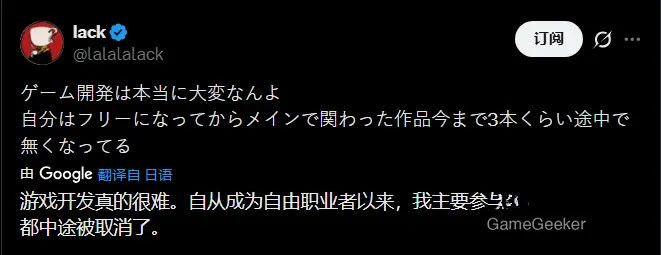
From another angle, a canceled project may be merely a financial loss on the balance sheet for a major company, but for freelancers, it is more like having several pages suddenly torn out of their résumé. This is especially true for young illustrators. Character design often requires compressing one’s aesthetic sense, time, and emotions entirely into a single project. Once that project is canceled, not only can years of hard work never be shown publicly, but their portfolio is left with gaps that are hard to explain. Unfortunately, the industry’s evaluation system happens to rely heavily on “what you have done,” rather than “what you nearly accomplished.”

Danryoku, an artist who worked on monster design for Eiyuden Chronicle, is relatively “fortunate” among people in this kind of situation. He has been in the industry for 14 years, worked on 6 mobile games, and also taken part in 3 canceled projects; the former have all now shut down, while the latter consumed about 5 and a half years in total. A creator can pour more than a decade of professional life into the machinery of the industry, only to be left with so little that can reliably endure. That fact itself is closer to reality than any piece of feel-good industry rhetoric. He even said that he still counts as lucky, because some people spend ten years on projects and end up with nothing at all.

But the deeper problem is that today’s game industry increasingly resembles the production of high-cost, long-cycle TV dramas: platforms chase traffic, teams gamble on timing, while freelancers are often the ones bearing the kind of time risk that is hardest to compensate. Player communities often lament games that shut down, but projects that never even make it to release are not granted the right to be remembered. Judging from the trend, this situation is unlikely to ease anytime soon: more projects, denser competition, and lower tolerance for error mean that the number of “disappearing works” will continue to grow.
So what deserves to be seen most in this discussion is not that a particular project is gone, but that the industry is pushing more and more creators into a predicament where “the work truly happened, yet cannot be proven.” Games may of course still be sold as commodities, but at the level closer to people, they should first and foremost be places where creators leave their mark. If even those traces cannot be preserved, then this so-called prosperity inevitably feels somewhat hollow.
Eiyuden Chronicle: Hundred Heroes





コメント 0
ご意見をお聞かせください
このゲームについての感想や評価をお寄せください。
コメントはまだありません。最初の一件をどうぞ。