
News
Grab two free PC games before Epic's clock runs out, while Undertale and Divinity: Original Sin 2 are 75% off
Astral Ascent and LUFTRAUSERS are free to keep today, while two of PC gaming's most celebrated RPGs cost less than $14 c
















Iron Surge unlocked its free demo on Steam at 22:00 Beijing time on June 10, letting players sample its retro-styled mix of RTS, roguelike progression, and auto-battler systems. At its core, it is a strategy game built around deployment rather than frantic clicking. If the demo clicks with you, the next step is obvious: wishlist it on Steam to keep up with the full release.

Beyond the genre shorthand, the game’s hook is easy to grasp. Iron Surge is not trying to send players back to traditional RTS habits like high-speed play, box-selecting units, and manually juggling multiple fronts. Instead, it shifts the focus to pre-battle planning. The developers explicitly emphasize "zero micro", meaning you do not need to constantly click units or manage formations in real time; your forces fight on their own based on the tactical setup and formation choices you made beforehand. The result is a mix of pre-battle planning and automated combat, which makes it especially approachable for players who enjoy positioning and composition but do not enjoy high-input execution.
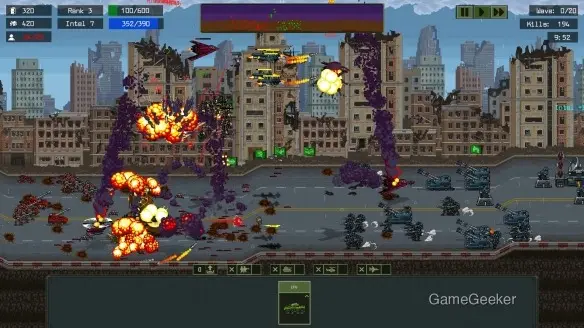
The setup is familiar, but it fits: a ruined world after a global nuclear war, where two survivor alliances fight over resources and dominance. Each run begins with random recruitment, and the roster includes infantry, tanks, turrets, giant mechs, combat drones, and massive airships. In practice, that means the game leans hard into wasteland warfare. With more than 60 random units and hundreds of upgrade modules to combine, the main question is whether those combinations produce strategies that feel both consistent and varied.

Its match structure is simple: defend first, then push back. You hold off multiple enemy waves before launching a heavy armored counterattack against the opposing base, giving the game a rhythm that draws from both tower defense and counterattack play. For players who like systems-heavy strategy and room to experiment, the key issue is not reaction speed. It is whether the game gives you enough space to test ideas. If the random units, modules, and formations create clear strengths, weaknesses, and counters, this kind of zero-micro design could still create a strong "one more run with a different setup" loop.

The game also is not limited to straightforward stage progression. It includes a non-linear campaign, and your moral choices lead to three different branches and six possible endings. That suggests it wants variation to come not just from each run’s unit and module choices, but from the broader campaign as well. For this kind of indie strategy game on Steam, the real test is whether players are interested in both optimizing loadouts and replaying story routes. That is usually what determines whether demo interest turns into real momentum for the full release.




Comments 0
Share your game review
Join the discussion and share your review of this game.
No comments yet. Share your review.