




















Opening
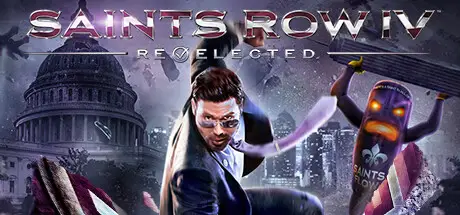
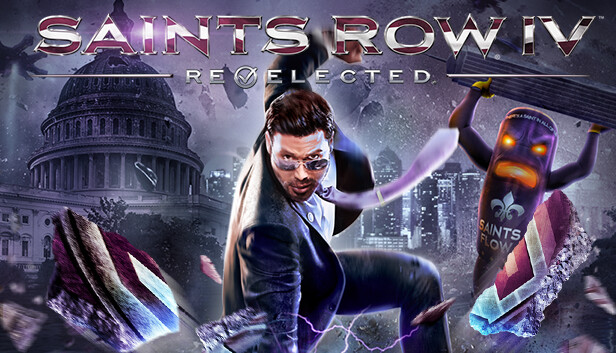
A gang leader gets elected President of the United States, pencils "cure cancer" into his first-term agenda, and then an alien empire flattens Washington and stuffs him and his entire crew into a simulated city. That is the opening of Saints Row IV: Re-Elected, and it tells you everything. This game was never going to play it straight. The dumbest possible fun is the only goal, and it floors the pedal toward that goal from the first minute.
Inside the simulation you never need a car again. Unlock the superpowers and you outrun sports cars, leap over skyscrapers, and glide halfway across town with your arms spread wide. The studio tore down the old gang-sandbox chassis, bolted on a superhero frame, and poured in a sonic Dubstep weapon, a playlist of '90s bangers, and pop-culture parody packed so tight there is no air left in the room.
It is rough. It is juvenile. Its textures are muddy enough to embarrass the word "Re-Elected." And as a stress-reliever it has almost no competition. What this review wants to settle is whether that gleefully uncopyable brand of fun is still worth a fresh term in office today.
Story | 8.5/10
Fabuła: 8.5/10A gang boss in the Oval Office, an alien apocalypse — and somehow it holds

Saints Row IV builds its tower on a foundation of pure nonsense. You are still the player-made Saints boss from earlier games, swept into the White House after foiling a terrorist plot. Five terms-worth of absurd governance later — you are literally drafting a cure for cancer — an alien empire called the Zin drops out of the sky. Their leader, Zinyak, snatches your crew, levels D.C., and locks you and the entire Third Street Saints inside a simulated rebuild of Steelport.
Any plot summary reads like a punchline mid-delivery. It works anyway, because the game declares its posture in the first thirty seconds: it does not want you to believe, only to laugh.
You are the President, you wield superhero powers tuned past the point of sanity, you punch ugly aliens, and everything else is excess. A game this honest about its own ridiculousness earns a strange sincerity — you never expect a serious story, so every joke lands clean.
What keeps the lunacy from drifting is that it is anchored. The simulation is a blank page the writers can scribble on at will: today a White House press conference, tomorrow a retro eight-bit level, the day after a flashback to the gang's rise. Every tonal whiplash is a gag, and every gag funnels back into one spine — retake Steelport, topple Zinyak. The absurdity is the coat; the main quest is the bone underneath, and the two are buttoned together more tightly than the premise has any right to allow.
Rebuilding the Saints, one rescue at a time — loyalty missions as a thank-you to the crew

Peel off the alien-invasion wrapper and the real skeleton is a rescue arc. Your crew is scattered, each trapped in a private nightmare, and you pull them out one by one until the Saints stand whole again and you finally earn the right to come for Zinyak. Anyone who has played Mass Effect will grin in recognition — these are loyalty missions, only the studio swapped gravity for goofs.
The standout is the Keith David subplot. The actor plays himself as your Vice President, governing the country at your side before the story reveals he sold you out — the Zin promised to restore Earth in exchange. So you storm Keith's own nightmare, with help from wrestler Roddy Piper, drag him free, and talk him back onto the team. A real, living actor playing a kidnapped version of himself that you have to save: that nesting-doll gag is exactly the kind of thing this script is proudest of.
Each teammate's nightmare carries its own flavor — a horror-movie haunted house here, a buried memory there — and the act of saving them quietly re-excavates a cast that had long since flattened into stock gangster types. Beneath the slapstick is a surprising sliver of character depth. You are not just clearing checkpoints; you are helping old friends make peace with their demons. By the time the band is back together and you turn to face Zinyak, that "my whole crew is here" rush feels genuinely earned, built brick by brick from this rescue line.
Parody perfected — wall-to-wall homage that never curdles into cynicism

The trapped-in-a-simulation setup is itself a riff on The Matrix; that strand even began life under the working title "Enter the Dominatrix," originally a Saints Row: The Third DLC before it grew into a full game. From start to finish the writing is a barrage of pop-culture references — films, games, memes, all of it grabbed off the shelf without hesitation.
But it is a world apart from reference-dumping for its own sake. Critics literally headlined their reviews "Parody Perfected," and the reason is that it never curdles into cynicism — there is always real affection underneath the chaos, for the player and the cast alike. The voice work carries the ambition: you pick from several Boss voices (industry veterans like Troy Baker, Nolan North and Laura Bailey are all on the roster), then layer a marquee name like Keith David on top, and the whole performance gets called the series' best. Set it beside that year's straight-faced crime epic, Grand Theft Auto V, and Saints Row runs the opposite extreme — yet pushes its own ambition just as far.
Audio | 8.5/10
Dźwięk: 8.5/10The '90s playlist takes the lead — old hits that became the series' calling card

If only one moment of Saints Row IV survives in memory, it is probably the spaceship run — you barrel through space while Haddaway's "What Is Love" detonates behind you like the genuine '90s anthem it is. Absurdity and nostalgia collide into something strange and perfect, and it has effectively become the whole series' audio signature. The playlist props itself up with old standbys like Stan Bush's "The Touch" too, and none of them are filler — each one is a fist landing exactly on the beat of the scene.
Borrowing a sing-along oldie to amplify a ludicrous set piece is the smartest thing this soundtrack does. It does not chase epic grandeur with an original score; it reaches for a song everyone already hums and shoves the over-the-top feeling to its ceiling. When the music carries its own decade-filter and collective memory, the on-screen lunacy gets to feel completely justified.
That curatorial instinct runs through the whole game. It leans hard on '90s pop and disco, and every track is stitched onto a specific high point rather than dropped in at random. The music tops off your excitement the first time a fresh superpower flings you onto a rooftop, then pushes the chaos toward something almost gloriously ridiculous when you tear through space, then drops to a sly hush before the next gag detonates. Here the soundtrack is not background ambiance but an emotional amplifier — it knows when to get your blood up and when to make you laugh out loud, and it is rarely wrong about the timing.
None of this would matter if the songs felt cynically chosen, the way licensed tracks so often do when a game is just renting a hit to borrow its cool. These selections feel curated by someone who actually loves them, which is why the joke never feels mean. The music laughs with the era, not at it.
The Dubstep weapon — music wired straight into the rhythm of every shot

The tightest fusion of music and play is that signature Dubstep blaster. It carries no ammo, firing off a recharging meter, and the sound waves it spits force every enemy and pedestrian in range to take a hit while dancing to the beat. Better still is the costume system — each skin not only reskins the device but swaps the track playing, and the tempo of that track genuinely changes the rate and intensity of each blast.
In other words, the song you pick decides how fast and how hard each shot lands. It is a rare design that turns background music into a core mechanic; sound stops being decoration and becomes the actual feel under your finger as you squeeze the trigger. Chinese outlet 3DM singled out the care in the sound design — disco and electronica conjuring a sci-fi, virtual, delirious world whose rhythm matches the visuals beat for beat. Pair that with star voice work and several selectable Boss voices, and the game always sounds busy, always reacting to what your hands are doing. Footsteps, weapon fire, interface feedback — none of it is a technical benchmark, but it more than serves the gloriously overcooked mood.
Visuals | 6.0/10
Grafika: 6/10Neon Steelport — the nightscape and power-effects are its money shot

Steelport is a neon-soaked cyber-city, poisoned through with alien tech. When night falls and you glide off a rooftop with superpower light trails streaming behind you, the city's cyberpunk character finally shows itself. This is the money shot, the frame most likely to end up as somebody's wallpaper, and the game knows it — almost everything memorable about the look happens while you are airborne and moving fast. The skyline glitters, the power trails streak, and for a few seconds the whole thing genuinely looks like the cyberpunk city it keeps insisting it is. Then your feet touch the ground and the illusion thins, which is the recurring story of this entire dimension.
The art direction has a genuine identity rather than a budget. It does not chase realism and it does not flex its tech; it simply treats one overexposed future metropolis as a superhero playground, handing every super-sprint and telekinetic leap a stage gaudy enough to deserve the spectacle. Purple is everywhere, the Saints' signature color smeared across signage and lighting until the city reads less like a place than a brand. It is garish on purpose, and the garishness is half the joke.
The trouble is that everything off that stage wilts under scrutiny. Stand still for a second and the muddy textures and flat scenery have nowhere left to hide. Crowd models repeat, building interiors are sparse, and the lighting that looks electric in motion turns plain the moment the camera stops. This is a game that lives or dies on momentum, and its art was clearly built with that bargain in mind.
The cost of a lazy remaster — muddy textures that betray the "Re-Elected" badge
As a generational re-release, Re-Elected's visual upgrade is remarkably timid, and that is its most-cited sin. Muddy textures and flat detail are the broad consensus among critics, and OpenCritic says it plainly in its verdict: limited enhancements and unwelcome technical issues keep this from being the definitive version it should have been. The remaster, bluntly, was never finished — it ports the game forward without ever modernizing the thing you actually look at.
The platform split is worth unpacking, because the versions are not equal. The console release earns its keep by dragging the last-gen disaster — the one that routinely sagged toward fifteen frames a second — back into stable territory, with smoother draw distance and cleaner lighting. That is a tangible, meaningful win even if it never wows you, the difference between a game that runs and a game that fights you.
The handheld port tells a stranger story. Portable mode is surprisingly steady, crashing even less often than its contemporaries, yet the frame rate stays nailed below thirty; docked mode buckles the instant explosions and particle effects pile up, and you will catch the occasional pop-in and a load screen that freezes for a beat. It is a respectable conversion for the hardware, far better than the studio's earlier Switch effort, but it is a compromise you feel rather than one you forget.
Lay all of that side by side and the verdict comes out uniform: playable everywhere, dazzling nowhere. No single version makes you gasp at the visuals, but none is broken enough to put down either. You came for the play, and the picture is just a serviceable container that never quite breaks the spell.
And here is the thing — the city itself is built to keep you moving, which quietly forgives most of those flaws. The towers are your launch pads, the wide boulevards are your sprint lanes, the alien spires scattered across the skyline are your climbing targets, and the whole map is laid out as a vertical playground rather than a place to sightsee. The harder you lean on your powers, the less time you spend staring at any one wall's texture, and the muddiness slips permanently into your peripheral vision. Steelport's art cannot carry a static screenshot, but it carries stretch after stretch of kinetic, gleeful destruction — and that, not fidelity, is the thing it was always trying hardest to give you, sparing no effort to do it.
Combat | 9.0/10
Rozgrywka: 9/10Five superpowers — turning open-world traversal into the series' best high
The biggest shift in Saints Row IV is that it all but retires the series' signature vehicle sandbox. The old thrown-explosive system is cut and replaced with five wildly different superpowers: super sprint, telekinetic jump, ice blast, telekinetic throw, and stomp. Max them out on the upgrade tree and the entire logic of the open world is rewritten — you outrun sports cars, you out-jump skyscrapers, you spread your arms and glide clear across Steelport, and for most of the game vehicles lose any reason to exist.
That traversal feel gets called one of the best in open-world gaming for good reason. It takes chores that should be tedious — climbing a giant alien tower, racing through the streets under your own power — and turns them into pure joy.
You are no longer driving from point A to point B; you are a weightless meteor, running riot across the vertical and horizontal at once. Map markers stop being errands and become excuses to fling yourself somewhere new. That floating exhilaration is something the realistic sandboxes of the same year simply cannot hand you, and it is the single change that most defines what this game is.
The Dubstep weapon and the character creator — parody poured into every input
Re-Elected packs in every one of the base game's lunatic gadgets, and the most famous is the sonic Dubstep blaster, whose sound waves force enemies and pedestrians alike to dance to the beat — the most literal symbol of the whole series' parody spirit. Beyond it sits a cabinet of gloriously silly devices and contraptions, and paired with hundreds of customization options in the character creator, you can dress your President up as anything ridiculous and take that chaos to the street. Every corner of the play reminds you the game has no intention of behaving.
More to the point, the powers and the absurd weapons spark off each other. You can hang a crowd in mid-air with telekinesis and then swap to the Dubstep blaster so they dance as they fall; you can super-sprint through a city block and stomp out a shockwave at the end. The systems beg you to keep recombining abilities and weapons, and every mash-up cooks up fresh chaos. Critics described that act of folding techniques together as fluid and satisfying — the thrill comes not from any single power being strong, but from the out-of-control sense that you can do anything when they all pile up.
The difficulty collapse — once the powers ramp, challenge gives way to catharsis
But the power set has its price. The early hours feel underpowered — before the abilities unlock you are just a President with a sidearm and middling combat feel — yet once the upgrade tree blooms, the exhilaration climbs exponentially while the difficulty basically caves in, and the late game is near-mindless mowing. That is exactly why 3DM scored the gameplay an 8.5 while flagging that "great power cuts both ways": getting strong feels fantastic, but the challenge gets flattened along with it. The glut of upgrades is a small flaw too, the menu stuffed with so many enhancement entries that newcomers freeze up in front of the word soup. Held up side by side, this traversal is closer to the superpower parkour of Crackdown than to a traditional sandbox shooter — you scale the city vertically, hoovering up scattered orbs to grow stronger, which is that recipe to the bone. Only the Saints' parody script, the dense meme-work, and the hundreds of customization options are differences Crackdown can never offer. It borrowed parkour's thrill, then wrapped it in its own brand of nonsense, and that is what kept it from drowning among superpower sandboxes — a game you struggle to forget once you have played it. The combat underneath all that flash is merely competent on its own, a serviceable third-person shooter you would not write home about. What elevates it is everything bolted on top: the powers, the absurd gadgets, the freedom to improvise. Strip those away and you have an ordinary game; leave them on and you have one of the most purely fun open worlds of its generation, even if that fun comes at the cost of any real resistance.
Content | 8.5/10
Zawartość: 8.5/10A bundle that holds everything — base game plus every DLC plus a full expansion
Re-Elected's most concrete value is that it is very nearly an everything bundle. On top of the base game it sweeps in every piece of DLC released at the time — Enter the Dominatrix, How The Saints Saved Christmas, the Dubstep remix pack and the rest — then crams in a whole standalone expansion, Gat Out of Hell, for good measure. You are not buying a game; you are buying a content library filled to the brim. For a title that launched early and then trickled out a long tail of add-ons, stitching every loose patch onto a single disc still reads as genuine generosity today.
The DLC is uneven in texture, too, which only makes the library more of a place to wander. Christmas is a holiday-themed comic short. Dominatrix fleshes out the origin of the game's whole simulation premise. The remix pack stuffs more tracks into that signature blaster.
None of them is an epic on its own, but folded into Re-Elected they mean you have bought out, in one shot, almost everything this game produced across its entire lifespan. No extra dollar is owed for any single slice, and in an era of nickel-and-dime season passes that alone feels almost quaint.
Gat Out of Hell — moving the stage from Steelport down to New Hades
Gat Out of Hell is the heaviest single chunk of that bundle. A self-contained short campaign, it hands you fan-favorite Johnny Gat, who storms Hell alongside Kinzie to rescue the "President" snatched by a demon. It carries over the base game's superpower-and-open-world frame but trades Steelport for the infernal New Hades, a scene with an entirely different look to run wild in. It could easily have been sold on its own; instead it just gets counted into Re-Elected's total.
Worth noting is that the expansion is no simple reskin. New Hades has its own flight mechanics and ability set, the demonic faction brings a roster of enemies distinct from the aliens, and even the narrative pitch leans closer to absurdist opera — it famously has a moment where a character suddenly breaks into a full musical number, the kind of swing only this series would attempt. Short as it runs, it gives veterans a "new map, new rules" exit that genuinely widens Re-Elected's content map rather than merely lengthening the base game. For anyone already bored of Steelport, a trip downstairs is a well-timed palate cleanser that costs you nothing extra.
Forty hours and up — checklist side content fills the open world
For sheer bulk, the main story runs around seventeen hours, but what really pulls you under is the dense checklist of side content. Super-powered races, alien-tower climbs, super-powered insurance fraud, tank mayhem — these activities pack Steelport to the gills, and chasing everything climbs comfortably past forty-two hours. Most of them orbit your powers: races test your traversal control, tower climbs force you to master jumping and gliding, insurance fraud has you hurl your body into traffic for cash, treating the physics engine as a toy.
The checklist design carries its era's limits, of course — some activities repeat enough that late on you feel like you are mechanically wiping icons off a map, the open-world busywork that the genre has since learned to trim. But in the context of "we packed everything in," what it offers is plainly a stretch of stress relief that never runs dry; you never have to fret that the content will bottom out soon, or that the disc owes you a paywalled chapter you have not bought.
For players who want to sink in for a long time without thinking too hard, this is a solid long-term investment — forty-odd hours in which you will scarcely hit a moment with nothing to do, and rarely a moment that asks you to do it slowly. Whether you treat that volume as generosity or as bloat depends entirely on how much you trust the studio's idea of fun, but the sheer quantity of it is beyond dispute, and at this point in the package's life the price you pay per hour is hard to argue with.

Komentarze 0
Chętnie poznamy Twoje zdanie
Witaj! Napisz, co sądzisz o tej grze — pierwsza osoba może się mile zaskoczyć.
Nie ma jeszcze komentarzy. Napisz, co sądzisz o tej recenzji.