



















Opening
Cat Squeeze is a tiny single-player Sokoban-style puzzle game about a kitten blowing holes in maze walls, and it nails the one thing it has to nail: it makes pushing boxes feel like you're rewriting the room, not just tidying it up. If that sounds like your thing, it's worth a look.
You play as Coco, a cat going through the Cat God Trial for the promise of endless dried fish, which is basically all the story you're getting. Don't come here for big lore. Come here because Coco can puff up, blast through specific wall spots, slip through pipes, and suddenly a simple grid becomes this weird little topology problem where the map itself is part of the solution.
And that's the hook. This isn't Patrick's Parabox levels of cold, abstract brain surgery. It's warmer. Softer. More approachable. The hand-drawn look and Coco's smug little animations do a lot of work when you're stuck staring at a room for five minutes with no clue what to do.
Right now it's sitting at 100% positive on Steam, but that's from 17 reviews, so let's not pretend the whole planet has weighed in.
Still, the barrier to checking is almost nothing. There's a free demo, and its save carries straight into the full game. If you've bounced off hardcore Sokoban before but still like spatial puzzles, this is the cute trap you might actually fall for.
Story | 5.0/10
劇情: 5/10Coco’s “Cat God Trial” Is Barely A Story, And That’s The Point
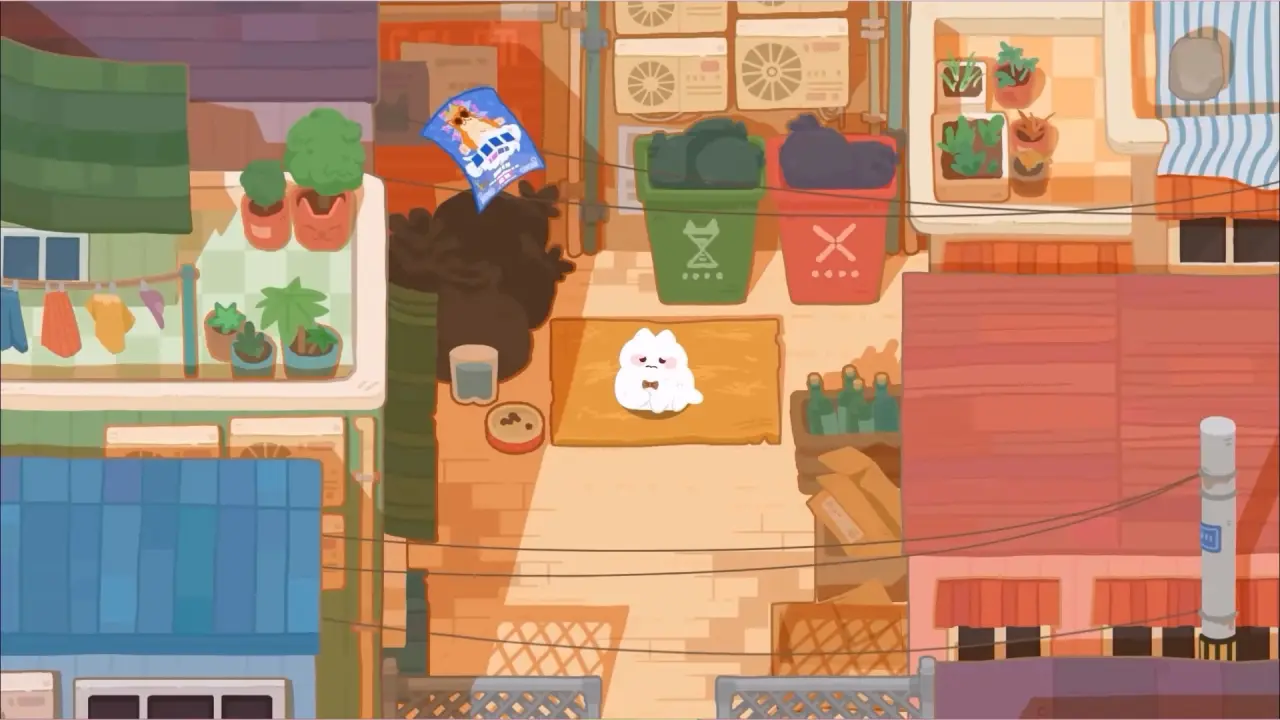
Story-wise, Cat Squeeze gives you about as much setup as a fortune cookie. Kitten Coco gets chosen for the Cat God Trial, she moves through one puzzle room after another, and the prize dangling in front of her is dried fish. That’s it. That’s the whole dramatic engine. No big mystery. No rival cat. No tragic backstory about why Coco needs those fish. She’s here, the rooms are here, and the game wants you solving them.
For this kind of puzzle game, that’s not automatically a problem. The whole pitch is mechanical: push boxes, slip through pipes, find the right blast spot, and blow open maze walls. The story doesn’t interrupt that. It doesn’t try to convince you Coco is on some grand emotional journey. It just gives the puzzles a cute wrapper and gets out of the way. If you’re here for spatial planning, that’s fine. If you’re here for plot, you’re leaving hungry.
There are no meaningful side stories either. No optional character arcs. No weird little NPC vignettes tucked into the corners. Collecting dried fish is the only real motivation, and even that feels more like a gate and a reward structure than a narrative goal. The four regions — Flower Fields, Forest, Ruins, and the snowy finale — do most of the “storytelling” through mood. Warm, soft early areas ease you in. Colder, harsher spaces tell your brain, “Okay, this is getting serious now.” That’s neat. But it’s atmosphere, not story.
So for story, I’m landing at a 5 out of 10. Not bad in a “this fails” way. More like: it does the bare minimum cleanly. It knows the puzzles are the main event. But if you want narrative texture, character motivation, or anything that sticks after the room is solved, Cat Squeeze just doesn’t have much to give you.
The Mouse Squeaks, The Regions Shift, But Nobody Really Changes

The tiny mouse pal is basically the only real character interaction in Cat Squeeze, and even then, let’s be clear: this is a tutorial voice with whiskers. The mouse squeaks tips along the way, nudging you toward the mechanics, helping you understand what Coco can do, and keeping the game from feeling too cold when you’re staring at a room that looks simple but clearly isn’t. It’s cute. It helps. But it’s not character writing in any serious sense.
There’s no branching path here. No dialogue choice. No decision that changes Coco’s journey. You don’t shape her personality, you don’t unlock some hidden emotional thread, and you don’t see her grow beyond the animation work that sells her mood. To be fair, those animations do carry some charm. Coco puffing up before a fur-blast, then looking smug afterward, does more personality work than the actual script. That little bit of attitude matters. It softens the frustration when a Sokoban-style room has you stuck.
But again, the writing is serving the mechanics, not the other way around. Cat Squeeze’s best “story moments” are really puzzle moments. You realize a wall isn’t permanent. You realize a pipe doesn’t just move Coco, it changes how you read the whole room. You stop thinking, “Where do I push this box?” and start thinking, “How do I rewrite this space?” That’s where the game has a voice. Not in plot. In the way its rooms teach you to think.
Compared with something like A Monster’s Expedition, the difference is pretty sharp. That game barely has narrative in the traditional sense either, but it fills the gaps with environmental storytelling and a museum-like sense of place. Cat Squeeze is more ruthless. It cuts the narrative meat right down to the bone. The vibe is cozy, the art is hand-drawn, and the regions change enough to keep your eyes interested, but the world doesn’t really tell stories. It hosts puzzles.
This Is Warmer Than Patrick’s Parabox, But Way Thinner As Fiction

The closest useful comparison here is Patrick’s Parabox, because both games care more about puzzle logic than plot. But Patrick’s Parabox is colder, cleaner, and more abstract. It’s pure geometric brain-melting. Cat Squeeze is warmer because it has a cat. It has dried fish. It has a little mouse giving you hints. It has Coco squeezing through pipes and exploding with fur energy to crack open walls. That surface charm makes the game easier to approach, especially if harder puzzle games usually bounce you off.
But warmth isn’t the same thing as story depth. Cat Squeeze uses cute presentation to make puzzle failure less painful, not to build a narrative. That’s an important distinction. The hand-drawn world gives you comfort, and the four regions give you a sense of progression, but you’re not moving through a tale. You’re moving through a curated set of rooms. The 122 fish doors sound like they should carry some grand pilgrimage energy, but in practice they’re puzzle gates. They structure the climb. They don’t deepen the fiction.
That’s why this story score can’t go higher for me. I like that the game doesn’t waste your time. I like that it knows exactly what it is. And I think the cat theme is doing real work, because the same wall-breaking, topology-bending puzzle design would feel a lot more severe if it were just gray boxes on a grid. But if your favorite part of games is character growth, side quests, branching outcomes, or a world that reveals itself through story beats, Cat Squeeze is not playing that game. For the right player, that’s okay. If you want Sokoban with a softer face, clever terrain-changing twists, and a low-friction way into thinky puzzle design, this setup works. But as a story segment? It’s thin. Pleasant, functional, and cute, sure. Just don’t come in expecting Coco’s Cat God Trial to be anything more than a charming excuse to push, squeeze, blast, and chase dried fish.
Audio | 7.0/10
音效: 7/10The music knows this is a tiny cat puzzle box, not an orchestra pit
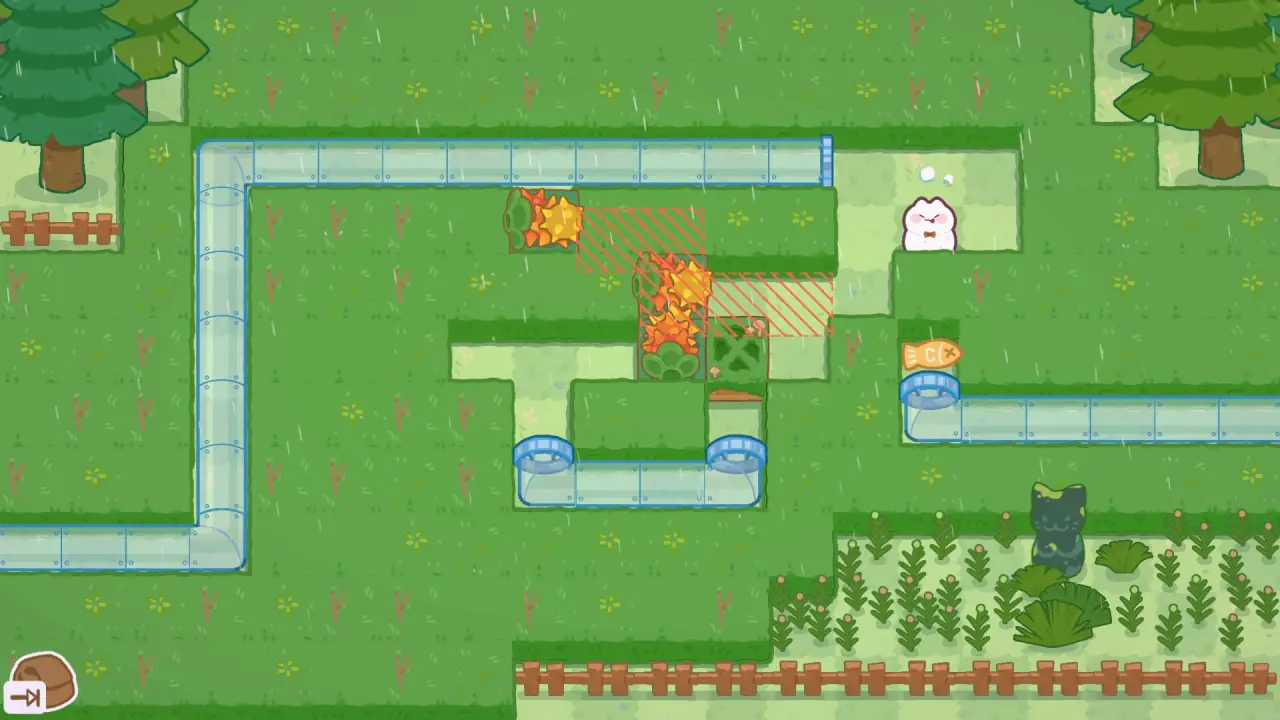
Cat Squeeze sounds exactly like the kind of game it is: small, cozy, and very focused. And I mean that as a compliment. This is not one of those indie puzzle games trying to make every box push feel like the end of the world. The music stays light. It gives you that soft, hand-drawn, “okay, one more puzzle” mood without stomping all over the actual thinking.
That matters, because this is still Sokoban-adjacent. You’re pushing boxes, slipping through pipes, hunting for the right blast spot, and eventually cracking open maze walls to change the room itself. If the soundtrack were too dramatic, it would get annoying fast. Instead, the background music sits in that “comfortable and competent” zone. It keeps Flower Fields and Forest feeling warm, and it helps the later Ruins and snowy finale feel like part of the same little Cat God Trial rather than a sudden genre swap.
There’s no big voice acting showcase here. Don’t come in expecting character banter or a narrative performance. The story is basically a frame: Coco is doing the Cat God Trial, dried fish are waiting, and a tiny mouse pal squeaks tips along the way. That’s it. But that actually works for the game. The emotional heavy lifting comes from Coco’s little puff-up and smug expression animations, paired with the sound design. It’s simple, but it keeps the game from feeling cold in the way something like Baba Is You can, where the restraint is part of the point. Cat Squeeze is warmer. Softer. More like a puzzle toy with fur on it.
The best sounds are the little rewards: boom, fish, retry
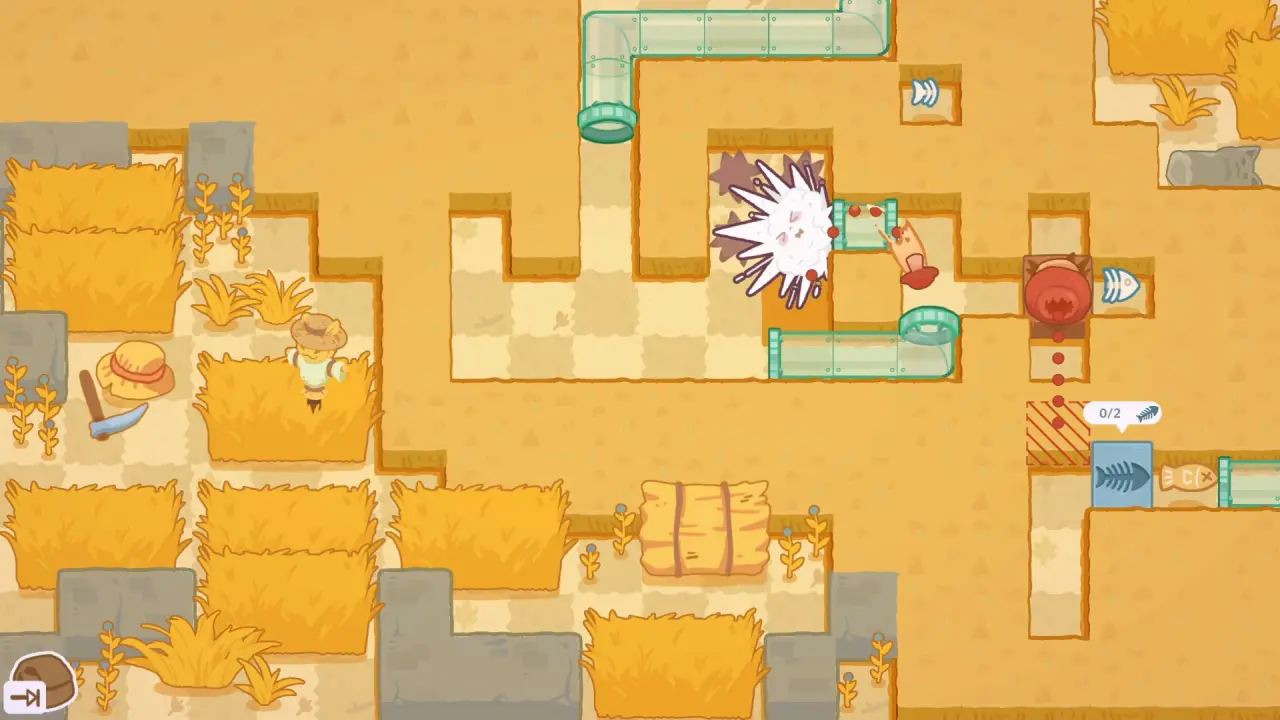
The sound effects are where Cat Squeeze gets the most mileage. The whole gimmick is that Coco doesn’t just shove boxes around. Coco can puff up, blast through walls, and use pipes to reposition across the grid. So the audio has one main job: make those actions feel good. And it does. The wall blast needs that little “boom” of payoff, because that’s the moment the puzzle stops being about moving objects and starts being about rewriting the room.
That’s the hook I like most here. A good push feels fine. A good teleport through a pipe feels better. But finding the exact spot to blow open a wall? That gives the puzzle a tiny spark of mischief. The audio backs that up without getting cartoonishly loud. It’s not trying to sell chaos. It’s giving you clean feedback: you did the thing, the room changed, now think again. Same with grabbing dried fish. That crisp reward sound matters more than you’d think, especially when the game is gating progress through those 122 fish doors and slowly asking more from you.
This is not a huge audio production. If you’re judging it like a massive campaign with layers of ambience, spoken dialogue, and sweeping themes, you’re bringing the wrong ruler. Cat Squeeze is PC and Steam only for now, sitting at 100% positive from a very small early review pool, and the game itself is small and focused. The audio matches that. It’s not spectacular. It’s not something I’d listen to outside the game. But for long puzzle sessions, it stays out of the way, keeps the mood cozy, and softens the frustration when you’re stuck staring at the same wall for five minutes. For a 7 out of 10 puzzle game, that’s about right: not flashy, not deep, but genuinely pleasant where it counts.
Visuals | 8.0/10
畫面: 8/10Coco’s puffed-up little face does half the visual heavy lifting
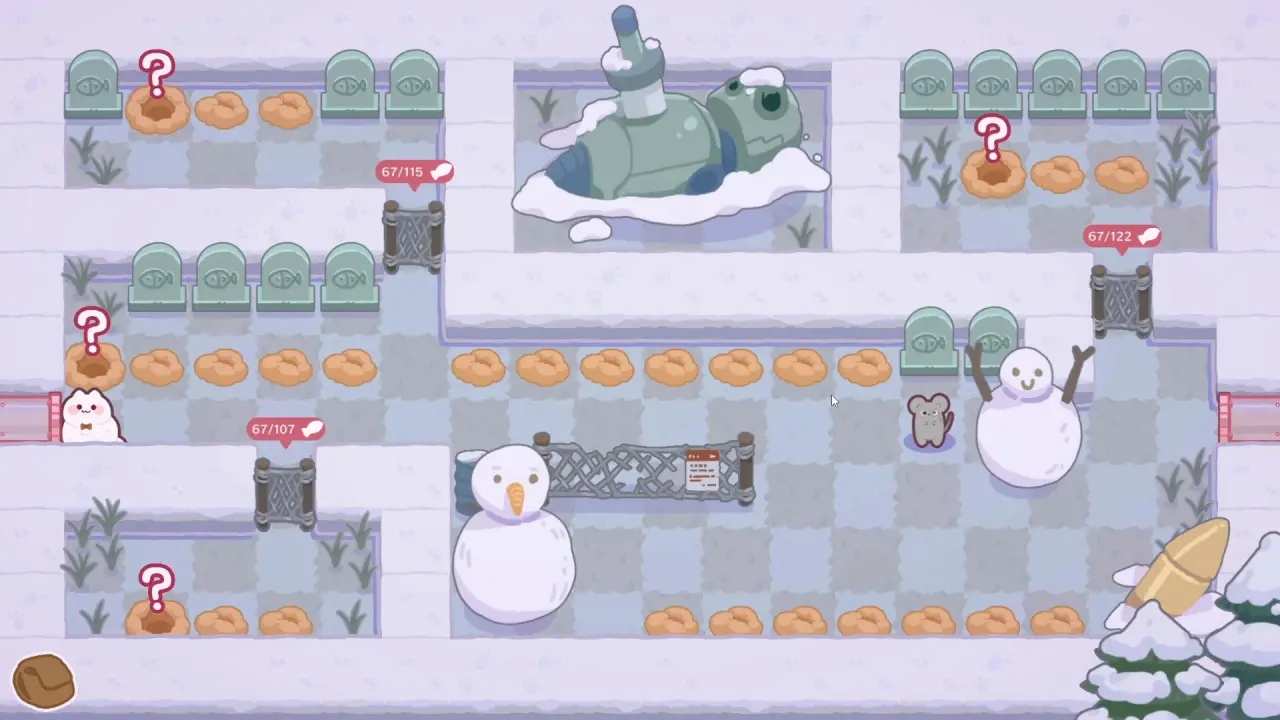
The first thing Cat Squeeze gets right is simple: it looks friendly before it asks you to think hard. That matters. This is still a Sokoban-style puzzle game about pushing boxes, slipping through pipes, blowing holes in maze walls, and planning routes on a grid. That can get dry fast. But the hand-drawn cartoon look gives it this soft, storybook feel that makes the whole thing less intimidating.
Coco is the big win here. The puff-up explosion animation isn’t just a cute gag. It sells the main mechanic. When Coco goes full fuzzball and blasts open a wall, the room doesn’t feel like a static puzzle board anymore. It feels like you’re actually messing with the place. And when Coco looks smug or satisfied after a move, that little bit of personality does a lot of work. It softens the frustration when you’ve boxed yourself into a corner for the fifth time.
That’s why I’d score the graphics at an 8 out of 10. Not because it’s technically flashy. It’s not. This isn’t some ray-tracing showcase, and nobody is coming here to count reflections or talk DLSS settings. The strength is readability plus charm. The art makes the puzzle space clear, and Coco makes the failure loop feel less cold. For a game about repeatedly realizing, “Oh no, I ruined this room,” that’s a pretty big deal.
Flower Fields to snow: the regions actually track the difficulty curve

The four themed areas do more than swap backgrounds. You start in the brighter, warmer spaces like Flower Fields, then move through Forest and Ruins, before the snowy finale gives the whole thing a harsher, colder look. That visual shift lines up nicely with the way the game eases you in, then starts to bite. It’s not just decoration. It’s pacing you can see.
That’s important because Cat Squeeze is built around 122 fish doors, and that structure could’ve felt like a menu with wallpaper. Instead, the regions give you a sense of moving deeper into the Cat God Trial, even though the story itself is basically just that frame and not much more. Visually, the game is doing more world-building than the writing is. The art carries the vibe.
And compared with something like A Monster’s Expedition, this is a totally different kind of cozy. A Monster’s Expedition has that soft 3D diorama feel, calm and spacious. Cat Squeeze goes for 2D hand-drawn illustration, and it fits the cat premise better. It’s warmer, more immediate, and easier to read at a glance. You’re not admiring a landscape from a distance. You’re staring at a compact little puzzle room, asking, “Where do I blow this wall open without ruining everything?” The art supports that exact question.
The UI gets out of the way, which is exactly what this puzzle needed
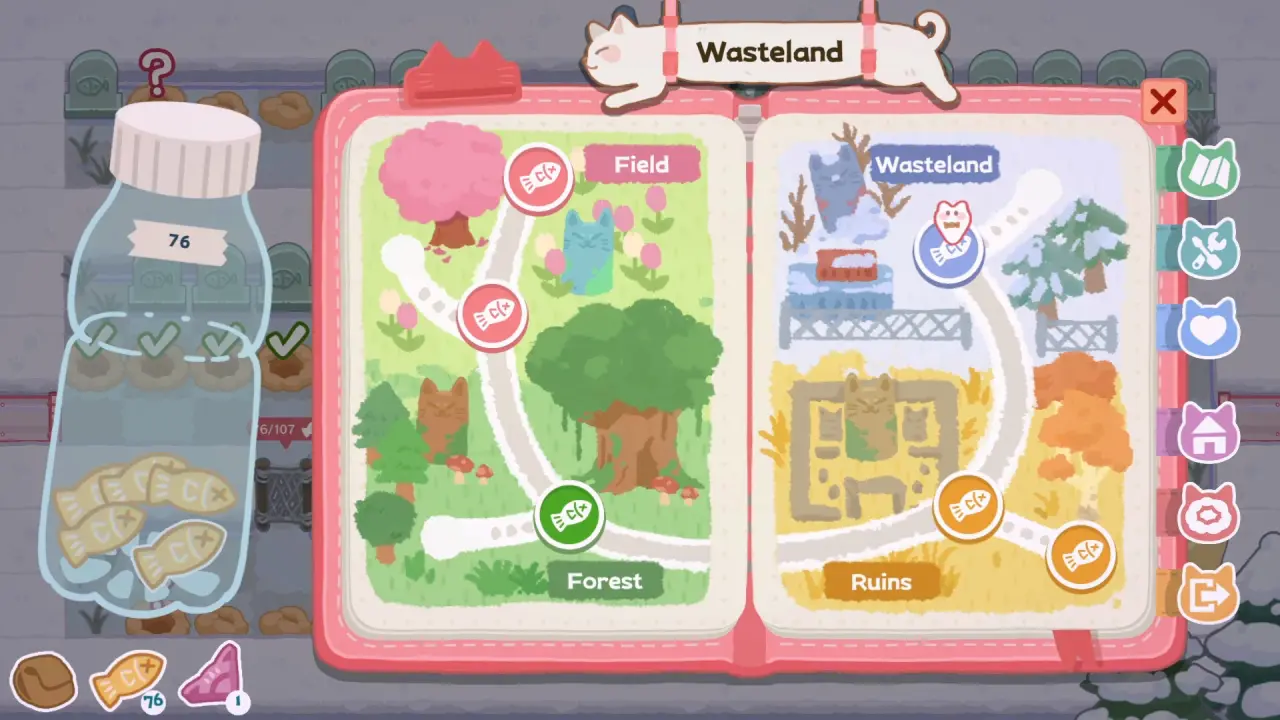
The UI is minimal in the best way. Cat Squeeze is about grid logic, so the screen needs to be readable instantly. Where are the boxes? Where are the pipes? Which walls can I break? Where does Coco need to end up? If you’re fighting the interface in a puzzle game like this, the whole thing falls apart. Here, the presentation stays clean enough that the hard part is the puzzle, not parsing the screen.
That also fits the target audience really well. If you like box-pushing and spatial planning, but you’ve bounced off the pure hardcore stuff before, this is the kind of visual design that gives you a hand without talking down to you. It’s cute, but it’s not noisy. It’s approachable, but it doesn’t hide the puzzle underneath a pile of effects. You can see the room, understand the pieces, and start making terrible choices immediately. That’s the good stuff.
On the tech side, there’s not a lot to flex, and that’s fine. Cat Squeeze is PC and Steam only for now, so there aren’t console versions to compare, no handheld port differences to break down, and no platform-specific visual trade-offs to argue about. The demo save carries into the full game, too, which means you can check the look and readability for yourself before buying. For a small, focused puzzle game, that’s the right move. The graphics aren’t trying to win a hardware war. They’re trying to make a clever room feel inviting enough that you’ll reset it one more time. And they pull that off.
Combat | 8.3/10
玩法: 8.3/10The box-pushing looks simple, until Coco starts blowing holes in the room
Cat Squeeze starts from proper Sokoban rules, and I mean the unforgiving kind. You push boxes. You don’t pull them. If you shove something into the wrong corner, that’s not a “whoops, I’ll wiggle it out” moment. That’s a deadlock. Reset, rethink, try again. So even with the cute cat face and the cozy hand-drawn look, the puzzle foundation is real. It’s not a decoration game wearing a puzzle hat.
But here’s the thing that makes it more than just “Sokoban, but cat.” Coco can puff up and blast through maze walls. That one trick changes the whole texture of the game. You’re not just asking, “Where do I move this box?” You’re asking, “What should this room even look like by the time I’m done with it?” Blow open the right wall, and suddenly you’ve created a shortcut, a new pushing lane, or a path to a fish. Blow open the wrong wall, and you might destroy the exact barrier you needed to hold a box in place. The game lets you reshape the board, but it also lets you ruin the board.
That’s the best kind of pressure in a puzzle game, because the mistake is usually understandable. You can see why your idea almost worked. Maybe you opened a route too early. Maybe you removed a wall that was secretly doing a job. Maybe you got excited because Coco looked adorable while exploding, and then five moves later you realized you’d freed a box into pure nonsense. I like that. It makes failure feel like a lesson, not a slap.
And the pipes are where the game really starts to stretch. Coco can slip through them, and that adds this teleport-style layer on top of the grid. Now you’re planning around position swaps, access routes, and what side of the room you can actually reach after a push. It’s still readable, still grounded, but it’s no longer flat in the usual Sokoban way. You’re dealing with a little pipe network sitting inside a box puzzle, and that’s where Cat Squeeze earns its identity.
The neat part is that a lot of rooms don’t feel like they’re demanding one sacred solution. You can often sniff out more than one route. Maybe you blast this wall first. Maybe you take that pipe first. Maybe you delay moving a box until Coco has looped around through a totally different angle. That gives the game a looser, more playful feel than the harshest puzzle games in this lane. It’s still brainy, but it doesn’t always feel like the designer is standing behind you with a ruler.
Flower Fields smiles at you, then Ruins and snow start asking real questions
The difficulty curve is one of the big reasons I’m landing pretty high on the gameplay here. Cat Squeeze doesn’t come out swinging like it wants to scare off anyone who hasn’t spent years in puzzle jail. The early areas, Flower Fields and Forest, are friendly. They teach you the language. Push the box. Check the corners. Use the pipe. Blast the wall. See how one system nudges the next. If you’ve bounced off pure hardline Sokoban before, this is way more inviting.
That doesn’t mean it stays soft. The game is built around four themed regions: Flower Fields, Forest, Ruins, and a snowy finale. Progress is gated by fish doors, including the big 122 fish gates, and that structure matters because the real bite sits deeper in. Once the game starts layering wall explosions, pipe travel, and box positioning in tighter spaces, the cute presentation stops protecting you. You still get Coco’s smug little expressions, and yes, they absolutely help soften the pain, but the puzzles themselves get dense.
By the time you’re in the later zones, the question isn’t just “can I solve this?” It’s “what order do I dare touch anything?” That’s where the three-layer feel kicks in: the classic box logic, the wall-breaking topology, and the pipe routing all stacked together. If you blast first, you may open the path but lose control. If you pipe first, you may reach a new side of the grid but trap the box behind you. If you push first, you may lock the entire room before the clever part even starts. That sequencing puzzle is the game at its best.
I also appreciate that the demo save carries into the full game. For a puzzle game like this, that’s not just a nice extra. That’s practical. You can test whether the rhythm works for your brain, see if the wall-blasting clicks, and then keep going without replaying the opening. Since this is a small, focused PC and Steam release from Cattery Studio and Pone Games, that low-friction demo setup matters. The game doesn’t need to pretend it’s some giant forever campaign. It just needs to prove its puzzles are good enough to keep you thinking.
And they are. I wouldn’t call the early game a challenge for people who already devoured the nastiest puzzle classics, but I don’t think that’s a flaw. It’s paced for people who like spatial planning but don’t want to be punched in the face on level two. Then, when the later regions tighten up, it has enough teeth to justify the climb.
It’s warmer than Patrick’s Parabox, less brutal than Sausage Roll, and not trying to be Baba
If you’re trying to place Cat Squeeze on the puzzle-game map, don’t expect it to out-weird Baba Is You or out-punish Stephen’s Sausage Roll. It’s not that extreme. Baba Is You has a bigger mechanical ambition because it lets you rewrite the rules themselves. Stephen’s Sausage Roll is famously mean in that beautiful, surgical way where every tile feels like a personal accusation. Cat Squeeze isn’t playing that game. It’s more approachable, more cheerful, and more interested in turning Sokoban into a cute little topology problem than in breaking your brain completely.
The closest comparison is Patrick’s Parabox, especially because both games care about space, structure, and how a room can be more complicated than it first looks. But Patrick’s Parabox is colder, more abstract, more pure geometry. Cat Squeeze is warmer. It has walls you can crack open, pipes you can slip through, and a kitten who gets puffy and pleased with herself. That doesn’t automatically make it better, but it does make it easier to step into. The puzzle logic still matters, but the vibe makes retrying less dry.
That’s also why the Thinky Games connection makes sense. Being curated alongside games like Baba Is You and Patrick’s Parabox, and showing up in Thinky Direct 2026, tells you the audience this is speaking to. It’s for people who want actual puzzle design, not just pleasant clicking. And based on the current Steam reception, it’s clearly landing with its tiny early crowd: 100% positive from 17 reviews. I wouldn’t overread that number yet, because 17 reviews is not a battlefield-tested sample. But it does line up with what the game is doing well.
The catch is, if you’re here for story, don’t be. The “Cat God Trial” setup is basically a frame, not a narrative meal. You guide Coco, chase dried fish, get tips from a tiny mouse pal, and solve rooms. That’s the game. If you need character arcs, big twists, or a campaign that eats dozens of hours, this isn’t built for you. It’s small and focused, and it’s better when judged on that scale.
For gameplay, though, I’m comfortable at an 8.3 out of 10. The core push-box rules are solid. The fur-blast wall breaking gives the rooms a real identity. The pipes add a clean second dimension without making everything unreadable. And the curve does a smart job of letting newer puzzle fans in before asking harder questions later. It’s not the most radical puzzle game in the room, but it knows its trick, it uses it well, and it makes being stuck feel just cute enough that you’ll probably hit retry instead of quitting.
Content | 7.2/10
內容: 7.2/10The 122 fish doors are doing more work than the story ever does
Cat Squeeze is not a game you play for a big plot payoff. Let’s get that out of the way. The setup is basically: kitten Coco enters the Cat God Trial, there are endless dried fish waiting, and a tiny mouse buddy chirps hints at you. That’s the story frame. Cute? Yeah. Deep? No. If you want character arcs, twists, lore dumps, or some emotional ending that recontextualizes the whole thing, this is not that game.
What actually carries the structure is the dried fish. They’re not just shiny little rewards for clearing puzzles. They’re also the keys. Progress is gated through 122 fish doors, and that gives the whole thing a clean push-pull rhythm: solve puzzles, collect fish, open the next batch, hit a new themed region, repeat. It sounds basic, but it works because it ties the puzzle brain and the collector brain together. You’re not doing optional checklist fluff off to the side. The reward is the road forward.
And the four areas help the pacing a lot. You start in Flower Fields, move through Forest, then Ruins, and eventually hit the snowy finale. Each region brings in ideas chapter by chapter instead of dumping the full rulebook on your lap at once. That matters, because Cat Squeeze’s best trick isn’t “push box onto switch.” It’s blowing open walls with Coco’s puffed-up fur blast, slipping through pipes, and using those tools to change what the room even is. The puzzle stops being about moving objects in a grid and starts being about rewriting the grid itself. That’s the hook. That’s why this works.
It’s small, focused, and better for it
Here’s the thing: Cat Squeeze is not trying to be your next 80-hour forever game. It’s small and focused. And I’m fine with that, because the value here is in density, not runtime. The game wants to hand you a room, teach you one nasty little spatial idea, let you wrestle with it, then move on before it wears out its welcome. That’s the right call for this kind of puzzle design.
There’s no DLC situation to decode here, either. No “buy the real ending later,” no extra puzzle pack hanging over the base game, no weird value math. The full game is the full game. That makes the pitch cleaner: do you want a compact, hand-drawn Sokoban-style puzzler about a cat blasting holes in maze walls and piping herself around the board? If yes, that’s what you’re buying. If you want a giant campaign with dozens and dozens of hours, you should lower your expectations before you click purchase.
The side content is also baked into the main loop rather than split into some separate menu of challenge rooms. Dried fish work as both reward and progression currency, so even when you’re chasing more of them, it doesn’t feel like you’ve wandered away from the real game. That’s a smart choice. It keeps the experience tight. The downside is obvious, though: if you’re the kind of player who wants a sprawling post-game, hidden questlines, or a big sandbox of optional systems, Cat Squeeze probably won’t feed you for long.
The demo makes the best argument, but the early praise is still early praise
One of the smartest things Cat Squeeze does has nothing to do with boxes, pipes, or exploding cat hair. The free demo save carries straight into the full game. That’s huge for a puzzle game, because the hardest sell is always, “Will my brain actually enjoy this specific kind of pain?” Here, you can just try it. If Coco’s wall-blasting, pipe-hopping room logic clicks for you, you keep going. If it doesn’t, you leave with basically no damage done.
That also makes the Steam reception easier to read, but not something I’d overhype. Right now it’s sitting at 100% positive on Steam from 17 reviews. Great sign, absolutely. But 17 reviews is not a crowd. That’s a small early audience, likely made up of people already tuned into this kind of thinky puzzle niche. The game was curated by Thinky Games alongside Baba Is You and Patrick’s Parabox, and it showed up in the Thinky Direct 2026 showcase, so the right players are finding it. But long-tail reputation is a different test.
And compared to Patrick’s Parabox, Cat Squeeze is warmer and easier to approach. Patrick’s Parabox is colder, cleaner, more abstract, and brutally geometric. Cat Squeeze has the cat face, the smug little animations, the hand-drawn softness, and that funny puff-up explosion. It gives you a cuter doorway into some pretty serious spatial planning. But if you’ve already beaten Baba Is You and you live for top-shelf puzzle cruelty, the early Flower Fields and Forest sections may feel light. The real bite waits deeper in, especially once those fish gates have pushed you through enough of the game’s toolkit. For content, I’m around a 7.2 out of 10: clever, charming, well-paced, but modest, and still waiting to prove it has legs beyond the early crowd.





留言 2
歡迎發表遊戲評價
歡迎參與討論,分享對這款遊戲的評價。
Hand-drawn Coco definitely gets my attention first, but turning Sokoban into a 3D topology puzzle with pipe swapping is the part that really sells it for me.
Cute art is nice, but I’m glad the real hook sounds like the wall-blasting and pipe-swapping puzzles instead of just coasting on the cat theme.
已顯示全部留言