















Opening
Most sequels are a victory lap. Supergiant decided to run a marathon instead.
Rather than reprint the roguelike that turned death into a story and call it a day, Hades II tears the blueprint apart and rebuilds it bigger. One protagonist became two campaigns; a single road to the surface became two parallel ones; the cast, the mechanical depth and the sheer volume of content all roughly doubled. You no longer play Zagreus, son of the Underworld. You play his sister, Melinoë — Princess of the Underworld, raised and drilled since childhood by the witch Hecate and a household of the dead for one purpose: to march back up and kill Chronos, the Titan of Time who broke his chains, clawed his way out, and seized the realm her family once ruled.
It arrived in early access in May 2024, grew through a year-plus of free updates, and only became whole on September 25, 2025, when the true finale finally dropped. A 94 on Metacritic, a 94 on OpenCritic, a 95% Steam rating, Best Action Game at The Game Awards 2025. Lightning rarely strikes the same studio twice, least of all in a genre as picked-over as this one. The question this review answers is simple: how did Supergiant climb back to the very top of a crowded field, a second time, without repeating itself?
Story | 7.0/10
ストーリー: 7/10Death as a narrative engine — the trick nobody can steal

Explain this one mechanic and you have explained why Hades II matters. The first game pioneered the idea; the sequel pushes it to the limit. The story isn't a cutscene you watch once. It's hundreds of lines of dialogue, shattered into fragments that unlock slowly as you sprint forward, fall, and start again. You don't finish the story so much as fight your way through it. Every time you die and trudge back to the crossroads, Hecate has a word about how today went wrong, Selene needles you in a slightly different register, and Thanatos thaws by a single degree.
Which flips the genre's oldest enemy on its head. In most roguelikes, your fiftieth run through the same rooms is a grind to be endured. Here, the fiftieth attempt means another new line, another relationship nudged forward. Repetition pays a narrative dividend — and that is the part rivals cannot copy. They can lift the Omega attacks, they can lift the tarot progression, but they cannot lift this: a whole game architected so that going around again is itself the point. The first game proved the idea worked; this one simply carries far more weight on the same spine, with a denser cast and busier events.
Two campaigns double the cast, but the 1.0 ending is the real argument

The biggest break from the original's single road is that there are now two near-independent story tracks. The Underworld line points at Chronos, the challenge that best personifies the whole game. The Surface line pushes Melinoë upward, toward Olympus, swapping in a fresh roster of enemies, a different set of god interactions, and a separate thread of plot. The two feed each other: burn out on one and you can switch to the other for a change of pace, a freshness the original's single loop could never offer.
Hecate, Selene, Thanatos, Hermes, Hephaestus — every figure carries a full arc rather than a cameo, and across all those runs toward Chronos you slowly assemble the picture of a family torn apart by time and stitched back together. The writing trusts you to hold a hundred threads at once, paying off a throwaway remark from forty runs ago with a quiet callback you'd swear you imagined.
But I have to be straight: the 1.0 finale is the loudest point of contention in the whole package. A central conflict built up over a year-plus resolves too loosely. Worse, for the diehards, Zagreus's return carries more emotional weight than Melinoë, the lead you supposedly came here for — you walk hundreds of hours in her boots and the spotlight tilts toward someone else at the last moment. That single misstep is why the story dimension lands at a seven from me. The volume of writing and the density of character work are best-in-class; the destination just doesn't earn the journey.
A story told in installments — which decides whether you should jump in now
You can't make sense of this narrative without its release history. When early access launched in May 2024, critics were blunt: anyone especially invested in story and characters should wait. Large stretches of interaction and the entire back half simply weren't in yet. What you got was a mechanically complete game that had told only its first act.
Supergiant then spent over a year filling in the gaps, free update by free update, until 1.0 dropped the true ending and finally closed the loop on a year of setup. For anyone chasing the complete story, in other words, right now is the ideal moment — you no longer have to wait the way early adopters did. You can walk the whole thing end to end.
That trajectory says something about the studio's posture. They never treated early access as a half-baked trial balloon; they shipped something close to finished from day one and then polished "already great" into "all but flawless." For a newcomer in 2026, that means the narrative you're buying has been stress-tested by time and iteration, with none of the risk early backers shouldered. The story you sit down to is the one the writers always intended, delivered whole, with every promised beat in place rather than scheduled for some future patch.
Audio | 10.0/10
サウンド: 10/10Darren Korb's score is the thread stitching mood, combat and story together

If one dimension here is close to untouchable, it's the music. Darren Korb takes the signature he established in the first game — chant, electric guitar, a Mediterranean lilt — and pushes it further, folding in more electronic texture until the whole thing reads as one high-energy, instantly recognizable voice. The hardware backs it up: a Best Score nomination at the 2025 awards show and a clutch of audio honors from the Game Audio Network Guild.
Roguelikes ask something brutal of a soundtrack. You run the same rooms dozens, hundreds of times; let the music grate and the entire experience collapses with it. The answer here is structure — themes and battle cues built as loops that breathe, with enough swell and variation that they don't curdle on the hundredth pass. You don't get sick of a room because the track behind it wears out. If anything, a familiar guitar lick kicks in and you feel that "one more run" itch all over again. That ability to survive repetition is exactly what separates this score from the kind that dazzles once and decays into wallpaper.
The integration with storytelling is the real flex, though. Combat peaks and the mix floods; you reach the crossroads and the melody steps back to let dialogue breathe; the half-second of silence before an encounter and the eruption that follows both land squarely on the emotional beat. The music isn't decoration glued on top. It knows when to shout and when to vanish, and that restraint is rare — plenty of scores can write a memorable theme, but very few know when to get out of the way of a line of dialogue, and that judgment is what elevates this one from good to essential.
Fully voiced — which is what carries those hundreds of unlockable lines
Hundreds of lines aren't enough on their own; somebody has to perform them. The 1.0 build is fully voiced, with dozens of new NPC events all recorded, the delivery steady and genuinely affecting. This locks straight into the story dimension: because every drip-fed line lands with real performance behind it, Hecate's severity, Selene's languor and Thanatos's reserve actually take hold over all your repeated runs. Read the same wry aside off Selene and off Thanatos and the texture is completely different — that granularity is what props up the whole drip-feed conversation system.
Set against the series timeline, the original's chant-and-guitar passages were already a calling card for roguelikes and indies alike, and the sequel doesn't coast on that. It adds on top of an already-high bar. New track quality, depth of the voice cast, the precision of the audiovisual marriage — it earns the way nearly every review singles the audio out for praise. This is a soundtrack you'd buy standalone and slot into a daily playlist, and the only dimension here I can hand a perfect mark. Not because it's flawless in some abstract sense, but because in the specific lane of game music — music that has to serve combat, mood and narrative all at once, and survive endless repetition while doing it — it's genuinely hard to point at where this score should be better.
Visuals | 9.0/10
グラフィック: 9/10Hand-painted character art — a house style you spot without the logo
You barely need the logo to recognize a Supergiant game. The sequel carries forward the studio's signature hand-painted, oil-thick character portraits — the linework, the palette, the lighting all freighted with an illustrator's heft. Pull a single portrait of Melinoë, Hecate or Selene out of context and it works as a poster. The style chases authorship over realism, and in a market drowning in photoreal AAA, that choice reads as bold rather than dated.
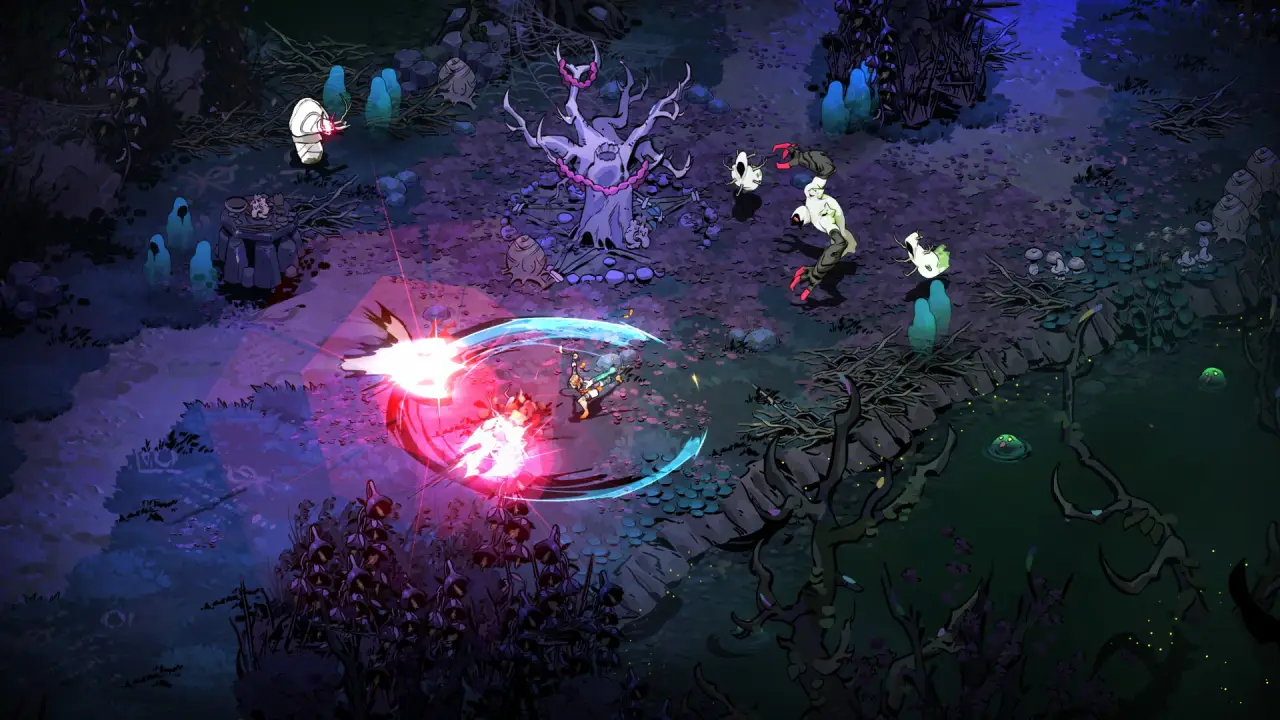
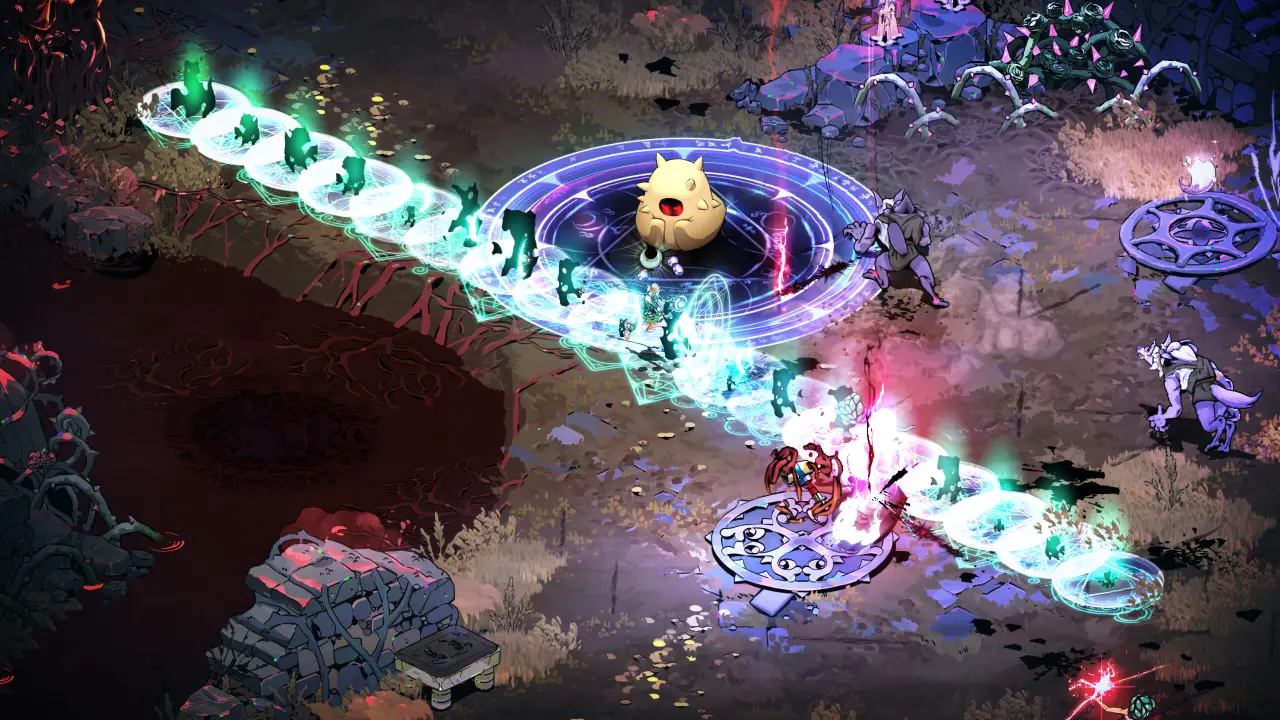
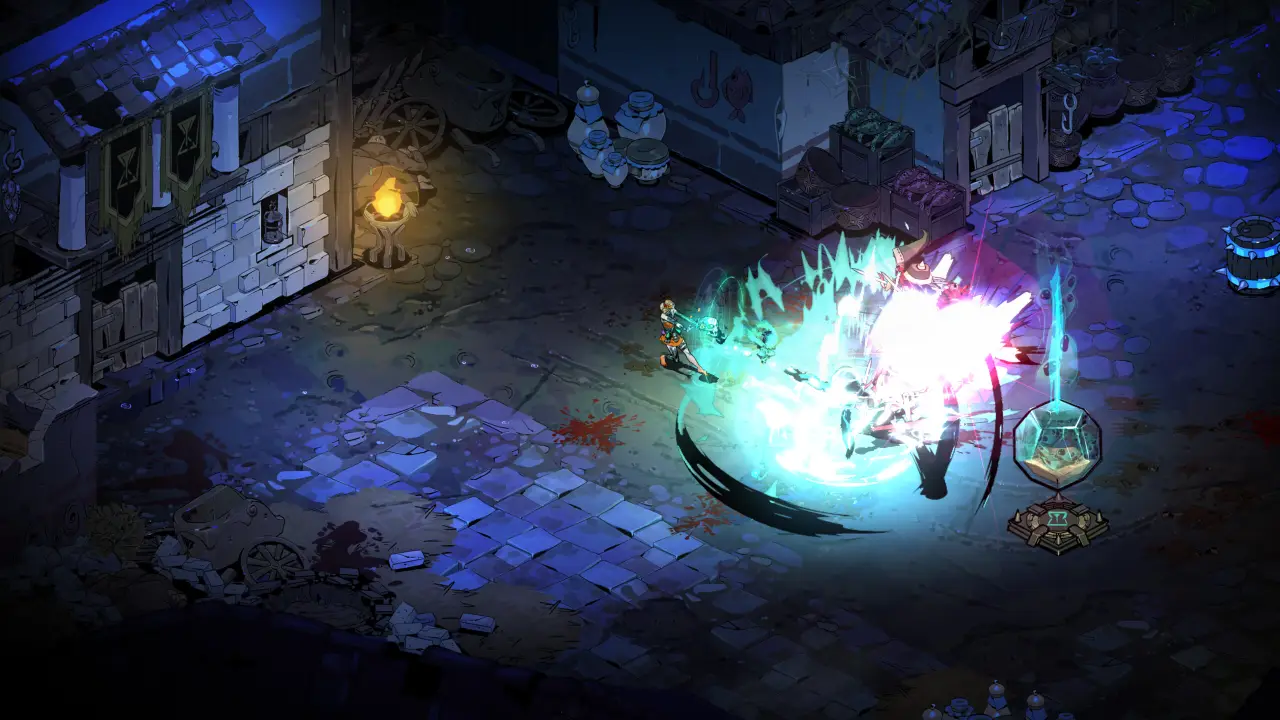
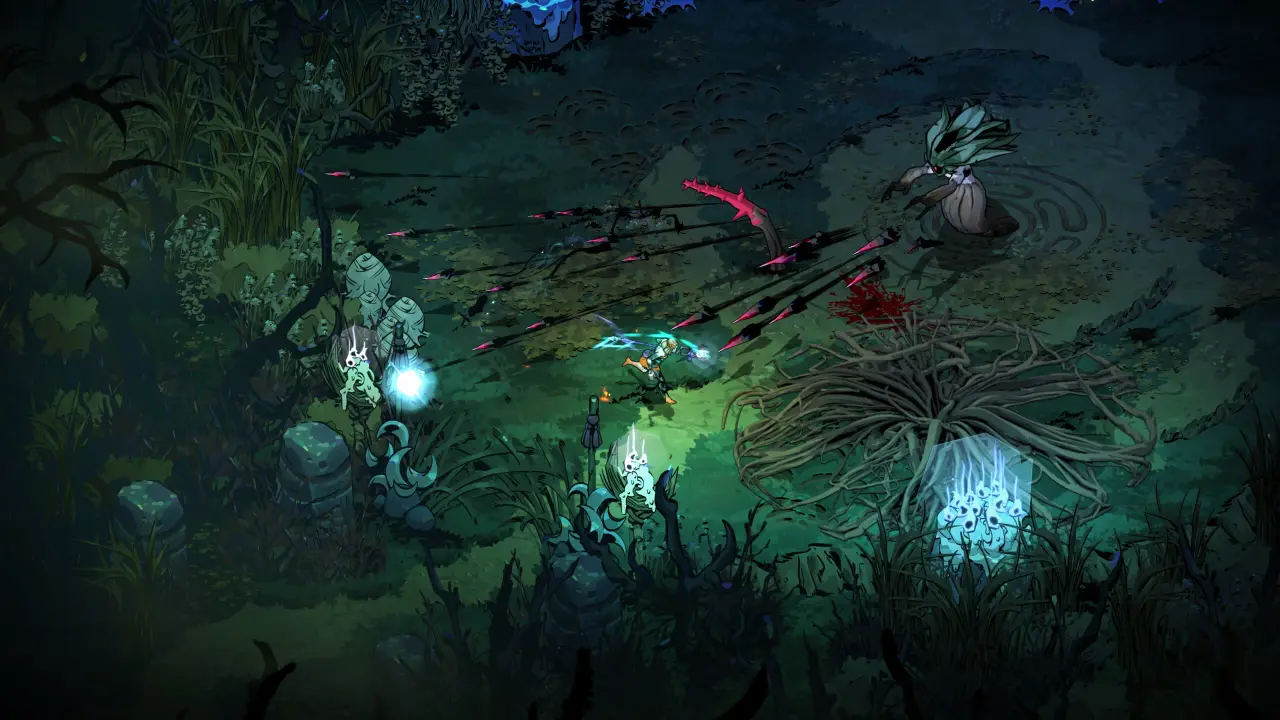
The combat screen speaks a different dialect entirely. From the top-down view, ability effects, enemy fire and boon glows pile up in saturated layers that somehow never smear into mush — a test of how well the art directs your eye, deciding what should pop and what should recede, and it's handled with discipline.
Even after dying twenty times in the same chamber, the relief on the walls and the way light rakes across the floor still make this entry feel subtly distinct from the last. That durability is the quiet advantage of a painted style over a rendered one: it leans on craft, not silicon, and craft doesn't age the way a graphics card does. A game built this way will look the part a decade from now, long after this year's photoreal showpieces start to show their seams.
What matters most is that the art and the game's temperament are of a piece. The weight of Greek myth, the strangeness of witch-lore, the gloom of the Underworld — the visual language holds all of it without a single frame breaking the spell. In an era when sequels routinely lose their texture to a new engine or a churned team, this one inherits and expands the original's look intact.
Credit too goes to how the animation reads in motion. Melinoë's spellcasting telegraphs differently from a melee lunge; enemies wind up their attacks with a clarity that lets you parry on instinct once you've learned the tells. In a top-down brawler where a single missed read can end a run, legibility is as much a visual achievement as beauty is, and the art direction never sacrifices one for the other.
Two visual registers, plus 120fps on Switch 2, with the platform spread to match

The structural payoff of two campaigns is two distinct visual moods. The Underworld keeps the familiar murk; the Surface walks you into more open terrain, where new areas like the Fields of Mourning use larger open blocks with rewards scattered amid swarms of foes. The pacing of what you see shifts enough that you never settle into one aesthetic rut.
The platform story is generous too. The full release hit Switch and Switch 2 simultaneously, and on Switch 2 the new hardware drives a smooth 1080p, 120-frames-per-second presentation in TV mode — and for an action roguelike built on parries and positioning, that frame rate isn't garnish, it's a number that materially shapes feel. The difference between sixty and a hundred and twenty frames is the difference between reacting to a tell and reading it comfortably, and on a game this precise that gap is felt in your win rate, not just your eyes. PC was a given; PS5 and Xbox Series followed half a year later, rounding out a complete spread. Whatever's in your hands, there's a version that holds up.
Because a top-down, hand-painted game doesn't make extreme demands on hardware, performance stays steady across the board — none of that "gorgeous but unplayable" tension. Loading is quick, the frame pacing holds even when the screen is at its most chaotic, and crashes are a non-issue in the 1.0 build. Pick it up for one run on a handheld during a commute, or plug in a controller and grind a serious evening on the TV; it absorbs both, which makes it one of the rare hardcore action games that suits commute and couch alike.
Visuals land at a nine. The identity and scene design are top-tier, the cross-platform optimization is clean, and the single point withheld simply acknowledges that technical photorealism was never its pitch — a deliberate artistic choice rather than a shortfall. You don't dock a painting for not being a photograph.
Combat | 9.5/10
ゲーム性: 9.5/10The Magick Bar turns "press to attack" into a constant trade-off

This is where the sequel pulls away from the original on pure feel. The first game was a thrill of immediacy — tap a button, fire the move, stack damage through footwork and dashes. Hades II bolts on the Magick Bar, a core resource that hangs a decision over every strike. Hold an attack or skill until the blue ring fills and you release the far stronger Omega version — Omega attack, Omega special, Omega dash — at the cost of draining your magick, which only refills if you stand still or lean on specific boons.
So every room becomes a tiny piece of arithmetic. Spend big or play it safe? Hoard magick for offense or keep it in reserve to survive? That "when do I charge, where does the resource go" tension makes the combat read as noticeably deeper than the first game's. It's also what cements Melinoë as a sorceress rather than a brawler — where Zagreus simply crashed into things, she plays as a hybrid who can both close the distance and control the floor.
Layer in the Hex system and it deepens again. A Hex is a summon-style ultimate granted by Selene, the moon incarnate; it charges as you spend Omega attacks and shifts run to run depending on how you've courted her. Suddenly there's a second meter to plan around, a payoff you steer toward rather than stumble into.
Boons, duo synergies and six weapons stretch the build space for hundreds of hours
In-run building is the soul of any roguelike, and the sequel widens both the pantheon and the web of synergies. The Olympians hand out temporary boons after you clear certain chambers, each god rewriting a different slice of your kit — and Duo Boons remain the single most electric moment of a run. Stack Zeus's chain lightning onto Aphrodite's charm, or wire Apollo's area damage into Poseidon's knockback, and a build that was drifting suddenly catches fire on one or two pivotal picks.
There are six weapons on the table, from the Sister Blades to the witch's staff and Demeter's scythe, and each one couples with the Hex system differently and feeds on a different family of boons, which keeps build variety honest. Multiply weapon aspects by boon combinations by tarot progression and the room to tinker comfortably underwrites hundreds of hours.
A quick triangulation pins its position. Its build depth sits next to Slay the Spire's "every pick rewrites the run" density; its action fluidity holds against Dead Cells; its fusion of story and combat answers something like Returnal — and it manages to do all three of those rarely-coexisting things well at once, in one game.
The tarot layer ties it together. Twenty-five Arcana cards, gated by your Grasp limit and linked through constellation bonuses, form a meta-progression that asks for real planning rather than a passive trickle of stat boosts. Deciding which cards to slot before a run, and how their constellations chain, is its own small strategy game played at the crossroads before you ever draw a weapon.
The difficulty curve cuts both ways: the late Surface isn't kind to newcomers
Honestly, depth has a cost, and it's the threshold. Push the Surface line into its back stretch and enemies hit harder while the screen gets busier — a clear difficulty spike that's rough on anyone still finding their feet. When a wall of fire, effects and bodies converges, a newcomer struggles to read where to dodge and what to hit.
The granular progression sharpens that early bounce-off. Boon effects are split across the base attack, the Omega attacks and the special, so while resources are tight up front, it's hard to assemble one coherent, comfortable build in a single sitting — you have to grind through a stretch that feels scattered and growth-starved. The early access crowd hammered this point harder; 1.0 softens it, but the underlying complexity remains.
The saving grace is God Mode, which hands out stackable damage resistance that ratchets up each time you fall, so players who just want the story without the hardcore wall can still press on. All told, gameplay earns a nine-and-a-half: the combat depth and build breadth are elite, and the lone reservation is that slope it never quite smooths over for beginners.
Content | 9.5/10
ボリューム: 9.5/10Two campaigns of comparable size, doubling the playable game outright
Talk about content and you can't dodge the blunt fact: against the first game, this is a super-sized portion. The original had one road to the surface. This one ships two roads of comparable scale that share almost nothing — the Underworld line driving at Chronos, the Surface line cutting toward Olympus. Maps, enemies, flow, plot and boss fights differ across both, and either track pulled out on its own roughly matches the entire original game.
That means what you're buying isn't "the first game plus extras." It's two solid helpings, and because the two tracks' progression systems tug at each other, the structure outlasts the original's single loop by a wide margin.
On the clock, How Long to Beat puts the main story around forty hours and a completionist run north of a hundred, before you even count a roguelike's native replay tail — a density that's lavish for an indie, matching the main campaigns of pricier AAA releases and then adding a "grind as long as you like" long tail on top. Put bluntly, you could pour a full work-week into this game and still have corners left unexplored.
What makes it land is that none of this is padding. Each line carries its own narrative motive, enemy design and boss choreography rather than reskinning one asset set twice. The puzzle logic, god interactions and scene rhythm on the Surface are a genuinely different solve from the Underworld's, which is what drops the word "doubled" out of marketing copy and into reality.
It helps that the encounter design keeps introducing new wrinkles deep into both campaigns. Just as you think you've mapped a region's bestiary, a fresh enemy type or a reworked miniboss forces you to re-read the room. That steady drip of novelty is what lets forty hours stretch to a hundred without the structure ever feeling like a treadmill — the game keeps finding small ways to surprise a player who has already seen a great deal.
There's also a quieter kind of content in how relationships deepen. The gifting, the side-conversations, the slow reveal of who these gods and shades are to one another — all of it accrues in the background while you chase the next boss, so even a "failed" run banks progress on some axis. Few roguelikes make losing feel this productive, and that, more than any raw hour count, is what keeps people coming back for a hundredth attempt.
Free updates, no paid DLC, and 2 million sales vouching for the stickiness
What's rarer still is how the content was delivered. Across the entire early access run, the studio kept widening the game through big free updates — more boons, weapon aspects, story — without slicing pieces off to sell as paid DLC. Then 1.0 dropped the true finale, an achievement system, the Fated List prophecy quests, late-game unlocks and a fresh batch of music in one stroke. To date there's no paid DLC; you buy once and get content that has been polished for over a year. The Fated List deserves a nod of its own — a wishlist of achievements and prophecies that surfaces what you might otherwise miss, nudging you back in for another lap.
The market vouches for the stickiness. On Steam alone, early access cleared over two million copies, and the rating holds at a 95% "overwhelmingly positive" across more than a hundred and ten thousand reviews. Roguelike players are famously hard to please — they've seen too many games dazzle for twenty hours and hollow out after — so sustaining a long-term score that high in that crowd says the content genuinely withstands the grind.
Where the original offered one lonely road, this one uses two campaigns to drag the question of "how long will this last" up to a new tier entirely, all while holding its price and positioning firmly in indie territory. Think of the first game as a refined but finite set menu; the sequel doubles the portions and wheels out an entire extra main course, and the bill barely moves. Content scores a nine-and-a-half; the half-point withheld is pure nitpicking — a slightly slow drip on some late unlocks, a couple of completionist targets that sit far out of casual reach — and it vanishes against a volume this large and this generously updated.



コメント 0
ご意見をお聞かせください
このゲームについての感想や評価をお寄せください。
まだコメントはありません。このレビューへの感想をぜひどうぞ。