




















Opening
Let me be straight with you before we go any further. OddFauna: Secret of the Terrabeast is an Early Access game, freshly out on Steam on June 2, 2026, and the developers themselves reckon it has another year to year-and-a-half of cooking before it hits 1.0. If you came looking for a finished, content-stuffed thing you can binge to the bottom, you can read on for curiosity, but keep that $24.99 in your pocket for now.
If you're the patient sort, though — the kind who likes to grow with a game — pull up a chair, because OddFauna has something I genuinely have not seen anywhere else in the cozy-farming space. Every critter you spot, every blade of grass, every little tool you craft was sculpted by hand from real clay by a husband-and-wife dev team, then scanned into the game. That fingerprint-real, you-can-feel-the-thumbprints texture might not grab you in a screenshot. Two hours in, it had me.
One thing about its pedigree will tell you a lot about its temperament. It comes from a studio called North Channel, but "studio" here means exactly two people — a married couple, one sculpting and painting every asset in clay, the other scanning that physical work into the game, writing the code, and wrangling the engine. So what you're playing isn't a product off an assembly line; it's handwork two people chiselled out one piece at a time. That authorship is its greatest charm, and, in a way, also why it's still rough: there are only so many hours in two pairs of hands. What follows is the honest breakdown — what it nails, where it's still rough, and whether those twenty-five bucks are worth spending today. I'll try not to make the call for you; I'll just lay out the math and let you pull the trigger yourself.
Story | 5.5/10
ストーリー: 5.5/10A confession to open with: if you want a tale with rising action and a third-act twist, OddFauna can't feed you that yet. That's the whole reason its story dimension lands at a 5.5. But the way it tells what little it tells is unusual enough to be worth pausing on. It isn't that the game has no story. It's that the story has been broken into pieces and folded into the act of tending your world.
You're not the chosen hero — you're a tiny beast keeping a bigger one alive
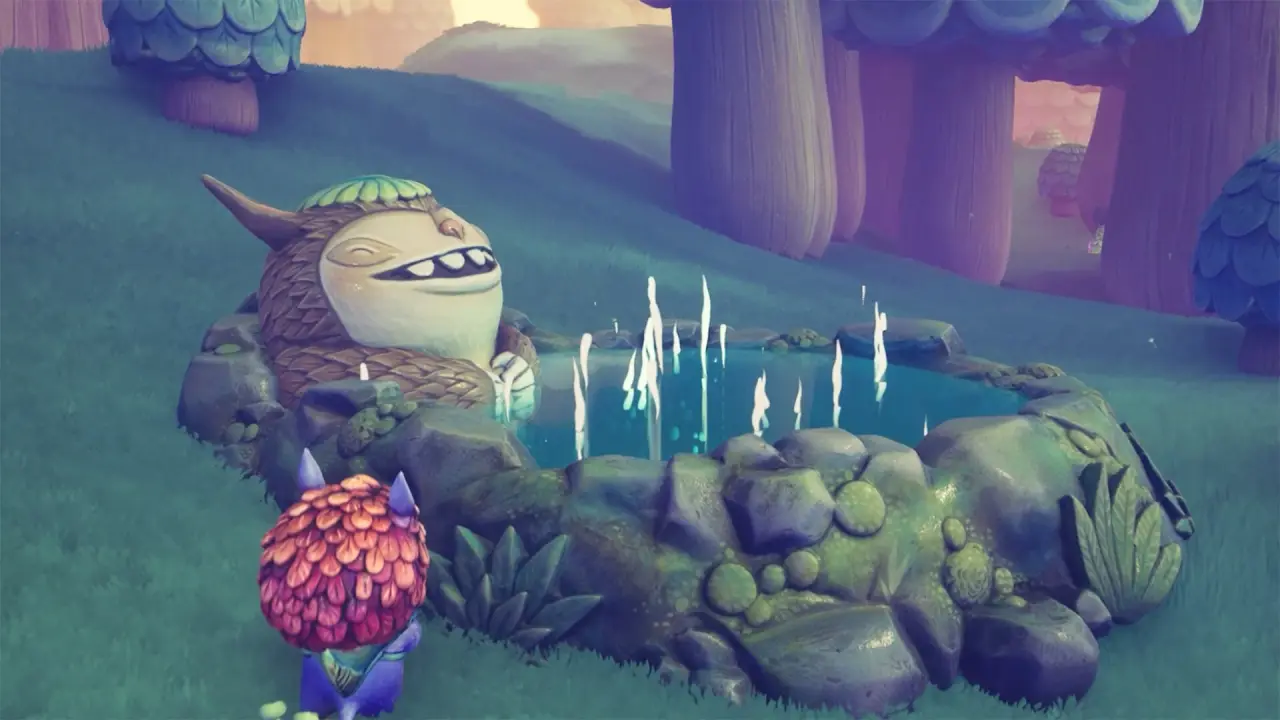
You play an Astor, a small creature standing on the back of a living giant called a TerraBeast, and the spine of the whole thing is quiet: bond with the beast, live on its back, and nurture the world it carries by gathering the flora and fauna that take root there. It starts as a patch of dirt no bigger than your palm. As you plant, divert water, and coax creatures in, that little world on its back slowly unfurls and comes alive. There is no save-the-realm horn blast here. Your job is gentle to the point of tenderness — look after the small home under your feet — and that posture dictates the emotional weather of the entire game.
That choice is also why the dramatic tension runs thin. It's a design stance, not a shortcut, but you should walk in knowing exactly what you're buying: mood over momentum, relationship over plot. There's a quiet ambition buried in that framing, too. Most growth games hand you a beast or a farm and treat it as a backdrop for your own progression, but OddFauna inverts the relationship — the world is the character you're caring for, and your reward is watching it stir to life rather than watching a number tick up. Whether that lands as profound or simply slight will depend entirely on your patience, and I won't pretend it'll click for everyone; some players will find the lack of a stated goal liberating, others will find it aimless, and both reactions are fair.
The plot is handed to you in fragments, and the main thread has barely cleared its throat

OddFauna serves its narrative in shards, drip-fed through exploration — you wander, you poke at corners, you piece together hints from the creatures and the land rather than from cutscenes. The studio has put "uncovering the secret of the TerraBeast" squarely on the roadmap, which tells you plainly that the real spine of the story is still to come in later updates. In the current v0.1.1 build, what you get is closer to a thin atmospheric wash than a thread you can chase.
The nearest thing to objective-driven content is the Blighted regions: corrupted zones you can only enter and cleanse once you've grown enough resources and tamed creatures with the right skills back home on your TerraBeast. It's a faint goal line for the players who want to dig deeper, but it reads as a gameplay target, not a plot.
That faint thread is worth taking seriously all the same, because it hints at where the writing wants to go. A blighted zone you have to prepare for, journey to, and slowly heal is a small narrative arc in disguise — there's a cause, an obstacle, and a resolution baked right into the act of fixing it. Right now it's the closest the game gets to making you feel like the world has a history you're stepping into rather than a blank canvas you're filling. Whether the eventual main story can build on that or just bolts cutscenes onto a sandbox is the open question, and it's the single biggest thing the next year of updates has to answer. If anything carries the weight of characterization here, it's the befriending loop — each OddFauna has a temperament and a favorite food, and learning one, feeding it right, and bringing it home plays out like getting to know a roster of personalities. So OddFauna isn't really telling you a story so much as letting you grow a relationship by hand, and that, for now, is the only emotional line it can honestly stand behind.
Audio | 7.0/10
サウンド: 7/10The sound here is charming without being remarkable — no theme you'll hum for the rest of your life, but a steady stream of little noises that genuinely make you smile while you play. That's the 7.0 in a nutshell: docked for the missing signature score, lifted by the small stuff done right.
The little sounds that tug your mouth into a grin

Players keep singling this out in their reviews, and they're right to. Foraging, crafting, every fiddly interaction comes with a cute, satisfying sound cue, so doing one small thing rewards you with one small noise. That sounds trivial until you remember what kind of game this is — one you're meant to sink hours into, puttering away at the same chores. That instant audio feedback is exactly what keeps the repetition of planting, gathering, and tinkering from going stale. Each action lands with a tiny hit of delight, and across a long session those add up.
The wider soundscape is tuned toward calm and low pressure too, locking neatly into the game's whole "won't rush you, won't scare you" temperament. No tense percussion is going to come marching in to hurry you along; it's mostly the loose, unhurried ambience of a place you're slowly making your own.
It's worth saying that this restraint is itself a design choice, not an absence of effort. A cozy game lives or dies on whether it can keep you comfortable for hours without lulling you into boredom, and the small reactive cues do a quiet amount of heavy lifting there — they give your hands something to feel responsive even when nothing dramatic is happening on screen.
Don't expect a standout OST — and Chinese players have to settle for English

But here's the honest ceiling. So far, neither press nor players have gone out of their way to praise a composer or call out a particular track, which tells you the soundtrack just isn't a selling point yet. Set against that clay art you can recognize at a glance, the audio is clearly a step behind, and the marriage of music to pacing is still shallow.
One very practical note for some readers: the in-game language is currently English only, with full English voice and no localized dub. The Steam page offers Simplified and Traditional Chinese for the storefront, but the words and voices inside the game are still English, so factor that in before you buy. The saving grace is that this is an intuitive, low-text game; if your English is shaky but serviceable, icons and trial-and-error will carry you through most of it, even if a little of the flavor slips past.
The other thing I'd flag is that audio is exactly the kind of dimension that tends to grow late in Early Access. A signature theme, layered ambient tracks per biome, music that swells when you finally heal a blighted zone — none of that is here yet, but all of it is the sort of polish a small team adds once the systems are nailed down. So treat the 7.0 as a snapshot of a soundscape that's pleasant but unfinished, with real room to climb — the foundations of charm are here, and what's missing is mostly the kind of orchestral flourish that arrives once the rest of the game stops moving underneath it. Hold it up against a cozy benchmark like Animal Crossing and the gap shows — that series is far more polished in its overall sound design and that signature sense of place. OddFauna's effects are likable; closing the distance to that bar is work left for future updates.
Visuals | 8.5/10
グラフィック: 8.5/10If there's one thing here I'll vouch for without hedging, it's the look — or rather, how the look gets made. The 8.5 is the highest mark in this whole review, and it's earned, because this art is one of a kind.
Every creature was sculpted by hand, out of actual clay

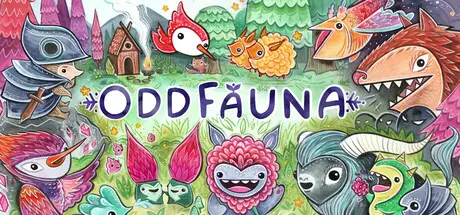
Start with the fact that rewired how I think about cozy-game art: everything you see in OddFauna — every character, plant, and prop — was sculpted by hand from real clay and then photoscanned into the engine. This is not a "clay-style filter." It's the genuine article. Artist Emma SanCartier sculpts all of it; even the berries you eat in-game were pinched and painted by her hands, not pulled out of a modeling tool. Lean in on a single critter and you can read the irregular ridges that only handwork leaves behind, the kind of detail procedural modeling struggles to fake.
The result is something screenshots only half-convey; you really have to see it move. The assets carry real-material reflections and a handmade wonkiness, like little figurines you could press a thumb into, rather than the glossy plastic of procedurally generated meshes. PC Gamer put it perfectly — they called these handmade critters "absolute catnip for my crafting game brain." Once that texture sinks its hooks in, immunity is hard to come by. There's a softness to the whole image, too, that you can't quite reverse-engineer from a normal art pipeline. Light catches the clay the way it catches a real object on a desk, with tiny pits and seams that scatter it unevenly, so even a humble shrub reads as something a person held and shaped rather than something a tool extruded. It's the kind of detail your eye registers before your brain names it, and it's a big part of why the game photographs so well in motion.
How two people sculpted enough clay to fill a whole world

Pinching the clay is only half the job. Getting those handmade assets into a world with mountains, forests, and hundreds of thousands of plants — without the frame rate folding — is the real trick. Tech-side developer Cliff Mitchell built it in Unreal Engine 4, leaning on the engine's Hierarchical Instance Static Mesh system to reuse a single handmade model thousands of times across a scene efficiently. So that "the entire world looks hand-pinched" impression rests on a rendering pipeline tuned specifically for handmade assets at world scale, not on brute-forcing high-poly meshes. That trade-off is also how a two-person team shoulders a visual workload this large.
The biomes — mountains, forests, grasslands, archipelagos — do give the visuals real variety, each region carrying its own palette and plant life. Early Access caps how much of that you can roam right now, of course; however gorgeous the art is, there are only so many places to wander.
One detail I keep coming back to: the way light lands on clay is simply different from how it lands on a typical modeled object. Real clay has tiny pits and seams, so light scatters across it unevenly, and even a humble shrub reads as something a person pinched and pressed rather than a tool extruded. It's a texture your eye clocks before your brain can name it — you can't quite say what's different, you just feel the image has warmth. That's a big part of why OddFauna is so photogenic in motion; grab a screenshot at random and it looks staged, like a little still-life someone set up on a desk. One sideways comparison to close on: Stardew Valley is 2D pixels, Animal Crossing is industrial vector-plastic cute, and both are lovely in their own right. What OddFauna hands you is a three-dimensional, physically warm clay feel — and on that road, almost nobody else is willing to put in this much labor.
Combat | 7.5/10
ゲーム性: 7.5/10Gameplay is OddFauna's real skeleton, and it's where the scorecard's verdict — right direction, solid foundation, still rough around the edges — comes into sharpest focus. The 7.5 reflects exactly that: the core loops stand up, the design ideas are endearing, but the moment-to-moment feel and the stability still need the developers' file and sandpaper.
Make friends, don't catch or fight — and reshape the land like clay

The mechanic I love most first: you don't collect creatures by trapping or beating them, you collect them by making friends. Every wild OddFauna has foods it loves, so you watch where it lives and how it behaves, guess what it might like, and try feeding it materials you've foraged or grown. Get it right and trust climbs; max that trust and it agrees to come home and settle on your TerraBeast. Better still, the creatures you befriend aren't ornaments — they plug into your ecosystem by their skills, some good at tilling soil for your crops, some active only in certain terrain. It stitches "keeping a pet" together with "wiring up a functional chain," and plenty of players say it's precisely this read-its-quirks-to-befriend-it design that has them collecting one creature at a time instead of checklist-grinding spawns.
Sitting right beside that is terraforming, and it makes the "like clay" line literal. You can genuinely dig a flat plot into a lake, fill a lake into a hill, level a slope into a field — and crucially, how you reshape the ground directly decides which creatures appear and what you can plant. That reshape-the-land, reshape-the-ecosystem causal chain is what gives OddFauna more legs than a plain cozy farm, and why it earns its "simulation / immersive sim" tags rather than just wearing them. Around these two pillars, the foraging, crafting, farming, and building loops are all live at Early Access launch: you forage materials, build tools and contraptions at a workbench, lay out gardens, and raise shelters for your creatures, growing a whole little ecosystem from bare ground. The studio frames it as a systemic sandbox where the player's actions directly shape the world — mess with it however you like and the world grows to match, instead of being shoved down a fixed script.
What keeps this from being idle-game busywork is that the loops interlock rather than run in parallel. Want to lure a particular creature? You may have to reshape the terrain into the habitat it likes first. Want to reshape that terrain, or craft a fancier contraption? You'll need to have foraged enough materials and grown the right crops. So foraging feeds crafting feeds terraforming feeds befriending feeds creatures-doing-your-chores feeds more efficient foraging, and the whole thing snowballs — the deeper you get, the more resources and helping hands you have on tap. It's less "click to plant, click to harvest" and more like assembling a little machine and then watching it start to turn on its own.
The gripes are concentrated: clunky controls, plenty of bugs

Now the deductions, because they deserve plain language, and the complaints are oddly consistent. The loudest is the feel of building and inventory: several players found the construction system awkward and hard to bend into the base they actually pictured, and inventory slots run short, with requests for nearby crafting. Worse are the bugs — structures vanishing into thin air, the camera drifting during creature interactions — and one review flatly called it "more glitch than game" right now. Held up against fellow systemic sandboxes like Subnautica or Oxygen Not Included, both are more mature in depth and polish. None of these complaints are about the design being wrong, though, which is the encouraging part — players aren't asking for a different game, they're asking for the game that's here to feel better in the hand and stop dropping their buildings into the void. Those are fixable problems, the kind a steady patch cadence chips away at, not fundamental misfires. I'm sold on OddFauna's direction, and several of its core mechanics have real cleverness in them, but the depth and the stability are both still on the way. That's Early Access being Early Access: take that deal or wait it out.
Content | 6.5/10
ボリューム: 6.5/10Content is OddFauna's most concrete shortfall right now, and the main reason it sits at a 6.5. It isn't that the work is bad — it's that the game simply hasn't grown up yet. Let me help you do the math on three things: how much is here, how much is promised, and whether it's worth jumping in today.
The foundation is all there, but there's not much to roam yet

The current build is v0.1.1, and the good news is that the core loops — foraging, crafting, farming, building, terraforming, befriending — are all present, not one missing. The bad news is that there's only a thin slice of biome to actually roam, with one player bluntly noting "you get one biome to explore, not much to do." The kitchen and all the pots and pans are stocked; it's the dishes on the table that are still few. That distinction matters more than it sounds, because building the kitchen is the hard, structural work and plating more dishes is the comparatively additive part — which is exactly why the roadmap reads as plausible rather than wishful. The bones that are hardest to retrofit are already in.
What's telling is how sharply playtime splits, and that split says more than any single number. One reviewer with 44 hours is still digging in, crediting the biomes, progression, and the varied uses of helper creatures with carrying dozens of hours; others felt done after three to five.
The gap between them is really just how willing you are to burrow into the systems — tinkerers can coax fresh ecosystems out of the same patch of land with terraforming and creature pairings, treating the sandbox as a toy with no fixed finish line, while players who want level-after-level progression hit the bottom fast. So before buying, weigh which kind of player you are; that's a more useful gauge than the hour count itself, and it's the single biggest predictor of whether you'll feel forty hours of value or four.
The roadmap is generous — the question is whether it ships

Looking forward, the studio's roadmap is laid out in real detail: a bigger creature roster, fresh biomes with their own flora, fauna, and resources, expanded crafting and gardening, plus entirely new systems — seasons, weather, cooking, fishing — and that main story thread that finally cracks open the secret of the TerraBeast. If those land as planned, OddFauna's scale will be nothing like what it is today.
Take seasons and weather alone — for a game built on terraforming and ecological interlock, the potential ripple is large. Picture the same patch of land you sculpted by hand sprouting different creatures and different crops as the season turns, the world quietly breathing on its own; that single feature could lift the depth of the current systems by a whole tier. Cooking and fishing read more like cozy side dishes, extra low-stakes things to potter at between farming and befriending. Every one of these ideas is pointed in the right direction. The only catch is that they're all still on paper.
But a roadmap is a promise, not something already in your hands, and I owe you that warning up front. The developers themselves estimate Early Access will run roughly one to one-and-a-half more years before 1.0. In other words, the $24.99 you spend today buys a complete gameplay foundation, a genuinely one-of-a-kind handmade art style, and a year-plus of updates to come — not a finished, stuffed-full game. The saving grace is the free demo, which lets you try before you buy, and the devs have said outright that the price only goes up at 1.0. So if you like the direction but fear the risk, the steadiest move is to play the demo first, feel out whether that handmade texture and the core loop click for you, then decide whether to climb aboard now. That's the expectation to set straight: half of what you pay goes to the present, half to a future still a year-plus away from growing in.





コメント 0
ご意見をお聞かせください
このゲームについての感想や評価をお寄せください。
まだコメントはありません。このレビューへの感想をぜひどうぞ。