
























Opening
Project Zomboid greets you with four words that double as its entire design philosophy: "This is how you died." Not "this is how you might die" — how you will die, stated as a certainty before you have taken a single step. That blunt promise is the truest thing any survival game has ever told a player, and it sets the terms for everything that follows. Project Zomboid is not a game about winning; it is a game about how long and how well you can postpone an ending that is already written, and that honesty is the foundation of one of the deepest survival simulations ever built.
Developed by the small UK studio The Indie Stone, Project Zomboid has been in Steam early access since 2013, and across thirteen years of continuous free updates it has grown into something genuinely staggering in its detail. Set in the fictional Knox County, Kentucky, in 1993, it drops you into a zombie apocalypse rendered not as an action-movie power fantasy but as a meticulous, isometric survival simulator. You will manage hunger, thirst, fatigue, mood, panic, injury, infection, fitness and even body weight; you will build a character from over two dozen occupations, sixty-plus traits and eleven-plus skills; and you will, eventually, make the one mistake that the game has been patiently waiting for. The 2024–2025 arrival of Build 42, a generational overhaul, only deepened an already bottomless game.
This review grades Project Zomboid across six dimensions, and the scores describe a specialist triumph: a 9.2 for gameplay and a 9.0 for content sit at the top, an 8.5 for audio supports them, and a 7.5 for its isometric pixel-art graphics and a 6.0 for its near-absent story mark the deliberate trade-offs, landing on an 8.5 overall. That spread is the review in miniature. Project Zomboid is a simulation of unmatched depth wrapped in a humble presentation, gated behind a brutal learning curve and a permadeath that erases everything. Whether that is a masterpiece or a non-starter depends entirely on what kind of player you are, and the next six sections will tell you which.
Story | 6.0/10
ストーリー: 6/10Project Zomboid scores 6.0 for story, and the number is a fair accounting of a game that makes exactly one narrative promise and otherwise leaves the storytelling entirely to you. There is no plot, no protagonist with an arc, no scripted events driving you forward — and yet the game's framing is so distinctive that it earns more than the bare minimum. The story score reflects a deliberate vacuum, but not an empty one.
"This is how you died": the only promise

The single most important narrative element in Project Zomboid is its tagline, presented at the start of every game: "This is how you died." It is not a threat or a tease but a statement of fact, and it reframes everything that follows. Most games promise victory, mastery, a happy ending earned through skill; Project Zomboid promises only death, and asks the single question of how you will get there. This is a genuinely bold and effective piece of authored tone, because it transforms the entire experience from a quest to survive into an elegy for a character you know is doomed. Every base you build, every skill you grind, every relationship you form with your own routine carries the weight of that foreknowledge — you are not building a future, you are documenting a life that will end. It is the rare game whose framing is more powerful than most games' full scripts, and it is the reason the story score clears the floor despite the total absence of conventional narrative. The game tells you how it ends, and then makes the journey there matter precisely because it is finite. That single promise does more emotional work than entire questlines in other survival games.
A world without characters

Where the score is held down is in the near-total absence of authored characters and events. For most of its history Project Zomboid has had no NPCs at all — the world is empty of the living, populated only by you and the shambling dead, and that emptiness is both thematically apt and narratively limiting. There is no one to talk to, no factions to navigate, no character drama to drive a plot, just the lonely business of staying alive in a depopulated county. This isolation is a deliberate and effective mood, reinforcing the desolation of the apocalypse, but it does mean the game offers none of the interpersonal storytelling that gives other survival titles their memorable moments. The long-promised arrival of NPCs in future builds may change this, but as the game stands, the story is a story of one, and the silence where other characters would be is a real, if intentional, gap. Judged as authored narrative, a world with no living characters simply cannot score highly, and the 6.0 reflects that the game's drama is environmental and personal rather than written and populated.
The emergent elegy and Knox County's quiet texture

What redeems the story score from the floor is the emergent narrative the systems generate and the quiet environmental storytelling layered into the world. The real story of any Project Zomboid save is the arc of your character: the desperate early scramble, the slow establishment of a routine and a home, the growing competence that breeds the overconfidence that finally kills you. Because of permadeath and the "this is how you died" framing, that arc carries genuine weight, and every player accumulates a personal history of survivors and the specific, often stupid mistakes that ended them. Around that emergent drama, The Indie Stone has woven a subtle authored texture: Knox County in 1993 tells its story through abandoned homes, the last notes of people who did not make it, period detail, and the slow environmental decay of a society that has ended. It is restrained, atmospheric storytelling that frames the silence without filling it, and it is the lone deliberate narrative layer the game offers. The 6.0 is the honest verdict — no plot, no characters, but a framing and a texture strong enough to make the emptiness mean something. It is a score that acknowledges the absence of conventional narrative while quietly crediting a game that found a way to make you feel the weight of a story it never actually wrote, and for many players that trade is more than fair.
Audio | 8.5/10
サウンド: 8.5/10Project Zomboid scores 8.5 for audio, and the high mark is earned because, like the best survival games, it makes sound a mechanic rather than a backdrop. In a game where the dead are drawn to noise, every sound you make is a decision with consequences, and every sound you hear is information you ignore at your peril. The audio design is woven so tightly into the survival loop that it becomes an instrument of play, and that integration is what lifts the score well above what a humble pixel-art game might suggest.
Noise is the enemy

The defining audio fact in Project Zomboid is that sound attracts zombies, and this single rule transforms the entire soundscape into a system of risk. Firing a gun is enormously loud and will summon every zombie within a wide radius, smashing a window to break into a house makes noise, a car engine is a rolling dinner bell, even sprinting and certain crafting actions generate sound that the horde can hear. This means the player is constantly performing an audio cost-benefit analysis: the fast, loud solution versus the slow, quiet one, the gunshot that solves an immediate problem but creates a far larger one. Stealth in Project Zomboid is fundamentally an audio discipline, a matter of managing the noise you produce, and that makes the sound design load-bearing in a way few games achieve. The tension of creeping silently through a town, acutely aware that one wrong sound brings death, is the core of the experience, and it exists because the audio system treats noise as a tangible, dangerous resource. Mastering the game is in large part mastering your own sound footprint, and that lesson is taught entirely through audio consequence.
The soundtrack of dread

Beyond its mechanical role, Project Zomboid's audio excels at building and sustaining dread, and the dynamic soundtrack is central to that. Rather than playing constant music, the game uses a tension-tracking score that swells when danger is near and recedes into silence when you are safe, so the music itself becomes a barometer of threat that you learn to read with your nervous system. When the strings begin to climb, your pulse follows, because you have been trained to associate that swell with a horde you may not yet have seen. This responsive scoring is hugely effective at maintaining the oppressive atmosphere that defines the game, ratcheting tension during encounters and granting uneasy relief in the quiet stretches. It never overstays its welcome, never tips into action-movie bombast, but instead works as a subtle, constant companion to the fear, amplifying the stakes of moments that on paper are just a survivor walking down a street. The restraint is the point — the music knows that silence is more frightening than noise, and it deploys both with real craft.
Ambient texture and functional intelligence

The third pillar of the 8.5 is the ambient soundscape, which does double duty as mood-setting and as practical survival intelligence. The distant moans of unseen zombies, the creak of an old house settling, the drumming of rain on a roof, the wind through empty streets — these ambient sounds build the desolate, lonely texture of Knox County in 1993 and keep the player perpetually on edge. But they are also functional: a skilled player learns to parse the ambient audio for threats, hearing the direction and rough number of a horde before it comes into view, distinguishing the moan that is far away from the one that is dangerously close. This turns listening into an active survival skill, an extra sense the game rewards you for honing, and it deepens the immersion because you are not just hearing the world but reading it. The combination of mechanically dangerous noise, a dread-building dynamic score, and a functionally rich ambient layer makes Project Zomboid's audio a complete expression of its survival philosophy. The 8.5 is the score of sound design that you do not merely listen to but actively survive by.
Visuals | 7.5/10
グラフィック: 7.5/10Project Zomboid scores 7.5 for graphics, the second-lowest of its dimensions, and the number captures a genuine and deliberate trade-off. This is an isometric, pixel-art game that has never tried to compete on visual fidelity, choosing instead a presentation that serves its simulation. Judged against AAA spectacle it looks modest; judged against what it is trying to do — convey enormous amounts of survival information clearly while sustaining a creepy, oppressive atmosphere — it is far more accomplished than the raw style suggests.
Style in service of the simulation

The isometric perspective and pixel art are not limitations but functional choices, and understanding that is key to the 7.5. A survival simulation as deep as Project Zomboid needs to communicate a vast amount of spatial information at a glance — where the zombies are, where the exits are, the layout of a building, the placement of your traps and barricades — and the top-down isometric view does this superbly, giving you the situational awareness the gameplay demands. The pixel art, meanwhile, keeps that dense information legible and performant, ensuring the screen stays readable even when it is full of detail and threat. This is style subordinated to function, an art direction chosen because it serves the simulation rather than because it dazzles, and on those terms it works extremely well. The visuals are never the point in Project Zomboid; they are the interface through which an extraordinarily deep system is made playable, and they accomplish that job with an efficiency that flashier presentations would struggle to match. The clarity is itself a design achievement, even if it never reads as a graphical one.
Atmosphere above its weight

What lifts the graphics score above a merely functional rating is atmosphere, because Project Zomboid is genuinely, consistently creepy despite its simple art. The game layers detailed dynamic lighting, weather systems and a careful color palette over the pixel base, and the result punches well above what the underlying style would imply. Night is genuinely dark and frightening, forcing you to rely on flashlights that draw attention; rain sweeps across the county and changes both the mood and your survival calculus; and the overall presentation conjures a pervasive sense of desolation and unease that more technically advanced games often fail to achieve. The atmosphere is a real and significant strength, proof that mood is a product of art direction and design rather than polygon count, and it is a major reason the game is so immersive. You feel the loneliness and the danger of Knox County not because it is rendered in high fidelity but because every visual choice, from the lighting to the weather to the muted palette, is bent toward making the apocalypse feel bleak and real. That atmospheric competence is worth a great deal.
The honest ceiling and Build 42's leap
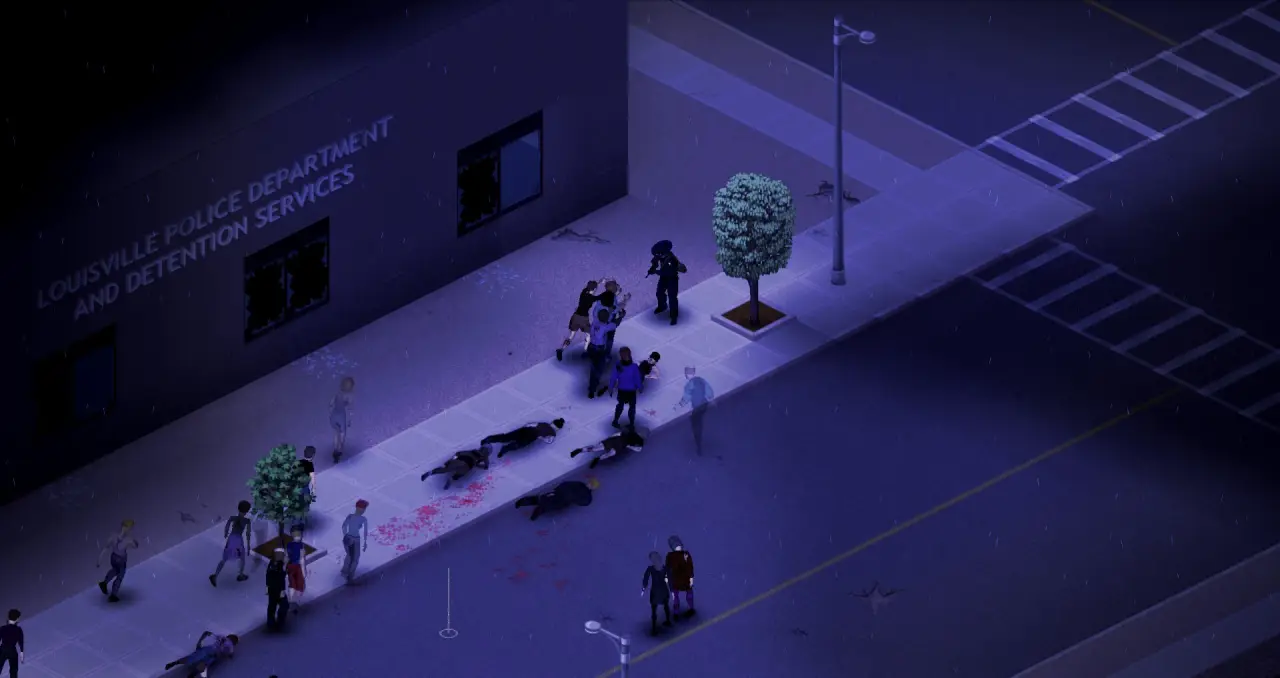
Where the 7.5 stops is at the plain reality flagged in the game's own criticisms: the isometric pixel-art presentation simply will not appeal to a large segment of players who expect modern, high-fidelity visuals, and no amount of atmosphere changes that for someone who wants AAA graphics. This is the honest cap on the score, an accessibility barrier as real as the difficulty — the look is an acquired taste, and some players will bounce off it before they ever discover the depth beneath. What has meaningfully raised the ceiling, however, is Build 42, the major update whose lighting and rendering overhaul represents a generational visual step for the game, sharpening the presentation and modernizing the atmosphere without abandoning the functional isometric identity. It does not turn Project Zomboid into a graphical showcase, and it was never meant to, but it narrows the gap and makes the game more visually appealing than it has ever been. The 7.5 is the fair verdict: a deliberately humble style executed with real atmospheric skill, recently improved, that serves its simulation perfectly while remaining an obstacle for the fidelity-focused. For the players it is built for, the graphics are exactly enough. And there is a quiet wisdom in that restraint: by refusing to chase a fidelity arms race it could never win, the studio kept its resources where they mattered — on the simulation — and ensured the game would still run, and still look coherent, on almost any machine more than a decade after release.
Combat | 9.2/10
ゲーム性: 9.2/10Gameplay is Project Zomboid's highest score at 9.2, and it is the dimension that justifies every other compromise the game makes. This is the deepest survival simulation on PC, a game that models the human experience of an apocalypse at a level of detail that borders on obsessive, all of it governed by a permadeath that makes every decision matter. The 9.2 is the measure of a simulation so rich and so honest that players sink thousands of hours into mastering it.
Character creation as a build-craft puzzle

Before you ever spawn, Project Zomboid presents one of the most consequential character-creation systems in any game. You choose from over two dozen occupations, each with its own starting skill bonuses, then spend points on more than sixty positive and negative traits — taking flaws like Smoker, Slow Reader or Underweight to afford strengths like Athletic, Handy or Fast Learner — across a system of eleven-plus skills that you will develop through play. This is not cosmetic; it is a genuine build-craft puzzle where every choice shapes how your survivor experiences the apocalypse, and optimizing a build for a particular playstyle is a deep game in itself. A character built for stealth and foraging plays completely differently from one built for combat and carpentry, and the negative traits force real trade-offs that follow you for the entire life of the character. This depth of customization is the ceiling of the post-apocalyptic survival genre, and it means that even before the zombies appear, Project Zomboid has already given you more meaningful decisions than many games offer in their entirety. The build you bring is the hand you are dealt, and learning to play any hand well is a huge part of the appeal.
Survival simulated to the bone

The core of the 9.2 is the survival simulation itself, which is staggeringly detailed. You manage not just hunger and thirst but fatigue, mood, panic, boredom, unhappiness, fitness, body weight, and a full medical model of injuries, wounds, fractures and infection. Step on glass and the cut can become infected; eat nothing but the same canned food and your character grows unhappy; fail to exercise and your fitness declines, slowing you down when it matters most. The psychological layer is especially distinctive — a panicked character aims worse and acts unreliably, so managing your survivor's state of mind is as important as managing their stomach. These systems interlock so that survival becomes a constant, absorbing act of holistic self-maintenance, a medical-and-mental simulator wearing the clothes of a zombie game. Layered on top is the long game of base-building, farming, carpentry, electrical work and vehicle mechanics, giving you the tools to carve out a sustainable life and a project to pour hundreds of hours into. The depth is the point, and there is simply nothing else that models the lived texture of an apocalypse with this much fidelity.
The brutal curve and the DayZ contrast
The honest cost of all this depth is one of the steepest learning curves in gaming. The first ten hours of Project Zomboid are a punishing cycle of repeated death, and the game's own data and reputation confirm that this bounce-out cliff drives roughly 80 percent of newcomers to quit before the systems click. There is little hand-holding, the interface is dense, and the permadeath means every fatal mistake sends you back to the start — a combination that reads as cruelty to players expecting a gentle on-ramp. This is the main factor keeping the gameplay at 9.2 rather than higher: the experience is sublime once you understand it, but understanding it costs a real toll in dead survivors and frustration. The contrast with its closest commercial rival is clarifying. DayZ shares the hardcore survival skeleton but expresses it in 3D, first-person, and around multiplayer PvP tension; Project Zomboid turns inward and downward, trading that confrontational immediacy for a depth of solo simulation, character customization and base-building that operates on an entirely different level of granularity. They are both survival masterpieces aimed at different desires, and for the player who wants the apocalypse simulated rather than shot, the 9.2 is more than earned.
Content | 9.0/10
ボリューム: 9/10Content scores 9.0, Project Zomboid's second-highest mark, and the case is overwhelming: a large, configurable sandbox, a deep web of interlocking systems, an enormous modding ecosystem, and thirteen years of free updates that have steadily expanded an already vast game. This is a title measured in thousands of hours, where the systems generate objectives faster than any player can complete them, and where the studio has spent over a decade adding to the package without ever charging for more.
A configurable sandbox of survival
The foundation of the 9.0 is the sandbox itself, which is both large and almost endlessly configurable. Knox County is a sprawling map of towns, suburbs and wilderness — Muldraugh, West Point, Riverside, the vast city of Louisville and more — all to be explored, looted and settled, with no fast travel to shrink the distances. On top of that geography sits one of the most flexible settings systems in any survival game: you can tune zombie population, speed, strength and behavior, loot rarity, weather severity, the speed of time, and dozens of other parameters to craft anything from a relaxed builder's holiday to a nightmarish sprint for survival. This configurability means the content is not a fixed experience but a dial you set to your taste, and it dramatically extends replayability — the same map plays as a different game under different rules. Add the curated challenge scenarios and the dynamic meta-events, like the helicopter that periodically draws hordes toward your position, and the sandbox alone offers far more than most full-priced games. The breadth of how you can play is as much a part of the content as what there is to do.
Systems and mods without end
What turns a large game into a bottomless one is the combination of deep interlocking systems and a vast modding scene. The base game's web of crafting, farming, carpentry, electrical work, vehicle maintenance and base construction generates an inexhaustible supply of self-set goals — survive a hundred days, build a fortress, cultivate a self-sufficient farm, clear an entire town, drive across the county to Louisville — so there is always a next project pulling you forward. Then there is the Steam Workshop, where more than ten thousand community mods extend the game in every conceivable direction: new maps, new vehicles, new professions, overhauls, quality-of-life tweaks, total conversions, and full Chinese localization among countless other languages. This ecosystem lifts the content ceiling toward infinity, ensuring that whatever you eventually exhaust in the base game, the community has built something to replace it. Few games support modding this deeply or attract a community this prolific, and the result is that Project Zomboid's content is effectively unlimited for any player willing to explore the Workshop. The mods are not an afterthought but a core pillar of the game's longevity.
Thirteen years free, and Build 42
The final pillar of the content score is the studio's extraordinary commitment to free, ongoing development. Project Zomboid has been updated continuously since its 2013 early-access debut, and across thirteen years The Indie Stone has added multiplayer, vehicles, animation overhauls, new systems and the massive Build 42 — a generational update that expanded crafting, the map, the visuals and far more — all delivered free of charge to anyone who owns the game. There is no paid DLC, no season pass, no microtransactions; you buy the game once and receive every expansion forever, a discipline that puts this small studio in the same conscience tier as developers like the makers of Stardew Valley. This combination of a configurable sandbox, bottomless systems, an infinite modding scene, multiplayer and roleplay communities, and over a decade of free growth makes the content proposition genuinely exceptional. The 9.0 is the score of a game with more to do than almost any survival title in existence, delivered with a respect for the player that is increasingly rare, and the thirteen-year evergreen player base is the proof that the content has never run dry. Most games ship their best content at launch and slowly wind down; Project Zomboid has done the opposite, growing richer and deeper every year it has existed, which is exactly why a 2013 title still drew a concurrent peak north of sixty-five thousand players more than a decade later.





コメント 0
ご意見をお聞かせください
このゲームについての感想や評価をお寄せください。
まだコメントはありません。このレビューへの感想をぜひどうぞ。