
























Opening
Almost no game gets to change your mind about it twice. In the winter of 2020 this one launched in pieces, and the version that crawled onto last-generation consoles ran so badly that Sony pulled it from its store and started handing money back. The studio that had spent years building a reputation on The Witcher 3 set that goodwill on fire in a single night, and for a long stretch the name was a punchline before it was anything else.
Walk into Night City today, though, and you would struggle to picture it ever being that broken. After the 2.0 overhaul and the Phantom Liberty expansion, the place stood back up, and it stood up steadier than anyone had a right to expect. It took home Best Ongoing Game at The Game Awards, won a BAFTA for Best Evolving Game, pushed past thirty-five million copies sold, and turned into the most profitable thing its makers have ever shipped.
What follows is a review of the game as it actually exists now, scars and all. I will be honest about the crash, because the crash is part of the story. But the harder, more interesting claim is this one: once every wound got stitched shut, Night City stayed exactly what it had always promised to be — the one first-person open city nobody else has managed to build twice.
Story | 9.0/10
劇情: 9/10Two minds, one skull, and a clock that never stops
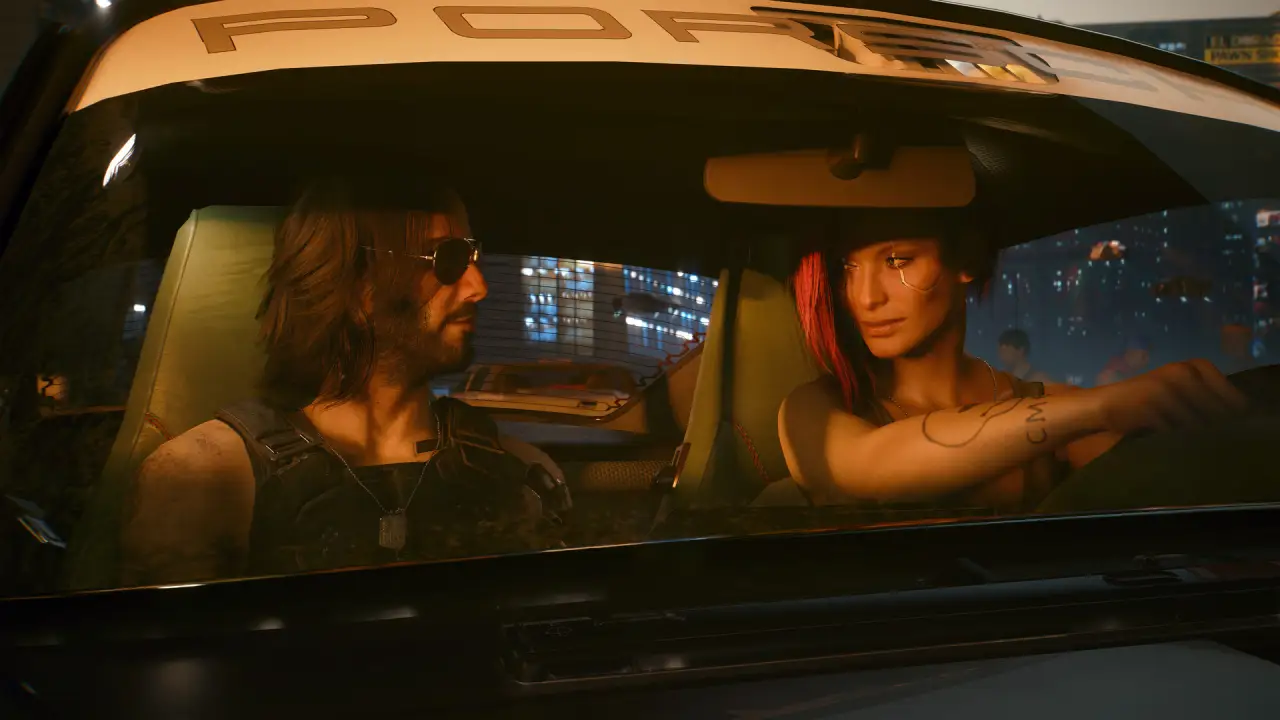
Strip away the neon and Night City is a story about dying. The merc you play as, V, jams a biochip called the Relic into the back of their head, and riding inside that chip is the stored personality of Johnny Silverhand — a rockstar and terrorist who has been dead for fifty years. From that moment V's skull becomes contested ground. The chip is slowly erasing V and writing Johnny over the top, and the whole campaign runs under an hourglass: every choice you make is a choice about a body you already know you have to give back.

The cleverness is in the compression. All the big cyberpunk questions — bodies for sale, corporations above the law, where a person stops being a person — get squeezed into one intimate problem: now that the countdown has started, how do you want to spend what's left?
This game does not ask you to save the world. It asks you how you intend to face your own ending, and that existential weight is loaded into the very first hour. It sets the whole thing on a road the studio's previous epic, with its hunt for a lost daughter, never even glanced down. There is no chosen-one prophecy here, no kingdom waiting to be rescued — just a borrowed body, a shrinking window, and the question of what a life is even worth once you know precisely how little of it remains. That framing is what gives the smallest errand in Night City a strange gravity it has no right to carry.
Keanu Reeves and the voice that argues back
If the chip is the engine, the running argument between V and Johnny is the fuel. Johnny, voiced by Keanu Reeves, is not a cutscene you trigger and walk away from. He lives in your head, interrupts you, sneers at your decisions, and refuses to let a single moral shortcut pass unremarked. He starts out treating V's body as a temporary cell he resents. Then the two of them get betrayed together, lose people together, claw through revenge together, and the relationship slides, awkwardly, toward something close to respect — close enough that by the end one of them is willing to hand the body over.

What sells it is the chemistry in the booth. Cherami Leigh, voicing the feminine V, trades lines with Reeves at a rhythm that several outlets singled out on its own, and that back-and-forth is exactly what keeps an absurd premise — sharing a skull with a dead man — from collapsing into gimmick. A first-person, full-length, two-lead narrative like this is something almost no other open world has dared to attempt, and it remains the sharpest blade in Night City's writing kit.
Side jobs that read like short stories
Plenty of open worlds treat side content as a chore list stapled to a map. This one doesn't. The best of its side jobs would stand alone as short fiction. Sinnerman walks you through a condemned man's final hours and refuses to let you look away from the actual weight of forgiveness. Happy Together drops you at the apartment door of a burned-out former cop and reaches straight for depression and the darkest edge of despair, the kind of territory most games sprint past. None of these missions hand you flashy loot. What they hand you is an aftertaste.

And crucially, the character arcs — Judy's Pyramid Song, Panam's nomad highway — are not sealed little vignettes. They reach forward and bend your ending. Who you stand beside, which fork you take, decides the posture V finishes the whole journey in. Because the choices carry weight, replaying actually means something rather than just resetting the map.
Then Phantom Liberty arrives and shoves an entire spy thriller into the city — a presidential crash, a double agent named Songbird, a finale that keeps you whipsawing between loyalty and survival — and pushes the narrative density up to the level the studio last hit with its Blood and Wine farewell. Its central twist of broken trust lands harder than anything in the base game precisely because, by the time it asks you to choose, you have come to care about everyone on the board. Even when the ending leaves a bruise, the writing here is one of Night City's hardest cards to beat, and it is the single dimension where this game most clearly outruns its own troubled history.
Audio | 8.0/10
音效: 8/10A band that doesn't exist, holding up a whole city
The first thing Night City does is grab you by the ears, and it does it with a band that was never real. SAMURAI is Johnny Silverhand's old group, a piece of fiction — yet its distorted guitar anthems were tracked by an actual band, the Swedish hardcore outfit Refused. So you get this strange, lovely collision: songs by a made-up band, played for real, turned into the sonic calling card of an entire metropolis. When that fuzzed-out guitar drops in a story climax, you understand in a heartbeat why Johnny is a man worth grieving over an entire campaign.

Underneath that sits a score from Marcin Przybyłowicz, P.T. Adamczyk and Paul Leonard-Morgan, and they refuse to treat music as wallpaper. They weave a network of sound across the whole map: every street radio pushes its own flavour of synthwave and electronica, and flipping stations as you drive is like flipping between the moods of one district and the next.
At the pivotal beats the electronic noise drops away and lets restrained strings take over. Here the music isn't decoration; it breathes in time with the writing, swelling when V's countdown presses hardest and falling silent at the exact moments the story wants you to sit alone with a choice.
Performance, localisation, and a voice you have to believe
When a game builds its core pitch on two leads sharing one body, casting basically decides whether the thing lives or dies. The swagger Reeves gives Johnny — tired, sardonic, idealism buried somewhere under the sneer — is the reason the character holds. Cherami Leigh's feminine V answers it with a delivery so natural that arguing with the man in your skull starts to feel like an ordinary Tuesday. The grip between those two performances is the bedrock the whole narrative stands on.

Mandarin players aren't shortchanged here either. The game ships full Simplified Chinese dubbing, and the street slang — that mix of corporate jargon and gutter argot — comes through fluent rather than stilted, keeping its grime without reading like a clumsy translation. Set it against the studio's earlier folk-epic sound and you get two opposite worlds drawn in sound: one conjuring a medieval fantasy out of lutes and chant, the other conjuring a neon wasteland out of fuzz pedals and synths, each scoring its own universe with total precision.
The ambient layer that makes the place feel alive
Pull your attention off the songs and the voices, and the ambient design has clearly had just as much sweat poured into it. On the street you catch hawkers calling out, vending machines chirping, an argument leaking from some apartment overhead, an AV thundering past above you — layers stacked on layers until the city feels like it is running on its own and could not care less that you exist. The combat audio is characterised too: the sharp crack of a light sidearm, the dull boom of a heavy one, the uncanny electronic whine of a smart device tracking its target all build muscle memory for your loadout.
It is these easy-to-miss details that turn Night City from a gorgeous painting into a space that swallows you. Put on headphones, kill the lights, and let the rain, the electrical hum of the neon and the fractured voices from the radio pour in together, and you genuinely believe you are standing on that wet street. The immersion isn't conjured by one killer track. It is built out of hundreds of small sonic decisions, and together with the visuals it forms the most convincing shell Night City wears.
Visuals | 9.5/10
畫面: 9.5/10A city that grows upward
The hardest thing to copy about Night City was never a spec sheet. It is how completely the place understands cyberpunk as a culture rather than a colour palette. The city grows upward: towers crush the sky into thin slivers, corporate neon hangs high over the slums, and every giant billboard is selling immortality, desire, and one more body mod. Look up and you get heaven; look down and you get the mud. That tear — squalor and luxury jammed into a single frame — is the soul of the genre, and Night City turns it into a physical space you can walk through, get lost in, and be stopped cold by mid-stride.

The verticality buys real immersion. The city is carved into six districts, from the corporate spires of the centre to the gang-held ruins of Pacifica, and each block carries its own palette, its own architecture, its own crowd. Add the Badlands and the expansion's new Dogtown and you have a map that wrings the vertical axis for everything it is worth — you are forever threading between overpasses, underpasses, rooftops and street level, the city itself a three-dimensional maze.
In first person, that density is still the ceiling for the entire genre. Other open worlds give you scale by spreading out; Night City gives it to you by stacking up, so a single intersection can hold a food stall at your feet, a ripperdoc clinic one floor down, a megabuilding atrium three storeys up, and a sky bridge of corporate traffic over all of it. You feel the weight of the place not because it is wide but because it presses in on every side at once.
When path tracing finally hits the neon
Holding all this up is REDengine 4 and a ladder of ray tracing tech bolted on over time. Patch 1.62 introduced Ray Tracing: Overdrive — which throws out the old approximations like screen-space reflections and ambient occlusion and hands the whole job to a single path-traced algorithm. In plain terms: light actually bounces around the scene now, the colour of a neon sign spills naturally onto the wall beside it, the floor beneath it, the character standing under it, and indirect lighting finally means something physical.

The payoff is loudest in the rain. Switch path tracing on and every puddle on the road mirrors the sign hanging above it precisely; the neon dissolves across the wet asphalt into a slick of liquid colour, that damp, hazy, cheap-yet-seductive texture no baked lighting can fake. Interiors gain just as much — light leaking through a beaded curtain, a holo-ad throwing coloured shadows across a back room — because every surface is now lit by the bounce of the surfaces around it rather than a designer's guess.
Pair it with DLSS 3.5's Ray Reconstruction — one unified AI model standing in for a stack of hand-tuned denoisers, cleaning up reflections and global illumination — and the image sits right at the front of the field, the rare case where the marketing buzzwords actually map onto something you can see.
The cost of the ceiling
Gorgeous as it is, this look comes with a toll gate. Seeing the full force of path tracing demands a high-end GPU; mid-range cards have to settle for a lower ray-tracing tier or switch it off entirely. That is the line in the ledger you have to read aloud about Night City's visual peak — it sets the bar absurdly high, but not many hands ever reach it.
On consoles the situation got sliced cleanly by the launch disaster. Current-generation machines deliver a steady 4K and high-frame showing that genuinely earns the city, the neon and shadow rendered well enough to make you forget how shabby it once looked. The last-gen versions that crashed hardest are simply unsupported now, the studio pouring its resources into the platforms that can actually run the place rather than propping up tired old hardware. Stand it against Red Dead Redemption 2's naturalistic ceiling and you get two opposite peaks — one wins you with wilderness and daylight, the other drowns you in neon and standing water — each pushing its own direction to the modern limit.
Combat | 8.5/10
玩法: 8.5/10Cyberware turns your body into a combat grammar
The bedrock of how Night City plays is its cyberware. Your body here is not fixed; it is a set of parts you can pull out and swap at will — arms, skeleton, nervous system, operating system, all of it replaceable. Bolt on Mantis Blades and you become a face-hugging blender of a death-dealer. Slot in a Sandevistan and you stroll between bullets, picking off executions in slow motion. Trade out your operating system and suddenly you are a netrunner reaching into enemy nervous systems from across the room. Every part you choose quietly rewrites your combat grammar, so building a character stops being about looks and lands squarely on how you fight.

Where the system really detonates is the hacking. An intelligence build can clear most of the game without firing a shot: from behind a wall you make a security camera turn on its owner, make a guard's weapon cook off in his hands, make an entire room overheat and seize up at once. Quickhacking takes the fantasy of how terrifying a hacker should be in a cyberpunk world and turns it into something you actually operate, a chain of contagious effects rippling from one target to the next.
There are no walls between stealth, hacking, gunplay and blades — mix them however you like, and nearly every player ends up sculpting their own personal Night City legend. The genius is that none of these lanes feels like the obviously correct one; a netrunner clearing a compound from a rooftop and a brawler ripping a car door off to use as a shield are having two completely different games, and both of them are working as intended.
The 2.0 rebuild — a second launch in everything but name
If cyberware is the foundation, Update 2.0 tore down and rebuilt the entire floor above it. The original loot-shooter gear deluge, the dreary "+5% poison resistance" perk slop, all of it got stripped out in 2.0 — the community took to calling the patch the game's second launch, and the name fits. The rebuilt skill trees go stat-stripped: Body, Intelligence, Reflexes and the rest no longer unlock bare percentages but identity-defining abilities — Overclock for netrunners, charged Tech-weapon shots, an Adrenaline Rush for the brawlers. Clothing came unbolted from stats too, so what you wear can finally just look good while cyberware handles your armour.

Combat picked up a hard edge of realism with it. The 2.0 police rework means your crimes actually set your wanted level, escalating from a lone squad car to roadblocks of extra units to an elite MaxTac team dropping out of the sky — running riot through Night City finally costs you something instead of summoning cops who teleport in and forget you ten seconds later. Enemies learned to use cover and flank, and react faster when you slip around their side, so a firefight now asks you to actually read a room rather than stand still and trade damage.
Lanes with no walls between them
What truly hooks you about this combat is that the lanes have no walls. It refuses to make you pick one path at character creation and march down it forever, the way so many RPGs do. Stealth, hacking, ranged fire and blades graft onto each other freely: blind a district's cameras with a hack, slip in and silently subdue a foe with the Mantis Blades, get clocked and pull a heavy ranged weapon for a straight fight, run dry and pop the Sandevistan to reposition. Every encounter leaves you several ways through.
Better still, 2.0 killed the respec penalty, which means you can tear up an old build and try something completely different on a whim. Today an unseen ghost in the machine, tomorrow a steel brawler going hand to hand — the game wants you tinkering and failing and trying again. Set it against The Elder Scrolls V: Skyrim's purer sandbox freedom, and this build system stays tighter to one question — which kind of outlaw do you want to be in Night City — rather than letting you dabble aimlessly in everything. It offers not infinite possibility but a handful of distinct, fully realised ones, each dug deep.
Content | 6.5/10
內容: 6.5/10A city you can live in for fifty hours
Night City never runs short of reasons to keep you there. The main story alone clocks in around twenty-four hours by player-tracked figures; walk the best of the story-driven side jobs alongside it and that stretches to forty-five or fifty. And that is before Phantom Liberty, which chisels an entire new district called Dogtown out of the eastern map — a war-torn black-market warzone ruled by Kurt Hansen, a defected colonel who refused his evacuation orders and crowned himself king. That slab of content alone adds something like twenty more hours. Stack it all together and what you get is a city you can genuinely move into.

The map design earns the runtime. Six districts, the surrounding Badlands, and Dogtown on top, each carrying a wholly different temperament: the cold glare of corporate glass downtown, the gang-haunted rubble of Pacifica, the Badlands offering a different way to live entirely — desert, campfires, open highway, freedom.
Vertical space gets wrung to the last drop, so you rarely feel the map was simply stretched wide and left hollow; far more often it is packed dense with information and detail. Dogtown in particular is compression done right — a single walled-off district that holds more incident per square metre than some open worlds manage across their entire surface, precisely because it was built late, by a team that finally knew exactly what the city was for.
The honest part — padding I have to flag
To score this dimension honestly I cannot only sing. Night City's content quality is split down the middle. The carefully written story jobs really do reach main-quest standard — but scattered across the same map is a heap of repetitive filler. The NCPD scanner hustles and a slice of structurally identical mercenary gigs start showing their template the more of them you grind through: clear a marker, read a log, collect a payout, repeat. That material exists to pad out map density rather than to honour the standard Night City sets elsewhere. A city can be large, but large and worth-stopping-at are two different claims; Night City is unimpeachable on the first and visibly uneven on the second.

That split is exactly why, for all that its sheer size holds up against anything in the genre, I have kept this dimension's score deliberately restrained. Saying the unevenness out loud is the least you owe a player about to move into the place for fifty hours. The good news is that the filler is easy to opt out of — nothing forces you to mop up every scanner marker — but the map's habit of waving them in your face means a completionist instinct will drag you through more chaff than the best of the writing deserves to sit beside.
Updates that rebuild value instead of cutting price
To its credit, the studio's run of free major updates has kept patching that weak spot. The 2.0 and 2.1 drops were never just bug fixes; they pushed real new things into the game. The NCART metro gave Night City public transit you can actually ride for the first time — sit in the carriage and watch the neon slide past the window. The vehicle combat rework finally let car chases trade real fire. None of that is small patchwork; it shoves the gameplay's outer edge a step wider.
The point is that the studio pulled players back to Night City on genuine added content rather than a parade of discounts — a rarity in an industry that mostly leans on sales to hold its numbers. They rebuilt the value of the game itself instead of manufacturing a buying impulse, and over the long run the market keeps a clear ledger of that difference. Set it beside Elden Ring's philosophy of driving exploration through the unknown and the blank space, and Night City runs the opposite play: it leaves nothing blank, it stuffs every corner with urban information so you are always tripping over something. Neither approach outranks the other, but you ought to know which kind of exploration you actually crave before you step in — the patient archaeologist of a quiet ruin and the overstimulated tourist of a living metropolis want very different things from a map.





留言 0
歡迎發表遊戲評價
歡迎參與討論,分享對這款遊戲的評價。
暫無留言,歡迎分享對本篇評測的看法。