























Opening
There’s no gentle main-menu moment where MOLE eases you in. You’re just suddenly sitting inside a giant post-war drilling machine, grinding down through Slavic soil, and the game hands you no HUD, no objective marker, no tutorial voice. The ship itself is the interface — every knob, gauge, and grubby little switch is something you physically reach over and operate. When a system fails, nobody tells you what to do; you look, you listen, you poke at the panels until it finally makes sense.
That’s the trick MOLE pulls: keeping this dying coffin of metal alive is the horror. It doesn’t chase you with a tall man sprinting down a corridor — the dread leaks out of the sound. Creaks, pressure, distant voices, machinery groaning somewhere it shouldn’t, all of it crawling under your skin without a single cheap jump scare. There’s a reason it sits at 97% positive across 1,308 Steam reviews: it knows exactly what kind of nightmare it wants to be.
If Iron Lung, Mouthwashing, or SOMA ever left you wanting something slower, meaner, and more hands-on, this is aimed right at you. Just go in clear-eyed — one run is roughly 2.5 hours and it’s mostly a one-shot ride, so if you need maps, clear goals, or a longer game to justify the price, this isn’t built for you. For everyone else, it’s one of the most committed little horror descents in ages.
Story | 8.0/10
劇情: 8/10The Descent Works Because Nobody Explains It to You

MOLE’s story is simple on paper, and that’s exactly why it lands. You’re the pilot of this horrible post-war drilling machine, the MOLE, pushing deeper under Slavic soil because there’s a signal down there. The crew is gone. The ship is dead quiet. The only things keeping you company are failing systems, bad sounds, and voices you really don’t want to trust.
And here’s the thing: the game doesn’t sit you down and explain the plot like it’s reading from a lore wiki. It makes you live inside the mess. Every dial, gauge, switch, and busted system is part of the story. There’s no clean UI layer separating you from the machine, so when something starts going wrong, it doesn’t feel like “objective updated.” It feels like the vessel itself is choking, and you’re the poor soul locked inside its ribs trying to keep it breathing.
That’s the big trick MOLE pulls off better than most horror games chasing this kind of vibe. The story is not just in notes or cutscenes. It’s in the way the ship behaves. It’s in what breaks, what responds, what refuses to respond, and what you start to think you heard through the walls. Compared to Iron Lung, which basically built its whole nightmare around one small submarine coffin, MOLE feels thicker. More mechanical. More involved. Iron Lung is sharper and more stripped-down, sure, but MOLE gives you more to chew on, and that extra machinery makes the descent feel less like a gimmick and more like a doomed ritual.
The downside is obvious, though. If you want a clear breadcrumb trail, MOLE is going to annoy you. It has no interest in holding your hand. No map, no clean guidance, no friendly little marker saying, “go here, press this, now be scared.” You have to observe, poke around, listen, and build the story out of pieces. I like that. But I also get why some players are going to bounce off it hard.
The Real Monster Is Grief, Not the Thing in the Dark

What surprised me most is that MOLE isn’t really about the drill, or the signal, or even whatever might be sharing that coffin with you. The horror works because the game keeps dragging everything back to a father who lost his son. That grief is the spine of the story. The surreal flashbacks don’t just give you background flavor; they reframe the whole descent as something personal, ugly, and impossible to escape.
That’s where MOLE separates itself from SOMA for me. SOMA goes big. Identity, consciousness, what counts as being alive, all that brutal existential stuff. MOLE is smaller, but not weaker. It’s focused on personal mourning. It’s about guilt. It’s about religion pressing down on the mind. It’s about madness not arriving all at once, but tightening around you layer by layer as you go deeper. The further you descend, the less it feels like you’re chasing a signal and the more it feels like you’re digging into a wound that never healed.
The character work is mostly indirect, and that’s both a strength and a limitation. You’re not getting big dramatic monologues from a cast of fully voiced survivors, because, well, the crew is missing and the ship is basically a tomb. But the father at the center of it has weight because the game trusts absence. It lets silence do a lot of the acting. You feel the missing people. You feel the missing son. You feel that this machine isn’t just going downward through soil; it’s going downward through guilt.
I’d call the writing strong, not perfect. Some players will want more concrete answers, and I don’t blame them. Fragmented storytelling is powerful when you’re locked in, but when you’re confused about where to go or what a system wants from you, story ambiguity can start feeling like regular old frustration. Still, when it hits, it hits hard.
The Side Paths Are Thin, But They Matter

MOLE is not packed with side content in the usual sense. Don’t go in expecting a big horror adventure full of optional characters, long side quests, and branching dialogue trees. This is a focused single-player first-person horror game, and a single run is about 2.5 hours. That short length is going to be the biggest argument around it, especially for players who are sensitive about price versus runtime.
But I don’t think the story feels empty. The side material is more like residue. Hidden achievements, story branches, environmental fragments, little bits of implication buried in the machine and the spaces around it. You don’t get a ton of extra plot shoved in your face, but the game gives enough texture that the world feels bigger than the route you’re taking through it. The quality is there; the density is the part that’s going to divide people.
As for choices and branches, I’d keep expectations grounded. MOLE does have hidden achievements and story branches, but this is still largely a one-shot narrative experience. You are not playing some sprawling decision web where every choice spins the whole story in a new direction. The branches feel more like different cracks in the same wall. You can look through them, maybe catch a different angle on the truth, but the emotional destination is still grief, guilt, and the terrible pull of whatever waits below.
That’s why I land at an 8.0 for the story side of MOLE. It’s not generous enough to satisfy players who need clarity, and it’s not long enough to make replay value a real selling point. But for the right audience — people who liked Iron Lung, Mouthwashing, SOMA, and that specific flavor of indie horror where atmosphere does half the talking — this thing has teeth. It tells its story through pressure, sound, broken machinery, and a man who cannot crawl out of his own loss.
Audio | 9.0/10
音效: 9/10The scariest thing in MOLE is the sound of the machine not sounding right

MOLE doesn’t scare you by throwing a monster in your face. Honestly, that would be the boring version. The real fear is sitting inside this filthy post-war drill coffin, listening to it breathe, cough, grind, and slowly betray you. Every dial, every gauge, every busted system is right there in the cabin, and because there’s no HUD holding your hand, your ears become part of the interface. You’re not just looking for problems. You’re listening for them.
That’s where the sound design does the heavy lifting. The hum of the machinery, the scrape of metal, the warning alarms, the little noises that absolutely should not be coming from inside the vessel — that stuff is the game. When something starts going wrong, it doesn’t feel like a pop-up objective. It feels like your own machine is tattling on itself, and you’d better figure out what it means before the whole thing turns into a grave.
And the music? Most of the time, you barely notice it. That’s the point. It doesn’t come in waving its arms like, “Be scared now.” It seeps in under the room tone, under the engine noise, under your own stress. MOLE is smart enough to know silence and pressure are more useful than a big horror sting. If you’re coming from Iron Lung, you’ll get the comparison right away, but MOLE spreads that pressure across the whole run instead of leaning on one sonar-driven trick. Iron Lung made you afraid of blind navigation. MOLE makes you afraid of operating the thing keeping you alive.
You’re fixing systems with one ear open the entire time

Here’s the thing: MOLE makes sound feel practical, not decorative. You’re not just soaking in spooky ambience while you walk down a hallway. You’re in first person, trapped inside a single-player horror machine, trying to keep this monstrous drill alive while voices of the dead pull at the edges of your head. So when the game makes you listen, it’s not flavor. It’s survival. A warning tone, a shift in rhythm, a weird knock behind the metal — those sounds become clues, threats, and accusations all at once.
That’s why the lack of guidance works so well here, even when it’ll absolutely frustrate some players. There’s no neat checklist saying, “Turn this, press that, go here.” You have to observe, experiment, and listen. If your sense of direction is weak, or you need clear objectives, yeah, you can get stuck. But for the kind of player who loved Iron Lung, Mouthwashing, or SOMA because those games trusted atmosphere over cheap noise, MOLE is in your lane.
The voice work also matters because the game isn’t just “creepy drill simulator.” There’s grief underneath it. The surreal flashbacks put you near a father who lost his son, and that emotional thread gives the horror a nastier bite. The voices don’t just fill dead air. They make the vessel feel haunted by memory, not just by whatever is physically sharing the dark with you.
No chase scenes, no cheap jumps, just pressure until the run ends

MOLE is about 2.5 hours for a single run, and look, that’s going to be the sticking point for some people. If you’re already side-eyeing the price-to-length ratio, or you only feel satisfied when horror gives you monster chases and big scripted panic moments, this probably won’t win you over. It’s also mostly a one-shot narrative experience, even with hidden achievements and story branches. Once you know the shape of it, the mystery loses some of its teeth.
But during that first run, the audio keeps the whole thing tight. The cabin is small, the metal never shuts up, and the game keeps feeding you just enough wrongness to make every repair feel like a risk. You’re turning knobs, watching gauges, checking systems, and the whole time you’re asking, “Did I just hear that? Was that the machine? Was that outside? Was that in my head?” That’s a much better kind of horror than a monster sprinting at the screen every ten minutes.
And compared to Iron Lung, MOLE feels fuller. Iron Lung is still the obvious reference point because it nailed that single-vessel claustrophobia first, but it’s shorter and thinner. MOLE has more mechanical texture, a longer arc, and a stronger narrative spine. With its 97% Steam positive rating across 1308 reviews, it’s clearly hitting the audience it’s built for. For me, on audio and atmosphere, this is a 9 out of 10. Not because it’s loud. Because it knows exactly when not to be.
Visuals | 7.5/10
畫面: 7.5/10The MOLE Looks Cheap Until the Light Hits the Dirt
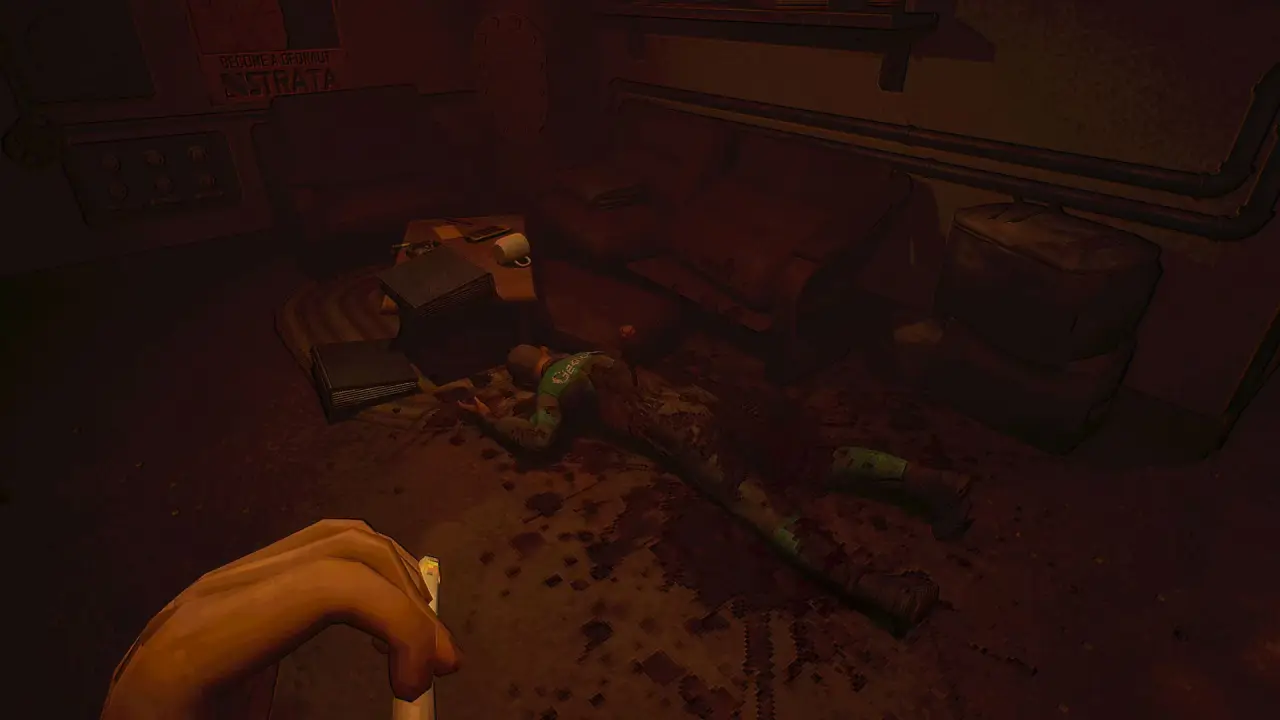
MOLE is doing that low-fi PSX thing, yeah, but here's the important bit: it doesn't look lazy. There's a big difference between "retro because we had no time" and "retro because the image needs to feel wrong." MOLE lands closer to the second one. The textures are smeared, grimy, and blunt in that old-school way, but the lighting gives the whole thing weight. You get this nasty mix of old polygons and modern mood lighting, and honestly, that combo does more for the horror than clean high-resolution realism would.
Because if MOLE looked too sharp, I think it would lose something. The blur matters. The dirt matters. The lack of visual certainty matters. When you're buried under Slavic soil inside this post-war drilling machine, you don't want every pipe and bolt rendered like a tech demo. You want the screen to feel sick. You want corners to swallow detail. You want a gauge to catch just enough light that you think, "Okay, I can read this," and then the rest of the cabin just drops into murk.
That's where it reminds me of Signalis, not because the games look the same, but because they both understand the trick. Low fidelity isn't just nostalgia bait. It's atmosphere control. Signalis uses its retro look to make memory and identity feel unstable. MOLE uses it to make metal, dirt, and darkness feel like they're closing around your head. So yeah, judged purely as a graphics showcase, it's not a monster. But judged as visual horror craft? It's genuinely effective. That's why this lands at a 7.5 for me: not technically flashy, but visually nasty in exactly the right way.
Every Wall, Dial, And Pipe Is Part Of The Trap

The best-looking thing in MOLE is the machine itself. Not in a "wow, look at the asset quality" way. I mean the MOLE feels like a place you can hate. The interior is narrow, dark, and packed with pipes, meters, switches, panels, and metal walls that constantly cut your view into little chunks. You're not just looking at a cockpit. You're living inside a coffin with controls.
And that matters because the whole horror pitch depends on the vessel being believable. This is a first-person horror game, and the game doesn't put a clean video-game layer between you and the machine. No floating HUD telling you what to do. No tidy objective marker. No friendly tutorial box. The interface is the space. If you need to understand what's happening, you look at the actual dials. If something is failing, you deal with the actual mechanism in front of you. That's a huge part of why the graphics work: the scene design isn't decoration, it's the control scheme.
The claustrophobia is doing a lot of heavy lifting here. Your vision is always being framed by metal, corners, panels, and dead space. The cabin doesn't just look cramped; it teaches your brain to feel cramped. After a while, the walls stop being background art and start feeling like pressure. That's the visual strength of MOLE. It turns a small environment into a mental state. Iron Lung did the single-room sealed-cabin nightmare first, and it still has that raw purity. But MOLE has a thicker mechanical texture to it. There's more to stare at, more to touch, more to misunderstand, and more ways for the room itself to make you nervous.
Don't Come Here Looking For Ray-Tracing Fireworks

If you're waiting for the part where I talk about ray tracing, DLSS, platform comparisons, and all that PC graphics checklist stuff, here's the thing: MOLE isn't really selling itself on that battlefield. Based on the available info, there isn't some big advertised ray-tracing suite or DLSS feature set to break down here, and there aren't meaningful platform-version differences to point at. So I'm not going to pretend this is a tech review for a blockbuster port. It isn't.
What MOLE is selling is art direction. The lighting is there to make the old textures breathe, not to flex. The darkness is there to hide information, not just to save on detail. The visual noise works with the sound design and the cramped first-person perspective to keep you uncomfortable. And because the game is single player and built around this one enclosed nightmare, it can commit hard to that look. It doesn't need giant vistas. It doesn't need spectacle. It needs a machine that feels like it's sweating rust into your lungs.
That does mean the graphics won't impress everyone. If you need polish to mean crisp textures, clean geometry, fancy reflections, and obvious technical luxury, MOLE is going to look limited. I get that. But for the audience that liked Iron Lung, Soma, or that kind of oppressive indie horror where the environment is basically the monster, this is the right visual language. It's not beautiful. It shouldn't be. It's ugly in a very deliberate way, and the ugliness is doing actual work.
The UI Is Gone, And That's The Scariest Visual Choice

The boldest graphics decision in MOLE is that the game basically refuses to draw a normal game interface over the world. That might sound like a systems point, but visually, it's massive. The cockpit isn't competing with icons, bars, arrows, pop-ups, or checklist text. You're looking at the machine itself. Every knob, every gauge, every ugly little panel is part of how you read the game.
That is the secret sauce. There is no UI barrier between you and the MOLE. The thing you see is the thing you operate. The horror isn't just "something is outside" or "something is making noise." The horror is that the machine is failing, you have to understand it, and the game won't translate it into a clean modern overlay. Repair becomes observation. Observation becomes stress. Stress becomes the monster. That's way more interesting to me than another hallway chase.
But this is also where some players are going to bounce hard. No map. No guidance. No clean objective feed. If you get lost easily, or if you want the game to clearly tell you what the next step is, the visuals can start to feel hostile instead of immersive. And because a run is about 2.5 hours, some people are going to be extra sensitive to whether that friction feels worth the price. For me, in the graphics category, the no-HUD approach is a win. It makes the art direction stronger, the cabin more believable, and the fear more physical. But yeah, it demands patience. MOLE doesn't guide your eyes politely. It traps them.
Combat | 8.5/10
玩法: 8.5/10Every Gauge Is a Button, and Every Button Can Ruin Your Day
MOLE’s best trick is also the thing that’s gonna bounce some people off in the first ten minutes: there is no cozy video game layer sitting between you and the machine. No HUD. No pop-up tutorial. No glowing objective marker. You’re inside this horrible post-war drilling vessel, and the knobs, gauges, switches, fuse boxes, pipes, and panels are the interface. That’s it. What you can see, you can touch. What you ignore, you’ll probably regret.
And honestly, that’s where the gameplay gets mean in a good way. You’re not “doing maintenance” because a quest log says so. You’re crawling around this metal coffin because something tripped, something overheated, something clogged, or some system is screaming at you through sound and pressure and bad vibes. Reset the breaker. Twist the valve. Check the gauge. Clear the ventilation. Listen for what changed. The horror isn’t just out there in the dirt. It’s in the moment where you realize you don’t know which system is failing, but the MOLE absolutely does not care.
That makes the whole ship feel like one big physical puzzle box. Fuse boxes aren’t menu screens. Engines aren’t abstract status bars. Even bigger set-piece interactions, like dealing with the engine systems or torpedo-tube-style machinery, ask you to read the room and work with the actual object in front of you. It’s clunky on purpose, but not in the lazy way. It wants your hands to feel busy. It wants you second-guessing whether you turned the right thing, or whether you just made the coffin worse.
This is why I’d put the gameplay side at an 8.5 out of 10. It’s not smooth in the traditional sense, and it’s definitely not friendly. But it commits hard. Repairing the machine becomes the horror. You’re not pausing the scary part to solve a puzzle. The puzzle is the scary part.
The Deeper You Drill, the Less Time the MOLE Gives You
The difficulty curve is simple, brutal, and effective: the deeper you go, the more the machine starts falling apart, and the less time you get to act like a calm, rational adult. Early on, MOLE lets you poke around a bit. You learn where things are. You test switches. You figure out what sounds normal, and what sounds like the game quietly loading a disaster into the next room. Then the pressure rises, failures stack faster, and suddenly your cute little “I’ll just explore” mindset is gone.
That’s the real rhythm here. It’s not combat. You’re not circling a monster, waiting for an opening. You’re fighting systems. The vessel needs a life-support loop, and you’re the weakest part of it. Breakers trip. Knobs need adjusting. Ventilation needs attention. The drilling machine keeps demanding little acts of mechanical faith from you, and the game trusts you to notice what’s wrong without spelling it out. I respect that a lot. I also get why some players will hate it.
Because yeah, the no-guidance design is a dividing line. If you like being told exactly where to go, exactly what to press, and exactly what objective comes next, this can feel hostile. There’s no map. There’s no gentle hint system holding your hand. If your sense of direction is bad, or if you just don’t enjoy learning a machine by messing with it, you can get stuck. Not “I missed a collectible” stuck. More like “I’m standing in a metal tube, something is dying, and I don’t know what language this machine speaks” stuck.
But for the right player, that’s the hook. If you played Iron Lung, Mouthwashing, or SOMA and came away wanting more oppressive atmosphere, more trust in the player, and more dread built out of systems instead of chase scenes, MOLE is speaking directly to you. It’s horror for people who don’t mind being uncomfortable and confused for a while.
Iron Lung Built the Coffin; MOLE Fills It With Machinery
The obvious comparison is Iron Lung, and that’s not an insult. Iron Lung nailed that single-room submarine nightmare: tiny space, terrible mission, no real escape, just you and the creeping thought that something is outside. MOLE is clearly playing in that same sealed-vessel horror space, but it’s a thicker game mechanically. Iron Lung is sharper and more minimal. MOLE is messier, longer, and more involved.
That difference matters. In Iron Lung, the submarine is mostly a pressure cooker for atmosphere. In MOLE, the drilling vessel is a working beast you have to understand. The whole thing has more moving parts, literally and structurally. You’re not just navigating a claustrophobic vehicle. You’re maintaining it, diagnosing it, and slowly building a mental map of its bad habits. The game uses that extra mechanical depth to stretch the tension across a roughly 2.5-hour run, which is longer and more filled out than the lean Iron Lung template.
Now, that length is also where the price conversation gets touchy. A single run being about 2.5 hours means some people are going to look at the cost and ask if that’s enough. Fair question. And while there are hidden achievements and story branches, this is still mostly a one-shot narrative horror experience. You’re not coming here for endless replay value. You’re coming here for one nasty descent with a strong mood and a machine that feels like it hates you personally.
What pushes MOLE over the line for me is that the mechanics actually serve the emotional stuff. The surreal flashbacks, the grief around a father who lost his son, and the voices of the dead aren’t just background flavor. They bleed into how the vessel feels. You’re not only piloting a monstrous drill under Slavic soil. You’re trapped in a machine, trapped in memory, and forced to keep both from collapsing. That’s a strong gameplay identity, even when it’s abrasive.
Content | 6.0/10
內容: 6/10Two And A Half Hours Is Just Enough Time To Crush You, Not Carry You
MOLE is not a long game, and I’m not gonna dance around that. A main run is about 2.5 hours. That’s the whole descent, the full spiral, the big emotional punch, the machine slowly turning from tool to coffin. And honestly, that length works for the kind of horror it’s chasing. This is not a game built for weekend grinding. It’s built for one tense sitting where you sit down, seal yourself inside this awful post-war drilling vessel, and come out feeling like the walls got closer every minute.
The pacing is the good part. MOLE doesn’t waste much time. You’re not running errands for NPCs. You’re not clearing map icons. You’re trapped in a first-person nightmare where every dial, lever, gauge, and broken system is your interface. There’s no HUD sitting safely on top of the world. The machine is the menu. The machine is the puzzle. The machine is the thing killing you. That makes the short runtime feel denser than it sounds, because you’re constantly reading the cockpit, listening for problems, and trying to understand what this monster of metal actually wants from you.
But here’s the catch: that same tightness is exactly why the price conversation gets ugly for some players. If you’re the kind of person who judges value by hours, MOLE is going to look risky. It’s a 2.5-hour, mostly one-shot narrative horror game, and that’s the biggest argument against it. I don’t think every game needs to be bloated to justify itself, but I also get why people hesitate. You’re paying for density, mood, and execution here, not a pile of systems that keep feeding you content for weeks.
There’s Extra Meat In The Walls, But This Is Still A One-Shot Descent
There is optional stuff in MOLE, but don’t go in expecting a side-content playground. The long tail is mostly hidden achievements, story branches, and the little details you catch once you understand how the vessel works. That matters, because this game is very much about trust. It trusts you to poke at systems, to get lost, to learn through failure, and to pay attention when the audio design starts whispering that something is wrong before the machine does. If you like horror that makes you investigate the space instead of following objective markers, that extra layer is satisfying.
Still, the replay value has a ceiling. Once you’ve seen the main emotional arc — the grief, the surreal flashbacks, the dead voices, the father broken by the loss of his son — you can’t really unsee it. A second run can help you connect the dots and chase branches, sure, but MOLE is not built like a roguelike, and it’s not trying to be a mechanical sandbox. The systems are clever because they’re physical and diegetic, not because they generate endless new situations. You’re learning one horrible machine, not mastering a whole genre engine.
And right now, there’s no DLC propping it up or padding the runtime. The base game is the full experience. I actually respect that. It doesn’t feel like a chopped-up product waiting for paid chapters, and it doesn’t stuff in filler just so the hour count looks healthier on a store page. But that also means you need to know what you’re buying: one concentrated horror story, with some hidden corners, not a long-term hobby game.
Iron Lung Fans Get More Machine, But Not Endless Game
The obvious comparison is Iron Lung, and yeah, MOLE absolutely lives in that same sealed-cabin panic zone. But the difference is pretty clear. Iron Lung is lean, iconic, and brutally simple: one small submarine space, a short run, a brilliant mood piece. MOLE feels thicker. The vessel has more going on. The repair work has more texture. The story feels more complete. You’re not just sitting in a tin can waiting for dread to happen; you’re constantly negotiating with a machine that feels like it could fail in six different ways while your brain is also coming apart.
That’s why MOLE’s 2.5 hours land better than they would in a weaker game. The retro PSX look with modern lighting gives it this grimy, oppressive feel without looking cheap. The sound design does most of the actual violence. It’s not constantly jumping out at you. It seeps in. Creaks, voices, mechanical strain, the sense that something is sharing the coffin with you. If you came from SOMA, Iron Lung, or Mouthwashing because you like atmosphere, implication, and emotional damage more than monster chases, this is absolutely aimed at you.
But I’d still put this content and value side at a 6.0 out of 10. Not because MOLE is thin in the moment. It isn’t. It’s intense, focused, and often nasty in the best way. The issue is what remains after the credits. There’s some detail-hunting, yes. There are branches, yes. But the main body is still a short, authored descent with limited replay pull. If you’re fine paying for one sharp, claustrophobic hit, MOLE delivers. If you need clear guidance, big playtime, or lots of repeatable systems, this is where the drill starts hitting rock.






留言 0
期待聽到你的聲音
歡迎來到評論區!說說你對這款遊戲的看法,第一個發言說不定有驚喜~
還沒有留言,來聊聊你對這篇評測的看法吧!