

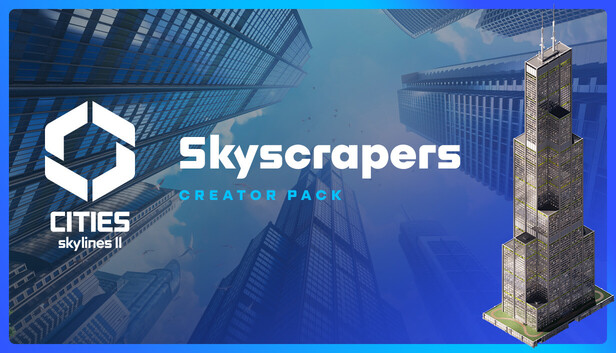
DLCCities: Skylines II - Creator Pack: Skyscrapers~ $7.99~ $6.39-20%→über Steam








“A living mega-city simulation with a genuinely deep core, but a catastrophic launch and thinner-than-the-original content keep its ambition from landing on day one.”
Is Cities: Skylines II worth dozens of hours? Yes. But that yes carries a condition you must accept going in: this is a game that desperately wants to become a better game, not one buffed to a smooth shine in every part. OpenCritic's 75.3 average and 52.6% recommendation, Steam's 55% "Mixed" — those numbers already tell you the reception is split, and the split comes straight from the gap between its ambition and its finish.
The pull is clear: larger maps, deeper city systems, a long-term stewardship space that runs from small town to mega-city. That sense of growth is solid and durable; the city keeps forcing you to catch up, you keep handing yourself new tasks, and the loop is genuinely addictive. The real way to judge it is to separate potential from present. By potential, it is nearly the blueprint for the next decade of the genre: a breathing population model, a traffic system with visible cause and effect, a mod ecosystem that keeps growing. By present, it did not cash that potential in at launch — the technical state and content depth both fell short of the ambition. A fair review has to hold both: neither dismissing the direction for being rough, nor excusing the launch because the direction is right. It is flawed good material, not a finished good work.
So who should buy in now? Split the answer. If you already love interlocking systems, treat city-building as a creative tool, and can tolerate some unfinished edges, it is worth it — its systemic depth and simulation ambition sit at the top of the genre, offering not light entertainment but the satisfying friction of inheriting a city that throws tantrums of its own. If instead you prize smoothness, stability, and low fuss, and want city-building as after-work decompression, wait. Stutter, clipping lots, and the tedium of stacked systems will all reach out and tug you exactly when you are most invested — like driving a powerful car whose tuning isn't done: glorious on the straights, clearly unfinished the moment you hit a corner. And if you are the waiting type, you lose nothing by holding off; this is the rare game that gets cheaper in completeness over time, where later arrivals inherit every pothole earlier players paved flat.
Which brings the unavoidable question: will the original outlast it? Its most direct rival is its own predecessor. In systemic depth, urban scale, and simulation grain, the sequel clearly surpasses that long-evergreen classic; in launch polish, content thickness, and Workshop ecosystem, the original — riding years of accumulation — is the steadier, rounder package. That is this game's most awkward and honest position: using a better direction to fight a more complete predecessor. But time is on the sequel's side. The Economy 2.0 rework, the steady performance patches, the ecosystem of nearly 7,900 mods — all of it says the game is improving at a pace you can watch. A sequel owns one thing the original cannot: a higher ceiling. My verdict is plain — a game whose foundation and direction both deserve respect, but one you should play with patience. It hasn't set every brick straight yet, but it is laying its wall in the right direction, and for a city-builder, "still growing" is itself in perfect harmony with the core joy on offer.
Kommentare 0
Wir freuen uns auf deine Meinung
Beteilige dich an der Diskussion und teile deine Bewertung des Spiels.
Noch keine Kommentare. Teile deine Bewertung.