























Opening
STARSEEKER: Astroneer Expeditions is basically Astroneer chopped into four-player, timed space raids, and what it nails is the panic of digging, looting, and scraping back to extraction before your oxygen window slams shut — but right now, it's worth it only if you've got a regular crew.
Because solo Astroneer people, I need to say this early: this is not your cozy offline hole-digging, base-building comfort game. It's always-online, it's built around squads, and it wants you moving. A run takes about half an hour, the station jumps to new planets, and suddenly that cute little terrain tool feels less like a toy and more like a rescue plan.
The magic trick is simple. Deep Rock Galactic gives you caves to survive; STARSEEKER gives you a whole planet you can chew through in real time. If the extraction path is blocked, you don't just swear at the map — you carve a new route, and that one idea is genuinely cool. The catch is that it's all still messy: Steam's sitting at 55% from 534 reviews, and yeah, Mixed sounds about right. Bad connections can eat a run's haul, the tutorial barely helps, and Early Access content runs thin after a dozen-odd hours. Still, when Tephra throws wetlands, jungle, and ocean into one map and your squad barely makes it out, that's the game working — warts and all.
Story | 6.0/10
劇情: 6/10The ESS Starseeker Gives You a Crew, But Not Quite a Story Yet

The story setup in STARSEEKER is simple: you’re part of the ESS Starseeker crew, the station jumps from planet to planet, and you head down with the squad to get jobs done before everyone moves on. That’s the frame. It works as a co-op excuse. It gives every run a reason to exist. But if you’re looking for a strong, clean, linear campaign? No. That’s not what’s here right now.
Most of the narrative comes through station NPC interactions and little bits of character discovery between expeditions. You come back from a run, poke around the Starseeker, talk to people, pick up scraps of context, and slowly get a feel for this traveling operation. I like the idea. A mobile space station full of working crew members is a good fit for a game about dropping onto strange planets with friends. It makes the hub feel less like a menu and more like a place you’re assigned to.
But here’s the problem: the game adds people without fully selling them yet. Original Astroneer got a lot of mileage out of pure environmental storytelling. You’d land somewhere weird, see the landscape, mess with the terrain, and your brain would fill in the blanks. STARSEEKER tries to be more direct. It gives you NPCs. It gives you crew identity. It gives you a station. And that should make the world feel warmer, more personal, more alive. Sometimes it does. But too often, it feels like the game is gesturing at a bigger story instead of actually telling it.
That’s why, for story, I’m sitting at a 6 out of 10. Not because the premise is bad. It isn’t. In fact, the crew framing is one of the smartest ways to turn Astroneer’s lonely space vibe into a structured four-player expedition game. The issue is follow-through. Right now, the narrative is more connective tissue than payoff. It keeps you moving from drop to drop, but it doesn’t give you enough sharp character moments or big discoveries to make the Starseeker crew stick in your head after you log off.
Reputation Turns Repeated Drops Into Belonging, And That Part Actually Works
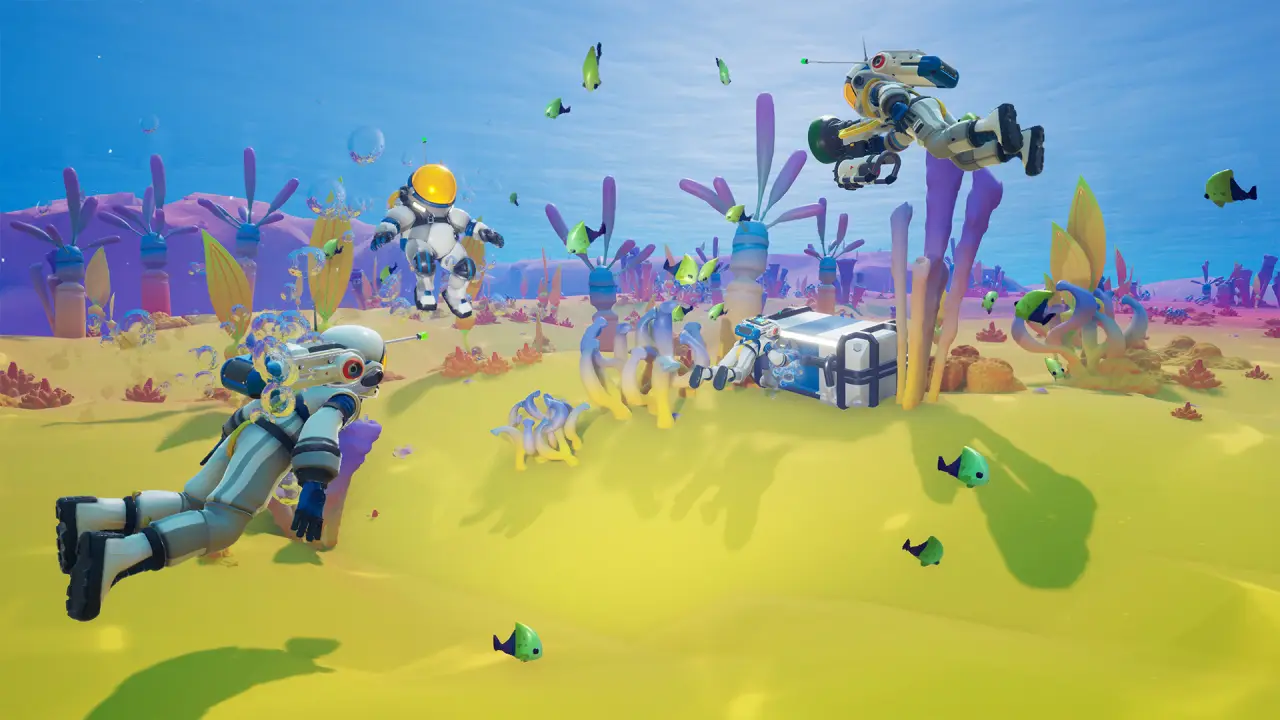
The strongest story idea here is reputation. Not in some big branching RPG way, because that’s not really the game. There aren’t meaningful moral choices or major narrative forks where you reshape the plot. You’re not picking sides in some huge space drama. You’re showing up, doing the work, earning trust, and becoming more of a real crew member through repetition.
And honestly, that fits this game better than a fake choice system would. STARSEEKER is built around drop-loot-extract runs that last about half an hour, with oxygen ticking down while you and up to three friends dig, gather, improvise, and try to make it back with your haul. So turning “attendance” into belonging is a clever move. You keep deploying. You keep helping the ESS Starseeker. You keep unlocking tech and cosmetics by playing, not by paying for shortcuts. Slowly, the game wraps that loop in the feeling of being part of a working space crew.
That’s the glue between story and gameplay. You’re not just clearing missions because a checklist says so. You’re proving useful. You’re becoming someone the station can rely on. It’s a small thing, but it matters, especially in co-op, where the real story is often what happened to your squad on the planet. The blocked extraction route. The bad oxygen call. The panicked tunnel you carved straight through the terrain because the clock was screaming at you. That’s where STARSEEKER gets its best narrative moments.
But again, the catch is that these moments come more from systems than from writing. The side material is thin right now. The station conversations and character fragments add texture, sure, but they don’t yet have the density or quality to carry the experience on their own. If you’re playing with a fixed group and you like Deep Rock Galactic-style short-session co-op, that’s probably fine. You’ll make your own stories. If you came here wanting a rich solo space narrative, especially as an original Astroneer player who liked taking your time offline, this is going to feel undercooked.
The First Few Hours Make The Story Harder To Care About

One of STARSEEKER’s biggest story problems is that the game doesn’t onboard you smoothly enough. The tutorial is rushed, and the game is weirdly reluctant to explain itself. That hurts the mechanics, obviously, but it also hurts immersion. When you’re spending the first few hours asking, “Wait, what am I supposed to do?” it’s hard to care about who’s talking on the station or why the crew structure matters.
That’s frustrating because the actual expedition fantasy is strong. You’re on strange new worlds, working with friends, completing planet-wide objectives before the station heads to its next destination. Planets like Tephra, with wetlands, jungle, and ocean folded into one map, can absolutely pull you forward the first time you see them. There’s a proper “what’s over there?” energy to it. And because the terrain can be sculpted in real time, the planet isn’t just a backdrop. It’s something you cut into, reshape, and sometimes escape through.
Compared to Deep Rock Galactic, that gives STARSEEKER a cool identity. Deep Rock is still the co-op extraction benchmark for a reason, but its caves are generated spaces you move through. In STARSEEKER, the whole planet surface feels more physically negotiable. If extraction is blocked, you can make your own route. You can literally dig the story of that run into the ground. That is fantastic emergent storytelling.
But the authored side of the story doesn’t match that energy yet. The key characters don’t get enough room. The station NPCs are there, and they help humanize the ESS Starseeker, but I don’t think the game has fully earned emotional attachment to them. They feel more like the start of character arcs than characters I’m ready to argue about in the comments. And because this is always-online, with no real offline solo mode, the player who might’ve taken the time to slowly absorb those details alone is already being pushed away.
Monthly Story Updates Sound Good, But Right Now This Is Half A Tale

The Early Access label matters here. STARSEEKER is promising monthly narrative additions, and that could change the picture a lot. More planets, more biomes, more station scenes, more character material — all of that could turn the ESS Starseeker from a decent co-op wrapper into a place players actually care about. But I can only review what’s in front of me, and what’s here right now feels like half a story.
You can feel the missing weight after a dozen-odd hours, when veterans start brushing against the content ceiling. The first run through a new planet can be exciting. The co-op pressure works. The oxygen countdown keeps everyone locked in. The terrain tools give every expedition a chance to become a messy little survival story. But once the novelty settles, the narrative layer doesn’t have enough depth to keep pulling you by itself.
There’s also a nasty practical issue: extraction bugs. If one bad connection can wipe a whole run’s haul, that doesn’t just hurt progression. It breaks the fiction. This is a game about accumulation, reputation, and showing up for the crew. Losing the reward for a run because the online side stumbles makes the whole Starseeker fantasy feel more fragile than it should.
So the story verdict is pretty clear. STARSEEKER has a smart frame, a solid crew fantasy, and a reputation loop that turns repeated missions into a sense of belonging. But it doesn’t yet have the character depth, side-story density, or narrative confidence to fully land. Original Astroneer told a lot with silence and landscape. This one speaks more, but it doesn’t always say enough. For now, it’s a promising co-op sci-fi setup with some great system-driven stories — and an authored narrative that still needs several updates before it feels complete.
Audio | 7.0/10
音效: 7/10The music stays calm until the oxygen clock starts yelling

What I like here is that the soundtrack doesn’t try to act bigger than the game. It stays in that same Astroneer lane: soft, curious, a little floaty, and mostly there to keep you moving instead of trying to sell some huge boss-fight energy. That fits this game way better than some dramatic, overcooked space score would. You’re not charging into a war. You’re picking through strange planets, grabbing what you need, and trying not to get stranded when the station leaves. The music understands that. It doesn’t shove itself to the front.
But the real hook is the oxygen warning. That sound layer does a ton of work. It’s the thing that turns a chill excavation run into a sprint back to safety, and it’s way more effective than a bunch of noisy combat stingers. You hear that countdown, and suddenly every extra tunnel, every resource node, every “one more minute” decision matters. That’s the whole game in audio form: keep digging, keep moving, but don’t get greedy. And because the runs are only about half an hour, that pressure lands fast instead of dragging.
It also helps that the game doesn’t lean into the kind of heavy, suffocating soundscape you get in something like Subnautica. That game loves to make the ocean feel hostile. STARSEEKER: Astroneer Expeditions is looser than that. It still has tension, sure, but the sound design isn’t trying to crush you. It’s nudging you. That lighter tone is a big reason the game feels approachable even when the timer starts biting.
Wetlands, jungle, and ocean all sound like places you can get lost in

The environments do a lot of the heavy lifting here. Tephra, especially, sounds like a proper mixed bag of biomes instead of one flat planet skin. You can hear the difference between wetlands, jungle, and ocean spaces in the way each area breathes around you, and that matters because the game wants exploration to feel tempting, not just efficient. When a map folds all that variety into one run, the audio has to sell the shift, and it does. It’s one of the reasons that first trip through a planet sticks with you.
The co-op side is where the mix really has to behave, and mostly it does. In a four-player squad, you need the planet to keep its identity without burying your friends under it, and that balance is pretty solid. The ambient stuff stays present, but it doesn’t smother communication, so you can still call out routes, oxygen, and extraction plans without fighting the mix. That matters more here than in a lot of other co-op games, because one bad connection can wipe a haul and the run is built around accumulation. If the audio were muddy on top of that, the whole thing would feel way more irritating than it already can.
And honestly, that’s where the game’s sound direction feels smarter than its tutorial. It doesn’t over-explain itself, but the audio keeps giving you readable cues: where you are, how risky things are getting, and when it’s time to stop messing around and head out. In a game where you can literally dig your own escape route, that all works together nicely.
Visuals | 7.5/10
畫面: 7.5/10Sculpted worlds are the real visual hook

Honestly, the best-looking thing in STARSEEKER isn’t some flashy special effect. It’s the terrain itself. The game keeps Astroneer’s bright, low-poly look, so everything pops in this clean, readable way that still feels a little weird and alien. And that matters, because this isn’t just scenery you run past. You’re digging through it, reshaping it, and abusing it to get home. That sculptable ground is the visual signature here. A blocked path doesn’t stay blocked. You carve a new one. You make a mess. You turn the planet into your own escape route.
And the planets do some heavy lifting too. Tephra, especially, is the kind of map that sticks in your head because it’s packing wetlands, jungle, and ocean into one place without feeling like three separate zones glued together. That mix gives each run a nice sense of discovery early on. The first time through, you’re actually looking around instead of just sprinting to the objective. But here’s the catch: because this is Early Access, the lineup of planets and biomes is still limited, so that wow factor fades faster than it should. The art style still holds up, but once you’ve seen the current pool a few times, you start feeling the ceiling.
Good spectacle, but the tech and platform tradeoffs show

My read is simple: this is a game built to look good in motion, not to flex raw graphical horsepower. It’s the kind of project where the stylized direction does a lot of the work, and that’s smart, because the whole thing has to run across PC, Xbox, PS5, and Switch 2. That wider platform spread usually means someone, somewhere, is making tradeoffs, and you can feel that. The game isn’t trying to be a bleeding-edge showcase. It’s trying to stay readable, run clean enough, and keep that Astroneer identity intact no matter where you play.
The upside is that the visual design gives it room to breathe. Bright colors, simple shapes, and those carved-up landscapes keep it from looking flat or cheap. The downside is that the tech side isn’t the reason you’d remember it. There’s no sense that this is here to wow you with jaw-dropping ray tracing wizardry or some huge graphics flex. It’s more practical than that, and honestly, that fits the game. The real problem is that the cross-platform release feels like it comes with the usual compromise energy: solid enough on style, but not the kind of thing where you’re going to be talking about fancy rendering tricks after the session ends.
The UI gets in the way more than it should
If I had one visual complaint that really kept bugging me, it’s the UI. The game doesn’t explain itself well, and the interface doesn’t do it any favors. You’re already juggling oxygen, extraction timing, and whatever mess your squad has just made on the planet, so the last thing you need is muddy information delivery. But that’s kind of where STARSEEKER stumbles. The game wants you to act fast and think on your feet, yet the way it presents what’s happening can feel messy and undercooked. A few sources called out the UI too, and yeah, that tracks.
That matters more here than in a slower game, because STARSEEKER is built around short, tense runs where you’re supposed to keep moving. If the screen isn’t clearly telling you what you need, the whole flow gets clunkier than it should be. And when you’re in a four-player run with the oxygen countdown ticking and the squad trying to extract before the station moves on, clarity is everything. The visuals themselves still carry the game a long way, but the interface keeps tripping over the presentation. It’s the difference between feeling sharp and feeling like the game is just a little too rough around the edges for its own good.
Combat | 8.0/10
玩法: 8/10The oxygen timer turns Astroneer’s chill digging into a proper squad scramble
Here’s the big shift: STARSEEKER takes Astroneer’s best trick, that gooey sculptable terrain, and shoves it into a four-player expedition format where the clock is always breathing down your neck. You prep on the space station, drop onto a planet, scan wreckage, gather resources, activate weird structures, grab what you can, and then get out before the oxygen situation turns ugly. That loop is simple on paper, but in a run, it gets tense fast.
The smart part is the length. These expeditions sit around that half-hour mark, which is just long enough to feel like you actually did something, but short enough that your squad immediately says, “Yeah, one more.” The oxygen countdown is the rhythm engine. It stops the game from becoming four people wandering off into the distance, quietly hoarding rocks. You’re always asking the same question: do we push deeper, or do we start carving a route back?
And that’s where the terrain tool still matters. If extraction is blocked, you don’t just sigh and follow the designed path like a good little player. You dig. You tunnel. You throw together a ridiculous escape ramp because your friend overcommitted five minutes ago and now everyone’s yelling. That’s the stuff that gives STARSEEKER its own flavor. It isn’t just co-op errands in space. It’s messy, physical problem-solving, and when it clicks, it really clicks.
Combat and moment-to-moment action sit more in that survival-action pocket than full-on shooter chaos. You’re managing danger, movement, oxygen, gear, and terrain all at once. The challenge isn’t only “can you aim?” It’s “can your squad make decent decisions under pressure?” That’s way more interesting for this kind of game.
Four-player online play is the hook, but solo Astroneer fans may bounce off hard
I’m going to be blunt: if your favorite thing about Astroneer was playing offline, alone, slowly flattening a moon into your personal construction project, STARSEEKER is not really built for you. You can play solo, sure, but the game is always-online, and the shared-world setup means it never fully gives you that quiet, private sandbox feeling. There’s usually someone around. The whole structure is pushing you toward squads.
For the right player, though, that’s the appeal. If you’ve got a fixed group and you like structured co-op runs, STARSEEKER makes a lot more sense. The station phase gives you that little pre-mission ritual: unlock tech, adjust your loadout, think about what the crew needs, then drop. The gear progression and customization aren’t wildly complicated, but they do give you a reason to keep running missions beyond “number go up.” You earn cosmetics and currency by playing, with no paid shortcuts, and honestly, that matters. In a co-op game, that feels refreshingly less gross than the usual store-first design.
The rough part is onboarding. The tutorial moves too fast, and the game is weirdly shy about explaining itself. Your first few hours can feel like you missed a briefing everyone else attended. That hurts, because the actual loop is good once you understand it. But STARSEEKER asks for patience up front, and not everyone’s going to give it that. The Steam reception sitting at 55% from 534 reviews, marked Mixed, makes sense to me. There’s a strong idea here, but the friction is real.
Deep Rock Galactic is the obvious comparison, but the digging changes everything
Look, the Deep Rock Galactic comparison is unavoidable. You drop in, work as a team, complete objectives, and extract before things go sideways. If you’re into that structure, STARSEEKER is clearly aiming at you. But the big difference is the ground beneath your feet. Deep Rock’s caves are generated spaces you navigate. STARSEEKER’s planets are spaces you can actively reshape in real time.
That changes the escape fantasy. In Deep Rock, a bad route is something you manage with traversal tools, class roles, and map knowledge. In STARSEEKER, a bad route can become a new tunnel. The whole planet is more negotiable. If the extraction path sucks, your team can just carve through it. That one mechanic gives the game a different kind of co-op comedy. Someone scans a wreck, someone else gets greedy with resources, oxygen gets low, and suddenly your “plan” is three people panic-digging a tunnel while the fourth insists they know where the ship is.
Planets like Tephra help sell the exploration side too. Folding wetlands, jungle, and ocean into one map gives that first run a real sense of “wait, what’s over there?” It’s not just another cave wall with different lighting. The first time through a planet like that, the game does pull you forward.
But this is also where Early Access limits show. There are only so many planets and biomes right now, and veteran squads can hit the content ceiling after a dozen-odd hours. That doesn’t kill the core loop, but it does mean the long-term hook isn’t fully there yet.
The runs are exciting, but bugs can make extraction feel cruel
The gameplay earns an 8 out of 10 for me because the main loop is genuinely strong. Drop, loot, improvise, extract — it works. The oxygen timer gives every expedition shape. The terrain deformation gives every squad a way to solve problems their own scrappy way. And the progression gives you enough loadout tinkering to care about the next run.
But the extraction bugs are the kind of problem that hits exactly where it hurts. This is a game about accumulation. You spend a run collecting, unlocking, and making the call to risk one more objective. So when one bad connection can wipe a whole haul, that doesn’t feel like a small technical hiccup. That feels like the game wasting your time. In a co-op extraction structure, trust is everything. If players don’t trust the exit, the whole loop gets shakier.
Still, when STARSEEKER behaves, it has something. It’s not just copying Deep Rock Galactic in a spacesuit. It’s taking Astroneer’s terrain sculpting and using it as the pressure valve for a timed squad mission. That’s a strong pitch, and more importantly, it’s fun in the hands. The catch is you need the right group, some tolerance for rough edges, and zero expectation that this is the old solo sandbox with a new logo.
Content | 5.0/10
內容: 5/10Half an Hour, Then the Clock Starts Winning
This game wants your sessions to feel snappy, and honestly, that part works. A drop, a loot run, and an extraction cycle lands at around half an hour, which is the sweet spot if you’ve got a squad that already knows how to move. You’re not signing up for a six-hour survival blur. You’re signing up for one more run, and then one more after that, because the oxygen countdown keeps everybody moving and talking and making bad decisions together. That pressure gives the whole thing its rhythm.
But here’s the catch: once the novelty wears off, that same structure starts to show its limits. This is Early Access, and right now the planet pool, biome pool, and mission templates are still pretty thin. You can feel the design trying to stretch a modest amount of content across a lot of repeat play. It’s got hundreds of missions, a reputation track, and crafting systems holding everything together, sure — but those are the bones, not the meat. After a dozen-odd hours, veteran players are already bumping into the edge of what’s there. That’s not a disaster for an EA build, but it does mean the current loop is more “good for a few nights a week” than “this will own your life.”
Hundreds of Missions, One Thin Content Shelf
The game does have a real content skeleton. There are hundreds of missions, a reputation line to push through, and crafting that gives you a reason to keep gathering junk instead of just extracting and logging off. That matters. It means the game isn’t just tossing you into empty runs and calling it a day. There’s an actual sense of progression here, and the way cosmetics and currency are earned through play — with no paid shortcuts in sight — makes the whole thing feel a lot less greasy than a lot of co-op games these days.
Still, I’m not going to pretend that a big mission count automatically means a big game. Right now, the content library is more impressive on paper than it is in your hands. The developer says this is meant to be roughly a year in Early Access, with monthly updates bringing in new planets, new characters, and endgame challenges, and that roadmap does matter. It’s a promise of where this could go. But today, in the build you can actually play, the long tail is short. Once you’ve seen the current planets and learned the mission patterns, the game starts leaning hard on repetition. Compared with Deep Rock Galactic’s deep bench of procedural cave setups, this is still running with a much smaller shelf. That’s fine if you’re in early, but it also means the value today is tied to patience, not abundance.
Digging Around the Limits, Not Past Them
What keeps this from feeling totally disposable is the terrain itself. Astroneer’s sculptable world is still the best thing in the room, because when an extraction route gets blocked, you don’t just sit there and wait for the level to solve itself. You dig your own way out. That’s a huge difference from Deep Rock Galactic, where the caves are built as curated, pre-made spaces. Here, the planet is part of the problem and part of the solution, and that does make each run feel more improvisational.
The problem is that the game doesn’t always respect the time you put into it. Extraction bugs can wipe an entire run’s haul, and in a game built on accumulation, that hurts. A bad connection shouldn’t be able to delete the payoff from a mission you already survived, but right now it can. So even when the game gives you that nice co-op flow, it also asks you to trust a pretty fragile system. That’s a rough trade.
And that’s really the long-tail story here: there’s a cool idea, a solid core loop, and a world you can physically reshape in ways Deep Rock can’t match, but the current content stack is still light. If you’ve got a regular four-player crew and you want structured, short-session space missions, there’s something here already. If you’re the kind of Astroneer player who wanted to slowly build alone and disappear into it offline, this version is not speaking your language yet.






留言 0
歡迎發表遊戲評價
歡迎參與討論,分享對這款遊戲的評價。
暫無留言,歡迎分享對本篇評測的看法。