









Opening
I made a choice in Chapter 3 of Season 1 that got a teammate who'd been with me for two episodes killed. The game didn't give me a chance to redo it, the save auto-overwrote, and that character just disappeared from the rest of the story. I stared at the screen for over ten seconds—this wasn't "your choices matter" marketing speak, they actually mattered.

Plot and Narrative | 8.5/10
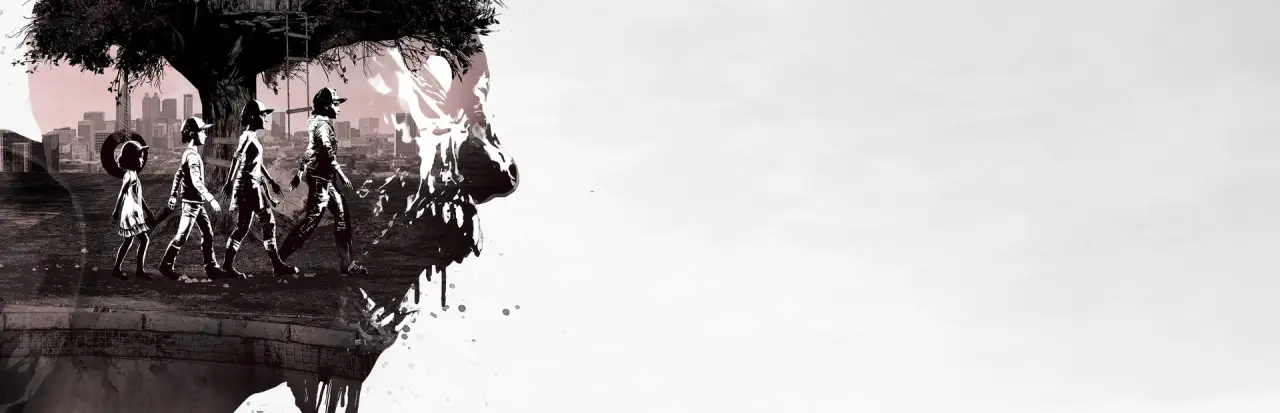
劇情: 8.5/10Telltale adapted The Walking Dead comic into a story about "people." The zombies are just backdrop—what really makes you tense are the choices the living make. The relationship between Lee and Clementine is the emotional core of the entire series—a convict and an eight-year-old girl, redeeming each other in the apocalypse. I cried at that final scene in Season 1, no shame.
The branching design is clever. It doesn't give you exaggerated options like "save the world" or "destroy the world," but makes you agonize between "save your friend or save a stranger" and "tell the truth or a white lie." Some choices show no immediate impact, then two chapters later someone brings it up and you realize that offhand promise planted a landmine.
But over four seasons, the formula starts repeating. Every season has the fixed rhythm of "group splits," "someone gets bitten," "final choice." By Season 3 with Michonne, I could already predict who would die next. Plus some branches are fake—on the surface you get three options, but in reality it's just different dialogue leading to the same outcome. Once this "illusion of choice" is exposed, the immersion takes a hit.

Gameplay Mechanics | 6.0/10
玩法: 6/10This isn't a "game" in the traditional sense—it's more like an interactive TV drama. Your actions boil down to three things: walking to glowing spots to trigger scenes, choosing dialogue within time limits, and occasionally hitting QTE prompts. Combat sequences are basically "press the button shown on screen" routines. If you fail, you just retry—there's no strategy involved.
Exploration is shallow too. Each scene has only a handful of interactable objects, and clicking through them all takes maybe five minutes. No puzzles, no collectibles, not even an inventory system. All you do is listen to dialogue, make choices, and watch what happens next—which is perfect for players who love narrative-driven experiences, but if you're expecting the stealth-plus-combat depth of The Last of Us, you'll be disappointed.
The only real "gameplay" is psychological. You have to guess what other characters are thinking, judge who's trustworthy, and weigh your options under time pressure. That tension feels real, but it comes from the script, not the mechanics.

Visual Presentation | 6.5/10
畫面: 6.5/10Comic-style rendering is this game's visual signature—thick outlines, flat color blocks, hand-drawn textures. It looks distinctive at first, but after four seasons you'll realize it's actually masking technical shortcomings. Character models are crude, facial animations are stiff, and emotions often rely entirely on voice acting to carry them.
The environmental design does show care. Abandoned motels, moss-covered trains, looted supermarkets—each location tells a story of the post-apocalypse. The lighting and atmosphere work well, especially in dusk and nighttime scenes where the oppressive mood hits right.
But the technical issues can't be ignored. Frame drops, texture loading delays, character clipping—these bugs existed in the original and persist in the definitive collection. Once a cutscene froze and I thought the game had crashed, only for it to resume after half a minute. In 2024, this level of optimization is unacceptable.

Sound Effects and Music | 7.0/10
音效: 7/10Voice acting is the biggest highlight. Lee's voice is steady and reliable, and Clementine's voice changes from childish in Season 1 to mature in Season 4, perfectly synchronized with her character growth. The supporting cast also delivers, especially the villains—you can hear their madness and desperation in their tone.
The soundtrack takes a minimalist approach. Most of the time there's only ambient sound—wind, footsteps, distant zombie groans. Music only appears at key plot points, with piano or guitar melodies that are simple but powerful. There's one track that repeatedly appears in farewell scenes, and eventually, as soon as the intro plays, I know someone's about to die.
Sound effects design is a bit rough. Gunshots and combat sounds are all very dry, lacking spatial depth. Zombie sounds are also limited to just a few types, which gets tiresome after a while.

Content Volume | 7.5/10
內容: 7.5/10Four seasons plus side stories, 23 chapters total, takes about 40-50 hours to complete. Each chapter is 1.5-2 hours, tightly paced with no filler. But this is a purely linear narrative game—after finishing it, there's not much replay value except trying different choices.
The branching design theoretically offers replay value, but in reality most choices only affect dialogue and minor details, while the main story progression is fixed. On my second playthrough I deliberately made completely opposite choices, only to find that 80% of the key plot points were still the same. This kind of "pseudo-branching" makes you feel like your choices don't really matter.
The ultimate collection bundles all DLC and side stories together, so it's decent value. But if you previously bought the season pass separately, this is just repackaging and reselling it to you with no new content.





留言 0
歡迎發表遊戲評價
歡迎參與討論,分享對這款遊戲的評價。
暫無留言,歡迎分享對本篇評測的看法。